


-
- Global AMC MENU
- NEWS
- HEALTH
- PEOPLE
- Introduction


Safe treatment of mitral regurgitation without thoracotomy…Increasing the quality of life for patients
Success rate of 94%, equivalent to that of world-leading hospitals
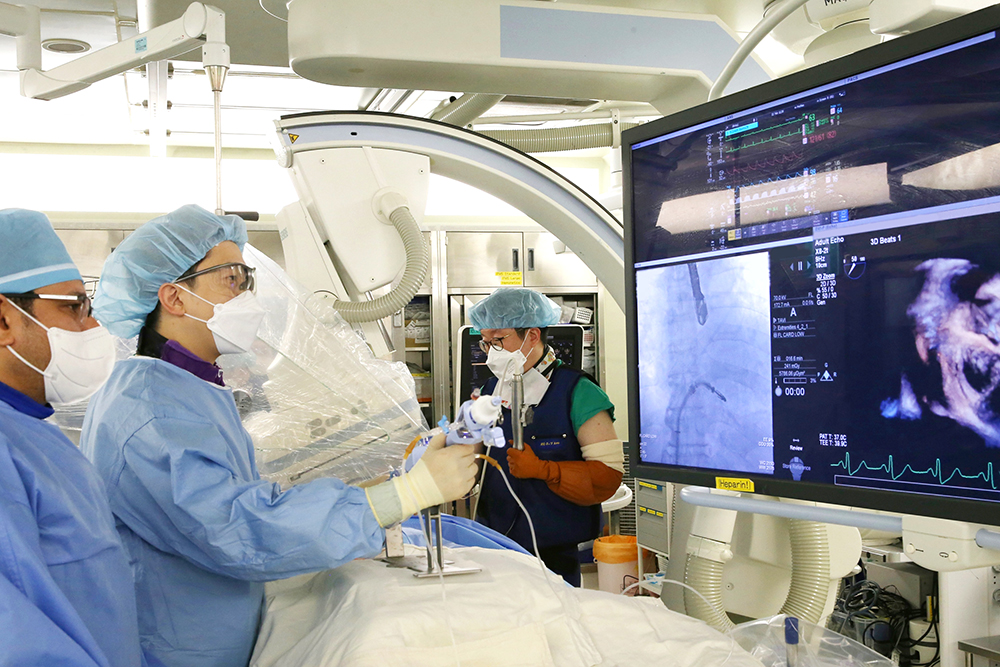
▲ Professor Dae-Hee Kim and Professor Do-Yoon Kang (first and second from right, respectively) are performing the MitraClip procedure
Kim (78, female), who had already undergone heart surgery three times, was diagnosed with mitral regurgitation when visiting a nearby hospital due to relapse in severe breathing dificulties. The symptoms of heart failure worsened, which she was admitted and discharged for four times a year, but she felt a great burden due to her age and a 4th operation. Accordingly, Kim underwent a MitraClip procedure instead of open-heart surgery at Asan Medical Center. It is a simple procedure in which a thin tube is inserted through the groin vein and a clip is mounted on the mitral valve. Due to its short recovery period, she was discharged within three days of the procedure. Kim, who is in stable condition, is healthy without re-hospitalization until now, 9 months after the procedure.
Mitral regurgitation is abnormal reversal in the blood flow of the heart which occurs when the mitral valve located between the left atrium and left ventricle does not close tightly due to aging, heart disease, and more. Its treatment was burdensome for elderly or high-risk patients with other medical conditions because the only treatment was through open-heart surgery.
Asan Medical Center is improving the quality of life for patients by performing MitraClip procedure to safely treat mitral regurgitation in elderly and high-risk patients who are not suitable for open-heart surgery.
AMC team led by Professor Dae-Hee Kim and Professor Do-Yoon Kang of Division of Cardiology performed Korea’s first 50 cases of MitraClip procedure, reducing the burden on patients and safely treating mitral regurgitation.
In particular, patient age was on average 77 and most had previously suffered from heart attack, heart failure, or heart surgery. Nevertheless, the team achieved a 94% success rate and a 98% 1-month survival rate.

▲ MitraClip procedure
MitraClip procedure reduces blood reflux by “clipping” mitral valve which helps to remove gaps that occur every time the valve opens and closes. Without chest opening, a thin tube is inserted through the groin vein to reach the inside of the heart, and the clip is mounted on the mitral valve using a 3D ultrasound to confirm the exact position of the clip and the anatomical structure of the mitral valve in real time.
Until now, conventional surgical procedure had been performed on patients with severe mitral regurgitation. Thus, elderly patients with high risk of surgery complications or high-risk patients with other medical conditions often gave up on treatment due to difficulties in surgery.
In January 2020, Asan Medical Center introduced MitraClip procedure for the first time in Korea to safely treat patients unable to undergo surgical procedures. AMC succeeded in treating an 82-year-old patient with MitraClip procedure, and this patient is still alive and healthy without any complications.
AMC Heart Institute successfully performed 14 MitraClip procedures in 2020 alone, the first year of its introduction, and is piling up know-how by achieving 26 cases in 2021 and 10 more by February of this year.
Of the 50 patients, 40% were elderly patients, aged 80 or older, and the STS score of patients were averaged on 10%. When STS score is 8% or higher, a patient is classified as a high-risk patient and has a high risk in surgical procedure.
※ STS Score: Mortality prediction within a month post-surgery created by the Society of Thoracic Surgeons (STS) for risk assessment
Despite these elderly and high-risk patient groups, the success rate of MitraClip procedures at Asan Medical Center is 94%. The 1-month survival rate is 98%, which was similar to the success rate and survival rate reported in the U.S. mitral valve surgery database. Also, there were no procedure-specific complications.
Professor Do-Yoon Kang said, "Not only elderly patients but also high-risk patients who had undergone heart surgery in the past received MitraClip procedures without complications. With the aging population, the number of patients with mitral regurgitation is increasing, and MitraClip procedure is becoming a reasonable treatment option.”
In addition, Professor Kim Dae-Hee said, "AMC Heart Institute has been able to achieve Korea’s first 50 cases of MitraClip procedure due to Korea’s most extensive experience in intervention and echocardiography and the solid teamwork accumulated for many years. We will continue to put much efforts to ensure the safety of elderly and high-risk patients."
MitraClip, made by Abbott (U.S.), was first introduced in 2003 and approved by the U.S. FDA in 2013. In Korea, this new medical technology was recognized in 2019, and it has been used to treat patients since 2020.
ASAN MEDICAL CENTER
BROCHURE DOWNLOAD
Sharing your hope
ASAN MEDICAL CENTER(2019)
