


-
- Global AMC MENU
- NEWS
- HEALTH
- PEOPLE
- Introduction


4,000 cases performed annually, leading the development of robotic-assisted surgery in Korea
Robotic surgery, application gradually expanding–the standard treatment in various fields
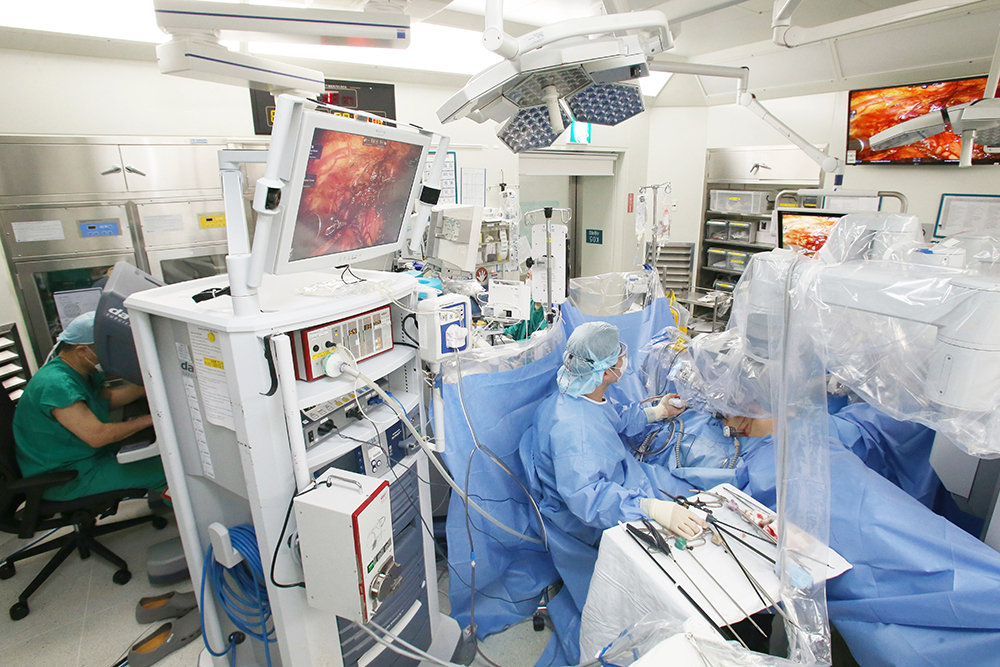
▲ Performing partial nephrectomy using robot surgery
Asan Medical Center (AMC) has performed 4,371 cases of robotic surgeries last year alone, recording Korea’s highest number. It has been achieved after 15 years since the introduction of robotic surgery for the first time in 2007. AMC has expanded the application scope of minimally invasive robotic surgery to improve patient safety and post-operative quality of life. AMC is taking the lead in quantitative growth, with cumulative 10,000 cases in 2017 and 20,000 in 2021, and qualitative growth based on abundant clinical experience.
Robotic surgery is performed by minimizing skin incision of the surgical site and inserting several remotely controlled robotic arms. Even in narrow spaces such as pelvis and chest wall, precise cutting and suture are possible with the assist of the 3D vision monitors. Recently, more advanced robot systems have been introduced and applied to various surgeries to minimize complications such as scars, pain, and nerve and vascular injuries. Robotic surgery is gradually expanding its scope of application and is becoming the standard treatment in various fields.
AMC performed 10,000 robotic surgeries in 2017, 10 years after the first introduction of the da Vinci robot system in 2007. Just four years later, in 2021, AMC surpassed 20,000 cases of robotic surgeries. Over the last five years, the number of robotic surgeries performed at AMC was 1,819 in 2017, 1,984 in 2018, 2,526 in 2019, 2,941 in 2020, and 4,371 in 2021.
Taking an in-depth look at the number of robotic surgeries conducted between 2007 and 2021, the Department of Urology performed the most cases of robotic surgery with 10,271 cases for prostate cancer and renal cancer. The Division of Hepatobiliary and Pancreatic Surgery performed 2,497 cases for pancreatic cancer and gallbladder diseases such as gallbladder cancer, and the Department of Obstetrics and Gynecology performed 2,302 cases for endometrial cancer, ovarian cancer and pelvic organ prolapse. The Division of Colon and Rectal Surgery performed 2,161 cases for diseases such as colon cancer and the Department of Thoracic and Cardiovascular Surgery 2,073 for cases such as esophageal cancer and heart valve diseases. In addition, the Division of Endocrine Surgery performed robotic surgery for thyroid cancer and adrenalectomy and the Division of Breast Surgery and the Department of Plastic Surgery for breast reconstructive surgery.
Many medical professionals visit AMC to learn state-of-the-art robotic surgery techniques and efficient operating systems. AMC opened the Robotic Surgery Training Center in 2013 and has been operating courses such as Basic Lab, Observation Course, Nurse Training Course, Fellowship Training Course, and workshop programs. In particular, the Robotic Surgery Training Center provides robotic surgery training programs in various clinical fields such as prostate cancer, colon cancer, and heart valve diseases which are popular among international physicians from Australia and Japan. The number of international physician training for robotic surgery is expected to increase as the COVID-19 pandemic situation improves.
ASAN MEDICAL CENTER
BROCHURE DOWNLOAD
Sharing your hope
ASAN MEDICAL CENTER
