


-
- Global AMC MENU
- NEWS
- HEALTH
- PEOPLE
- Introduction


A real time 3D image of the heart structure allows physicians to precisely identify the treatment site during the procedure, reducing radiation exposure.
Professor Jun Kim of the Division of Cardiology at Asan Medical Center said the new pulse field ablation technique enables even safer and more precise treatment compared with the conventional approach.
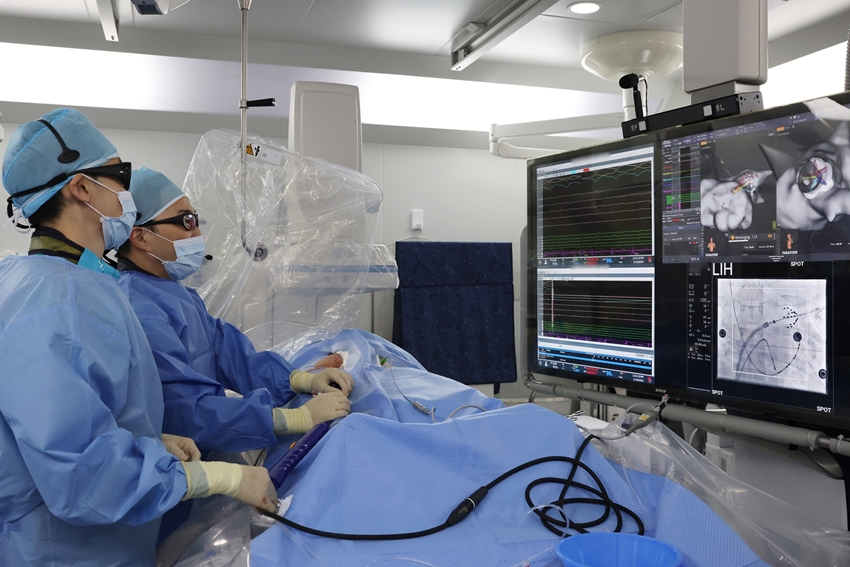
▲Professor Jun Kim of the Division of Cardiology at Asan Medical Center (right) performs 3D pulse field ablation on a patient with persistent atrial fibrillation.
A pulse field ablation procedure, recognized last year as a new medical technology, is now being widely used as a safe treatment option for atrial fibrillation, a common type of arrhythmia, while minimizing side effects.
Most recently, a next generation device equipped with a three dimensional (3D) mapping system has been introduced for pulse field ablation. By providing real 3D images of the heart structure, the system allows physicians to visualize the treatment site throughout the procedure, enabling even more precise therapy.
A cardiology team led by Professor Jun Kim of the Division of Cardiology at Asan Medical Center recently performed a successful 3D pulse field ablation procedure on a man in his forties with persistent atrial fibrillation. The patient was discharged in good health the day after the procedure.
Atrial fibrillation is the most common type of arrhythmia. It occurs when the atria beat extremely fast and the ventricles contract irregularly, which can lead to stroke or heart failure. When the condition cannot be controlled with antiarrhythmic medications or other drug therapies, radiofrequency catheter ablation or cryoablation has traditionally been performed. However, in rare cases these methods may cause complications such as esophageal thermal injury or pulmonary vein damage.
Pulse field ablation uses a high energy electric field to selectively target only the atrial muscle tissue. The procedure time can be shortened to approximately one to two hours, and serious complications such as esophageal thermal injury or pulmonary vein stenosis rarely occur. As a result, it is now widely used as a safe, next generation treatment option.
Most recently, Asan Medical Center successfully performed a 3D pulse field ablation procedure using a next generation device equipped with a 3D cardiac mapping system. By rendering the heart’s anatomical structure as a real time three dimensional image, the system allows physicians to precisely identify the target area. It also enables confirmation that the catheter is making adequate contact with the lesion during the procedure, further enhancing treatment accuracy.
In addition, unlike conventional pulse field ablation, which requires multiple X ray scans during the procedure to confirm the position of the inserted catheter, the new system allows physicians to track the catheter’s real time location without additional X ray imaging, thereby minimizing radiation exposure.
Asan Medical Center is the first in Korea to introduce the latest system with a 3D pulse field catheter built directly into the device. Until now, most 3D pulse field ablation procedures in Korea have relied on connecting an additional catheter for 3D imaging to a conventional pulse field ablation system.
Because this system is the most widely used device worldwide, its safety and effectiveness are well established. It also eliminates the need for additional catheters during the procedure. As a result, patients can receive more accurate and safer treatment without a significant cost difference compared with conventional pulse field ablation.
Professor Jun Kim of the Division of Cardiology at Asan Medical Center said, “With the rising number of older adults and people who are overweight or obese, the number of patients with atrial fibrillation continues to grow. We will continue our efforts to provide safer and more precise care for these patients through 3D pulse field ablation, which accurately reproduces each patient’s unique cardiac anatomy.”
ASAN MEDICAL CENTER
BROCHURE DOWNLOAD
Sharing your hope
ASAN MEDICAL CENTER(2019)
