


-
- Global AMC MENU
- NEWS
- HEALTH
- PEOPLE
- Introduction


Photosensitizer Coated Stent Enables Repeated Laser Irradiation for Stronger and Longer Lasting Treatment Effects
Retrievable Immediately After the Procedure, Reducing Complication Risks … A Promising Interventional Option for Patients with Multiple Esophageal Cancers
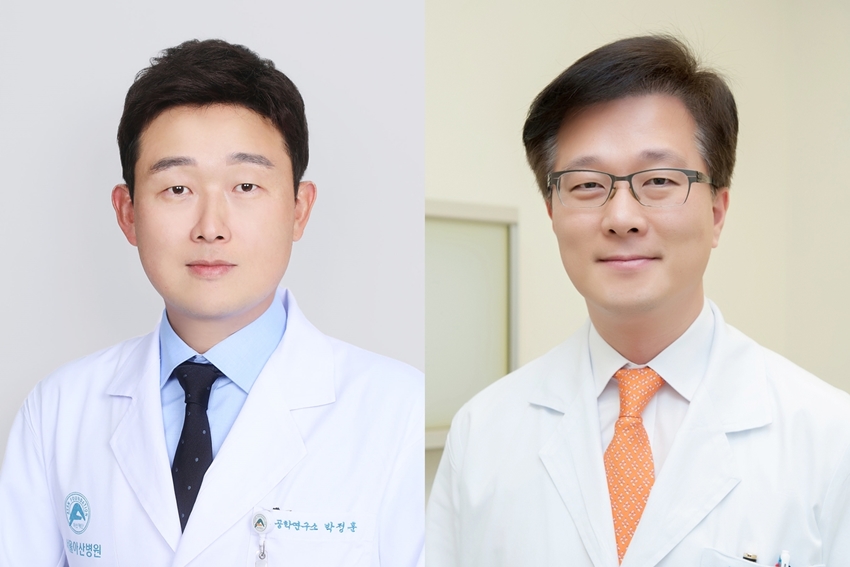
▲ (From left) Professor Jung-Hoon Park from the Department of Convergence Medicine and Professor Do Hoon Kim from the Division of Gastroenterology at Asan Medical Center
Photodynamic therapy is a treatment that selectively destroys cancer cells by irradiating a photosensitizer with a specific wavelength of laser light to generate reactive oxygen species. This therapy is also being applied in the treatment of patients with esophageal cancer.
However, in conventional photodynamic therapy, the photosensitizer administered intravenously spreads throughout the body, making localized treatment difficult. Treatment effects are limited to the areas exposed to the laser, resulting in shallow penetration. In addition, the therapeutic effect is often short-lived, with cancer cells frequently regrowing two to four weeks after treatment.
A research team led by Professor Jung-Hoon Park of the Department of Convergence Medicine and Professor Do Hoon Kim of the Division of Gastroenterology at Asan Medical Center recently announced the development of a new photodynamic therapy system. In this system, a photosensitizer is coated onto the surface of a stent, which is then positioned at the tumor site. A laser fiber catheter can be inserted through a dedicated channel inside the stent, allowing repeated laser irradiation of the lesion.
Testing the new photodynamic therapy system in a porcine esophagus model demonstrated that repeated laser irradiation of the lesion led to cancer cell death at a rate faster than cell regeneration. The treatment effect was also shown to extend deeper, reaching the submucosal layer of the esophagus.
The research team first coated the stent surface with the photosensitizer AlPcS4 and created a transparent cylindrical channel inside the stent exclusively for laser delivery. In conventional photodynamic therapy, the laser fiber had to be inserted separately, causing variations in light intensity and irradiation area depending on the distance and angle between the lesion and the fiber. The team explained that, with the laser channel positioned at the center of the stent, light can be delivered uniformly, and the fixed distance between the stent and the lesion maximizes treatment efficiency.
In addition, the stent developed by the research team is designed to be immediately retrievable after treatment by securing both ends to a catheter. This design reduces the risk of complications such as perforation or bleeding that can occur with prolonged stent placement. It also allows the stent to be inserted repeatedly for localized photodynamic therapy whenever needed, minimizing the burden on patients.
To evaluate the efficacy and safety of the photodynamic therapy system, the research team conducted experiments using a porcine model implanted with esophageal tumors. The results showed that repeated treatments increased the depth of therapy, reaching the submucosal layer, while minimizing tissue damage such as necrosis or inflammation. No stent-related complications were observed during the study.
Professor Jung-Hoon Park of the Department of Convergence Medicine at Asan Medical Center said, “The newly developed stent-based repeated photodynamic therapy system is expected to become a novel minimally invasive interventional treatment, not only for esophageal cancers with short lesions but also for patients with multiple lesions in different areas of the esophagus.”
Professor Do Hoon Kim of the Division of Gastroenterology at Asan Medical Center said, “The stent-based photodynamic therapy system allows for localized, repeated treatments, which is clinically significant because it can enhance therapeutic effectiveness and durability while greatly reducing the procedural burden on patients.”
This research was supported by the Mid‑Career Researcher Program of the Basic Research Project, funded by the Ministry of Science and ICT and the National Research Foundation of Korea. The study was recently published in the international journal ‘Biomaterials Research’, which has an impact factor of 12.5.
ASAN MEDICAL CENTER
BROCHURE DOWNLOAD
Sharing your hope
ASAN MEDICAL CENTER(2019)
