


-
- Global AMC MENU
- NEWS
- HEALTH
- PEOPLE
- Introduction
NEWS
Born with Her Heart Outside Her Body, Serin Finds a Miracle at Asan Medical Center
2025.12.18


An Ultra Rare Condition Affecting Five in One Million, “Ectopia Cordis” Claims More Than 90 Percent of Lives Before or Shortly After Birth
Korea’s First Successful Treatment of a Newborn with Ectopia Cordis Achieved Through Highly Complex Reconstructive Surgery Placing the Heart Inside the Thoracic Cavity and Covering It with Cultured Skin
A Miraculous Survival Made Possible Through Multidisciplinary Collaboration Among Specialists in Pediatric Cardiology, Cardiothoracic Surgery, and Other Fields
The Baby’s Parents Say, “Our Precious Child Conceived After 14 Rounds of IVF. We Are Grateful to the Asan Medical Center Medical Team for Never Giving Up and Giving Us Hope”
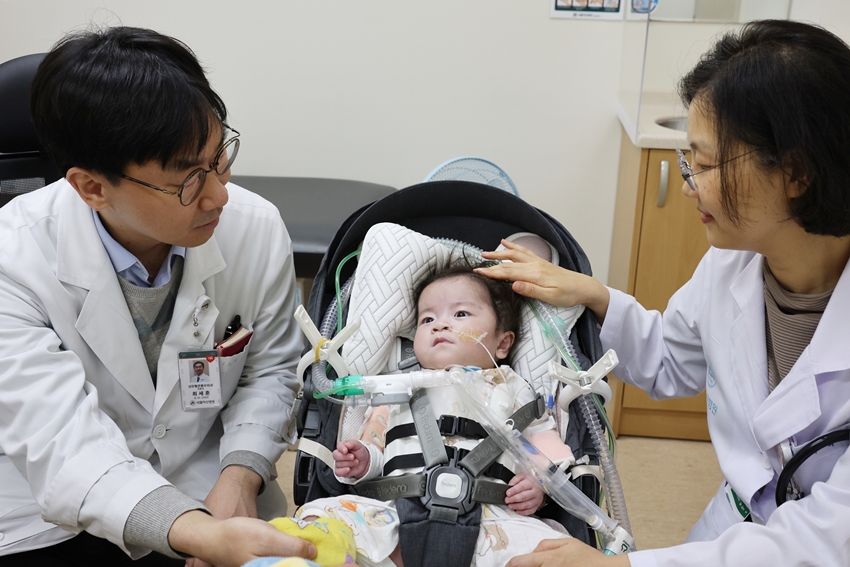
▲Asan Medical Center has successfully treated Korea’s first newborn with ectopia cordis, a condition in which the heart develops outside the body.
(From left) Professor Sehoon Choi of the Department of Thoracic and Cardiovascular Surgery at Asan Medical Center, Serin Park, and Professor Jae Suk Baek of the Division of Pediatric Cardiology at Asan Medical Center, December 12.
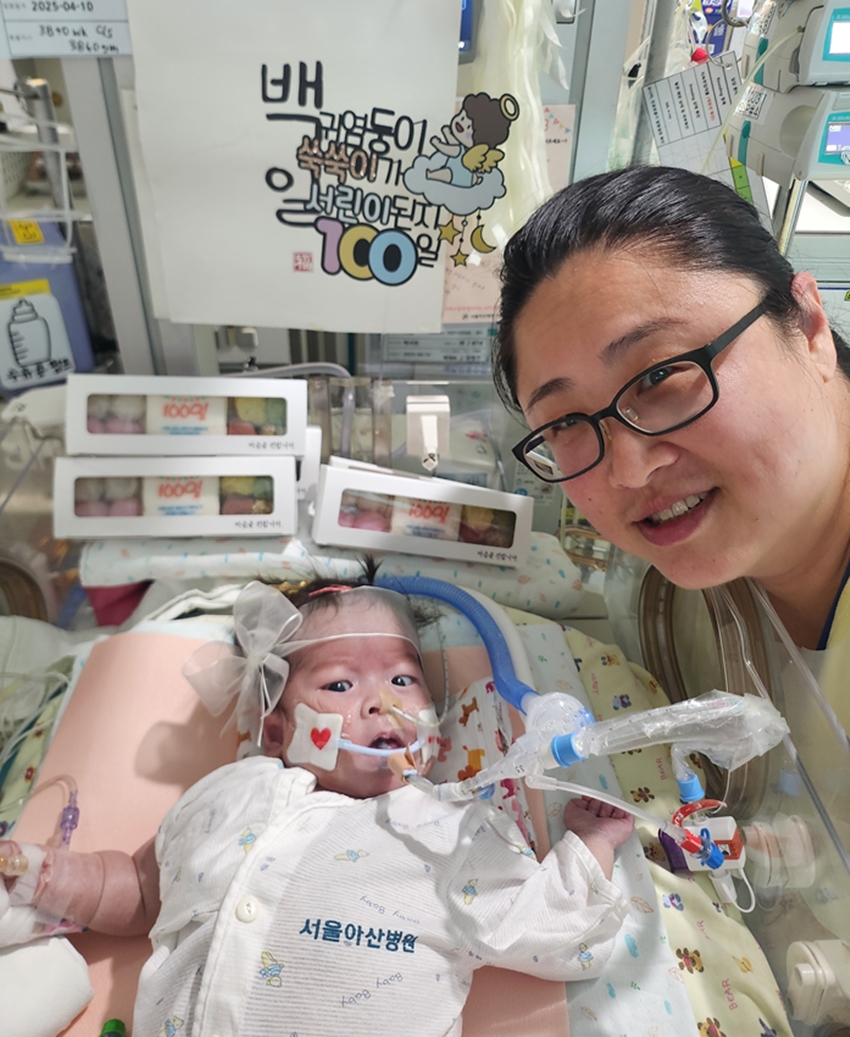
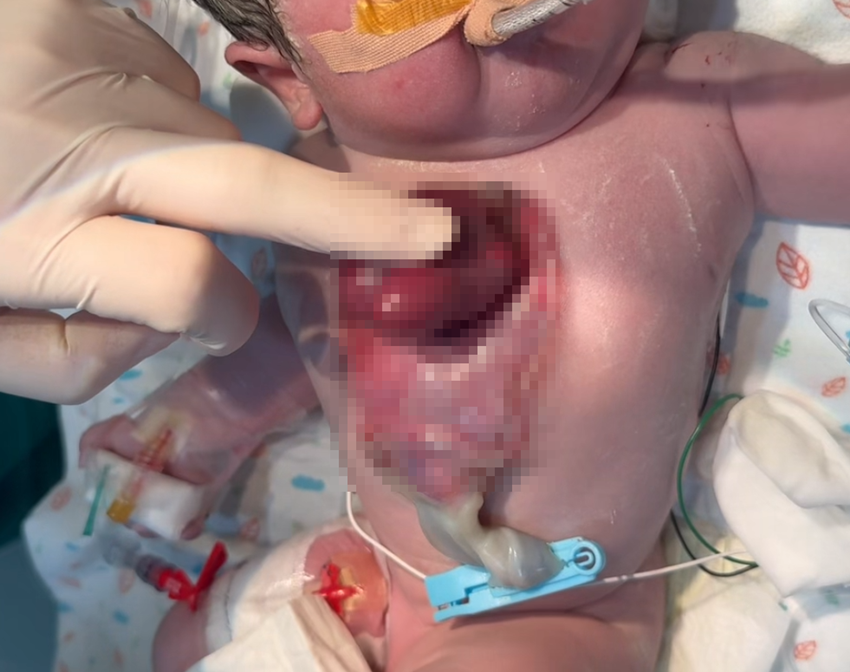
▲Full view of Serin Park’s chest at birth on April 10, showing her ectopia cordis condition.
Sustained by the Asan Medical Center medical team’s conviction that “this life can be saved,” together with the parents’ earnest hope, Serin endured 38 weeks in the womb. On April 10, she finally entered the world. From the very moment of birth, however, the real battle began. With the entire sternum absent and extensive defects in the skin and soft tissue of the chest and abdomen, her heart was beating completely outside her body. This was the first case in Korea in which a newborn’s heart was fully exposed outside the body, and an exceptionally rare case even worldwide. The condition proved far more severe than what had been anticipated based on prenatal ultrasound findings.
Once again, the medical team at Asan Medical Center refused to give up. Specialists from the Division of Pediatric Cardiology, the Department of Thoracic and Cardiovascular Surgery, the Department of Plastic Surgery, the Division of Pediatric Cardiac Surgery, the Department of Obstetrics and Gynecology, and the Department of Convergence Medicine of Asan Medical Center came together with a shared commitment. Through repeated, in-depth discussions and case conferences, they determined the course of treatment to ensure Serin’s survival, deciding to proceed in stages. The plan was to first secure sufficient space within the thoracic cavity to reposition the heart, and then reconstruct the chest by covering it with cultured skin grown in advance.
The most urgent priority was to protect the externally positioned heart from trauma, infection, and dehydration, while maintaining respiration and body temperature. The medical team immediately initiated mechanical ventilation and applied sterile dressings. On April 11, the day after birth, Professor Eun Key Kim of the Department of Plastic Surgery at Asan Medical Center performed a procedure to temporarily cover the open chest and exposed heart with an artificial skin substitute to provide protection.
Professor Sehoon Choi of the Department of Thoracic and Cardiovascular Surgery at Asan Medical Center performed three operations on May 7, 14, and 22 to gradually reposition the heart into the thoracic cavity. These were highly complex procedures that required creating sufficient space for the heart while maintaining blood pressure and avoiding damage to surrounding organs. By carefully lowering the liver and incrementally guiding the heart inward, Professor Sehoon Choi was able, by the third surgery, to place the entire heart securely within the thoracic cavity. Subsequently, on June 10, Professor Eun Key Kim successfully transplanted autologous cultured skin grown from a small sample of Serin’s own skin to reconstruct the chest.
Although Serin’s heart was returned to its proper position just two months after birth, her chest remained covered only by skin without a rigid structure such as bone, leaving it vulnerable to external impact. To address this, Professor Namkug Kim of the Department of Convergence Medicine at Asan Medical Center used 3D printing technology to create a customized chest protector designed to bring both sides of the rib cage together and prevent separation of the chest wall. In addition, the Department of Rehabilitation Medicine at Asan Medical Center provided ongoing rehabilitation therapy to support Serin’s growth and development so that she could grow like other children her age.
Serin gradually regained her health and was eventually able to move to a general ward. Around 100 days after birth, she smiled at her parents for the first time. The tiny heart that had once beaten outside her body was now beating strongly in its rightful place inside. Serin has since been discharged and continues to grow in good health while attending regular outpatient follow-up visits. For definitive correction, further surgery will be required to reconstruct the anterior chest wall using a rigid artificial structure and to cover it with Serin’s own muscle and skin tissue. This additional procedure is planned after she grows older, likely when she is at least three years of age.
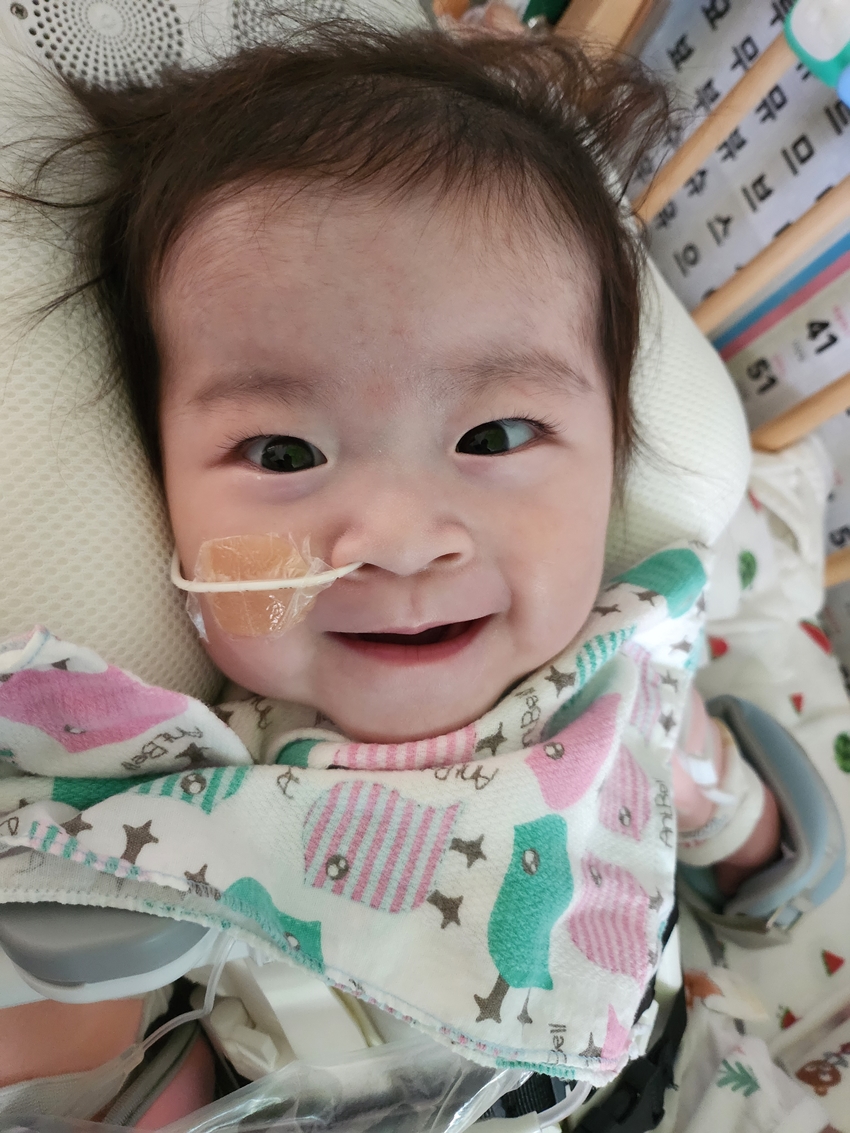
▲Serin Park showing her bright smile.
Serin’s mother said, “We could not give up on our precious child, whom we met after 14 rounds of in vitro fertilization. Even in a desperate situation with extremely limited treatment cases and information on ectopia cordis, all of the medical staff at Asan Medical Center never gave up and continued to search for a way to treat her, giving us hope. We are deeply grateful to the medical team for helping us return home together with Serin.”
Professor Jae Suk Baek of the Division of Pediatric Cardiology at Asan Medical Center said, “At every stage of care, we faced unexpected challenges, but the small changes Serin showed became a clear source of hope for the medical team. That hope, in turn, served as an important foundation for deciding the next steps in her treatment. I hope this story conveys a message of encouragement to children with rare diseases and their families, showing that the determination to keep taking even one more step forward can open up new possibilities and paths.”
Professor Sehoon Choi of the Department of Thoracic and Cardiovascular Surgery at Asan Medical Center said, “Saving a baby with ectopia cordis, an ultra-rare congenital condition, is not something that can be accomplished through the efforts of a single physician. To address the complex challenges involved, specialists from multiple fields with extensive clinical experience came together to share their assessments and treatment strategies from their respective perspectives. It was through this close, multidisciplinary collaboration that we were able to save Serin.”
ASAN MEDICAL CENTER
BROCHURE DOWNLOAD
Sharing your hope
ASAN MEDICAL CENTER(2019)
