


.JPG)
Asan Medical Center recently announced that it successfully treated a complex congenital heart defect in a low birth weight infant whose heart was no larger than a thumb, just eight days after birth.
Complete corrective surgery, considered the most ideal approach for treating complex cardiac malformations, is typically performed after four months of age once sufficient weight gain has been achieved. However, the infant’s oxygen saturation continued to decline and recurrent hypoxic spells developed, creating a critical situation in which treatment could not be delayed.
A team led by Professor Tae-Jin Yun of the Division of Pediatric Cardiac Surgery at Asan Medical Center recently succeeded in treating a complex congenital heart defect in a premature infant, Hong Yijun, who weighed only 1.5 kg, through complete corrective surgery that restored normal cardiac structure in a single operation.
Given that the patient was a low birth weight infant just eight days old, the procedure was expected to be highly challenging. However, following 49 days of intensive postoperative care, the infant recovered steadily and was discharged in good health on January 5 (Monday).
Yijun, the first son born to his 45-year-old mother after more than a year of in vitro fertilization treatment, was a long-awaited and deeply cherished child. However, the joy was short-lived, as prenatal examinations revealed that Yijun was approximately three weeks smaller than expected for his gestational age and had a congenital heart defect.
Following comprehensive diagnostic testing, Director Hye-Sung Won of the Fetal Therapy Center at Asan Medical Center (a professor of Department of Obstetrics and Gynecology), diagnosed the unborn child with tetralogy of Fallot (TOF), a complex congenital heart disease, in August 2025.
As the baby had come as a near miracle to parents of advanced maternal age, they continued the pregnancy while holding on to even the faintest hope. On November 10, about one month earlier than the expected due date, Yijun was born at 35 weeks of gestation and entered the world.
Born prematurely with a low birth weight of 1.5 kg, Yijun was confirmed to have TOF, consistent with the prenatal diagnosis. This complex congenital heart defect occurs in approximately three to four out of every 10,000 births and leads to cyanosis, as structural abnormalities of the heart impair adequate oxygen delivery throughout the body.
The standard surgical treatment for TOF is complete corrective surgery, which restores normal cardiac anatomy in a single operation. However, because the procedure requires opening the chest, stopping the heart, closing the ventricular septal defect, and reconstructing the valve, it is a highly demanding surgery. As such, it is generally performed after four months of age, when the infant has gained sufficient weight.
Accordingly, in premature or low birth weight infants such as Yijun, temporary palliative procedures such as shunt surgery or stent placement are generally performed to alleviate symptoms.
A systemic to pulmonary artery shunt, which temporarily connects a systemic artery to the pulmonary artery, not only requires a second operation later but is also typically recommended for infants weighing at least 3 kg. When performed in low birth weight infants, it is known to carry a very high risk of postoperative mortality. Stent placement in the right ventricular outflow tract, meanwhile, is technically challenging in infants as small as Yijun and has the critical drawback of causing permanent damage to the pulmonary valve after the procedure.
The most ideal treatment option for Yijun was to promote growth and wait until he gained sufficient weight before performing complete corrective surgery. However, although Yijun initially remained stable without severe cyanosis immediately after birth, his oxygen saturation gradually declined over the following days, and hypoxic spells began to occur, making it impossible to delay treatment any longer.
Professor Tae-Jin Yun of the Division of Pediatric Cardiac Surgery at Asan Medical Center chose the most challenging path, taking into account Yijun’s long-term future. Rather than opting for a temporary measure, he decided on complete corrective surgery to restore normal cardiac structure in a single operation.
On November 18 (Tuesday), just eight days after birth, Yijun was taken into the operating room. Surgeons opened his heart, no larger than an adult’s thumb, closed the ventricular septal defect, relieved the narrowing of the right ventricular outflow tract, and corrected blood flow to restore normal circulation while preserving the pulmonary valve.
Given Yijun’s extremely small size, with blood vessels thinner than a needle, and his physiologically immature condition, a prolonged operation was anticipated. However, drawing on extensive expertise accumulated through performing one of the highest volumes of TOF surgeries worldwide, the pediatric cardiac team at Asan Medical Center successfully completed the procedure in just four hours.
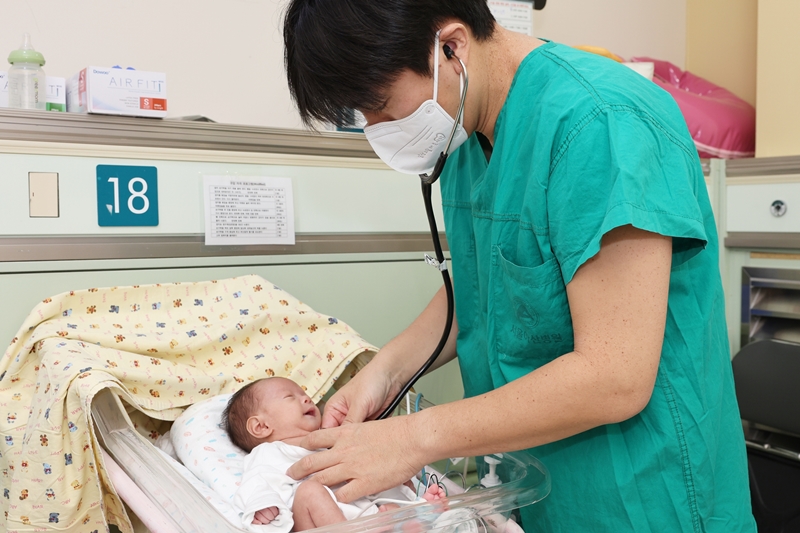
▲ Asan Medical Center successfully treated a complex congenital heart defect in a low birth weight infant whose heart was no larger than a thumb, just eight days after birth.
The photo shows Professor Euiseok Jung of the Division of Neonatology at Asan Medical Center examining Yijun as he received intensive postoperative care in the Neonatal ICU on January 2 (Friday).
Professor Euiseok Jung of the Division of Neonatology at Asan Medical Center provided intensive care for Yijun in the Neonatal ICU, including ventilatory support and blood pressure management. As Yijun recovered steadily, intravenous therapy was discontinued and enteral feeding was initiated on November 29 (Saturday), 11 days after surgery.
Postoperative echocardiography confirmed complete closure of the ventricular septal defect, with the well-preserved pulmonary valve remaining stable and showing no evidence of stenosis or regurgitation. As a result, 49 days after surgery, on January 5, 2026 (Monday), Yijun was discharged in good health, weighing 2.2 kg.
Yijun’s mother shared her gratitude, saying, “From the moment I learned during pregnancy that Yijun had a heart problem, I was deeply worried. However, the firm and confident voices of the medical staff at Asan Medical Center, telling me to focus solely on giving birth and assuring me that they would take care of the treatment, gave me the strength not to lose hope. Having been given such a miracle, I will do my best to raise Yijun to grow up healthy and strong.”
Professor Tae-Jin Yun of the Division of Pediatric Cardiac Surgery at Asan Medical Center stated, “While we have performed complete corrective surgery in many newborns with tetralogy of Fallot, treating Yijun, who had just been born and weighed only 1.5 kg, was a challenge even for our team. However, we determined that preserving the pulmonary valve as much as possible and completing the correction in a single operation, so that the child would not face the burden of reoperation, was the best gift we could give.”
Meanwhile, the Congenital Heart Disease Center at Asan Medical Center is a leader in the treatment of pediatric cardiac anomalies, performing more than 10,000 echocardiographic examinations and approximately 750 cardiac surgeries each year. Through close multidisciplinary collaboration among Division of Pediatric Cardiology, Division of Pediatric Cardiac Surgery, Department of Obstetrics and Gynecology, Division of Neonatology, Pediatric Critical Care Medicine, Department of Radiology, Department of Anesthesiology and Pain Medicine, and Department of Pathology, the Congenital Heart Disease Center provides seamless, integrated care ranging from prenatal diagnosis to postnatal treatment.
In addition, the Congenital Heart Disease Center operates a home monitoring program to enable early detection of emergencies and determine the optimal timing for surgery. Caregivers enter data such as the infant’s food intake, weight changes, oxygen saturation, heart rate, and feeding volume into a mobile application at home, allowing medical staff to monitor the information closely and provide timely, specialized oversight.
Director Jeong Jin Yu of the Congenital Heart Disease Center at Asan Medical Center (a professor of Division of Pediatric Cardiology), stated, “In this era of ultra-low fertility, with a total fertility rate of just 0.75, every child born is a precious gem to our society. Even for premature infants who come into the world after a difficult journey, we will continue to do our utmost to ensure that they can grow into healthy members of society through Asan Medical Center’s multidisciplinary care system and specialized medical programs such as home monitoring.”
