


-
- Global AMC MENU
- NEWS
- HEALTH
- PEOPLE
- Introduction


Professor Do Hyun Park’s Team from the Division of Gastroenterology at Asan Medical Center Confirms Clinical Effectiveness of Minimally Invasive Endoscopic Ultrasound Guided Tissue Biopsy
Nine Out of Ten Patients With Suspected Recurrence Accurately Diagnosed, Guiding Treatment Decisions and Reducing Unnecessary Chemotherapy
“Optimizing Treatment Strategies by Establishing a Precision Diagnostic Framework Through a Multidisciplinary Lymphoma Care System”
.jpg)
▲ (From left) Professors Do Hyun Park and Gunn Huh of the Division of Gastroenterology, Professors Dok Hyun Yoon and Hyungwoo Cho of the Division of Oncology at Asan Medical Center, together with Professor Ho Seung Lee of the Department of Gastroenterology & Hepatology at Korea University Anam Hospital
Lymphoma is a malignant disease in which immune cells known as lymphocytes undergo abnormal proliferation and can develop anywhere in the lymphatic system, which is distributed throughout the body, including lymphatic vessels and lymph nodes. For accurate diagnosis, excisional biopsy of lymph nodes has traditionally been performed. However, when lesions are located deep within the abdominal cavity, this approach places a significant physical burden on patients.
A Korean research team has reported that performing tissue biopsy for intra-abdominal lymphoma using endoscopic ultrasound enables accurate diagnosis without surgery, demonstrating high diagnostic accuracy and safety in the evaluation of lymphoma.
A research team led by Professors Do Hyun Park and Gunn Huh of the Division of Gastroenterology, Professors Dok Hyun Yoon and Hyungwoo Cho of the Division of Oncology at Asan Medical Center, together with Professor Ho Seung Lee of the Department of Gastroenterology & Hepatology at Korea University Anam Hospital, recently reported the results of endoscopic ultrasound guided tissue biopsy in 87 patients with suspected intra-abdominal lymphoma. The study showed that lymph node tissue was successfully obtained without surgery in 98.9 percent of patients, and that 85 percent achieved diagnostic results sufficient to determine treatment direction, including lymphoma subtype classification.
Using endoscopic ultrasound tissue biopsy, the research team was able to visualize lesion locations inside the body in real time and obtain tissue samples while avoiding major blood vessels. This approach enabled the safe acquisition of tissue specimens even from lymph nodes located deep within the abdominal cavity or around the aorta, where surgical access is particularly challenging.
This study is expected to make a significant contribution to the diagnosis of patients with suspected intra-abdominal lymphoma using a minimally invasive approach, enabling the rapid establishment of personalized treatment strategies.
Although lymphoma can be cured with appropriate treatment, accurate diagnosis is essential because treatment options and prognosis vary depending on the specific subtype. For this reason, surgical excisional biopsy, which allows for the acquisition of sufficient tissue samples, has long been used as the standard diagnostic method.
However, when lymph nodes are located deep within the abdomen, surgical access is often difficult and carries a higher risk due to the presence of major blood vessels. This can be a significant burden, particularly for patients with suspected recurrence whose physical condition has already been weakened by prior chemotherapy.
In this context, endoscopic ultrasound guided tissue biopsy has emerged as a new alternative due to its lower invasiveness compared with surgery. The procedure involves inserting an endoscope through the stomach or duodenum and using ultrasound to visualize the tumor in real time, allowing tissue samples to be obtained with a fine needle. It is already known to provide high diagnostic accuracy for pancreatic tumors and other solid lesions and is widely used in clinical practice.
Recent advances in biopsy needles and endoscopic ultrasound technology have made it possible to obtain well preserved tissue samples even from lesions located deep within the body, enabling immunohistochemical staining and detailed subtype classification. However, evidence has been limited as to whether endoscopic ultrasound guided tissue biopsy can also distinguish specific lymphoma subtypes and provide the information necessary to guide treatment decisions in lymphoma care.
The research team analyzed the medical records of 87 patients at Asan Medical Center who underwent endoscopic ultrasound guided tissue biopsy between March 2016 and December 2024 due to suspected intra-abdominal lymphoma or suspected recurrence. Among them, 46 patients were evaluated for initial suspicion of lymphoma, while 41 patients had previously been diagnosed with lymphoma and treated, and were later suspected of having recurrence.
Lymph nodes accounted for the largest proportion of biopsy sites, representing 76 percent of all cases. Among these, para aortic lymph nodes were the most common locations. Such involvement was observed in 71.4 percent of patients with an initial suspicion of lymphoma and in 65.2 percent of those with suspected recurrence.
The success rate of obtaining tissue samples from lymph nodes was 98.9 percent, demonstrating excellent technical feasibility. Diagnostic results sufficient to guide treatment decisions were achieved in 85.1 percent of patients overall, including 82.6 percent in the initial suspicion group and 87.8 percent in the suspected recurrence group.
Notably, among patients with suspected recurrence, 61 percent were found to have specific lymphoma subtypes through the examination, allowing chemotherapy to be initiated promptly. In contrast, 26.8 percent were diagnosed with conditions other than lymphoma, such as inflammation or reactive changes, enabling them to avoid unnecessary chemotherapy.
Procedure related adverse events were very rare, confirming the excellent safety profile of the examination. Only 3.4 percent of patients experienced mild, transient symptoms such as low grade fever after the biopsy, all of which resolved without medication. No patients developed serious complications, including bleeding or organ injury.
Professor Do Hyun Park of the Division of Gastroenterology at Asan Medical Center said, “This study is significant in demonstrating that lymphoma can be diagnosed with sufficient accuracy using endoscopic procedures instead of surgery. Through endoscopic ultrasound tissue biopsy, patients can confirm the presence of lymphoma with high accuracy without the burden of surgery, while clinicians will be able to rapidly identify recurrent cases and provide appropriate treatment in a timely manner.”
Professor Park added, “At Asan Medical Center, patients are precisely diagnosed and treatment strategies are determined through a multidisciplinary lymphoma care system involving the Division of Oncology, the Department of Radiology, the Department of Surgery, and the Department of Pathology. Based on close collaboration with the Department of Gastroenterology, endoscopic ultrasound guided tissue biopsy is then performed. This multidisciplinary approach helps reduce unnecessary surgery and enables the rapid identification of recurrence, contributing to the optimization of treatment strategies.”
The study findings were recently published in ‘Gastrointestinal Endoscopy’, a leading international journal officially issued by the American Society for ‘Gastrointestinal Endoscopy’, with an impact factor of 7.5.
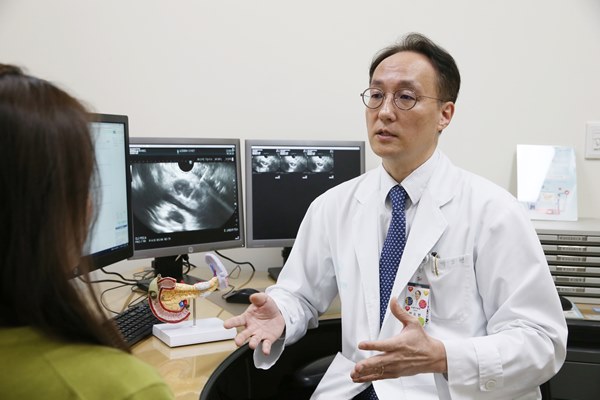
▲ Professor Do Hyun Park of the Department of Gastroenterology at Asan Medical Center is treating a patient with suspected lymphoma recurrence.
ASAN MEDICAL CENTER
BROCHURE DOWNLOAD
Sharing your hope
ASAN MEDICAL CENTER
