


-
- Global AMC MENU
- NEWS
- HEALTH
- PEOPLE
- Introduction


Despite nine out of ten patients being elderly or high-risk cases, the complication rates remain exceptionally low, with bleeding occurring in just 0.6 percent of cases and perforation in only 0.03 percent, underscoring a markedly high level of procedural safety
Backed by Korea’s largest clinical experience and strong multidisciplinary teamwork, Asan Medical Center continues to lead the treatment of high complexity pancreatic and biliary diseases
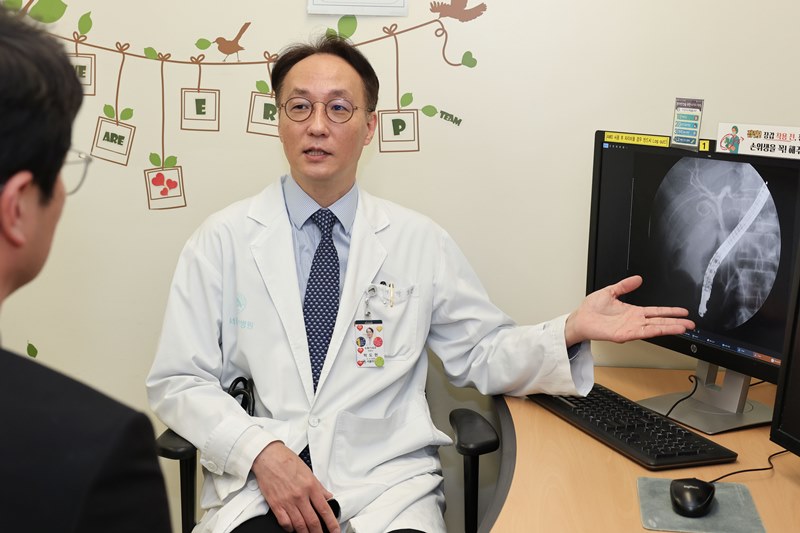
▲ Director Do Hyun Park of Asan Medical Center Pancreatobiliary Disease Center (Professor of Division of Gastroenterology), is treating a patient with pancreatic and biliary disease who has undergone ERCP.
When gallstones or cancer obstructs the bile duct and pancreatic duct, which serve as pathways for digestive fluids and bile, endoscopic procedures are used to diagnose and treat pancreatobiliary diseases.
These procedures allow both diagnosis and treatment to be performed in a single session using an endoscope alone. However, they are widely regarded as highly complex due to the intricate anatomy of the bile and pancreatic ducts and their anatomically challenging locations.
Asan Medical Center Pancreatobiliary Disease Center recently announced that it has become the first in Korea to perform 150,000 ERCP (Endoscopic Retrograde Cholangio-Pancreatography) procedures, an endoscopic technique used to diagnose and treat pancreatic and biliary diseases that often cause severe pain.
Compared with the Mayo Clinic in the United States, one of the world’s leading medical institutions, which has performed approximately 60,000 ERCP procedures since conducting its first case in the early 1980s, Asan Medical Center’s achievement of 150,000 ERCP cases stands out as a globally exceptional record.
At Asan Medical Center Pancreatobiliary Disease Center, most patients who undergo ERCP for pancreatic and biliary diseases are aged 65 or older or are classified as severe high complexity cases. Despite this, post procedural complication rates have been found to be remarkably low, with bleeding occurring in just 0.6 percent of cases and perforation in only 0.03 percent.
ERCP is primarily performed to diagnose and treat the bile duct and pancreatic duct when gallstones causing acute cholangitis, or when it is blocked by conditions such as pancreatic cancer, bile duct cancer, or ampullary cancer obstruct the bile duct.
During ERCP, an endoscope is advanced to the duodenum, and a catheter is inserted through the duodenal papilla, the opening of the bile and pancreatic ducts. Contrast media is then injected to visualize the anatomy and identify lesions in the bile and pancreatic ducts. Depending on the findings, therapeutic procedures such as removal of obstructing stones, dilation of strictures, or stent placement are performed as needed.
ERCP enables both diagnosis and treatment to be performed in a single session using an endoscope alone, allowing for faster recovery and a lower risk of complications compared with surgical procedures. Even when surgery is required, performing ERCP beforehand helps improve conditions such as cholangitis, pancreatitis, and jaundice, and allows for detailed assessment of the anatomical structure of the bile and pancreatic ducts, thereby enabling more accurate and precise surgery.
However, the bile and pancreatic ducts are known to be difficult to examine and differentiate diseases due to their complex anatomy and challenging anatomical location. As a result, far fewer physicians perform ERCP compared with routine upper gastrointestinal or colonoscopy procedures, and ERCP is regarded as a highly complex procedure in which the risk of complications such as pancreatitis, bleeding, and perforation is heavily influenced by the expertise and level of experience of the medical staff.
Asan Medical Center Pancreatobiliary Disease Center has recorded 150,000 ERCP procedures since performing its first case in 1989. Building on the expertise accumulated through decades of experience, the center now performs more than 8,000 ERCP procedures each year, with over 95 percent of them conducted for therapeutic purposes.
ERCP is known to carry a higher risk of complications than other endoscopic procedures. According to a comprehensive meta-analysis of 380 studies worldwide involving more than two million patients, post ERCP complication rates were reported at 1.5 percent for bleeding and 0.5 percent for perforation.
Based on its extensive clinical experience, Asan Medical Center has reduced ERCP related complication rates to 0.6 percent for bleeding and 0.03 percent for perforation. Compared with large-scale global studies, this represents reductions of approximately 60 percent in bleeding and 94 percent in perforation.
These outstanding outcomes are particularly notable given that nine out of ten patients undergoing ERCP at Asan Medical Center are elderly or high complexity cases with severe or multiple comorbidities, demonstrating the hospital’s exceptional level of expertise and treatment performance.
When gallstones are too large or accompanied by bile duct strictures, treatment with ERCP alone may be challenging. In such cases, percutaneous transhepatic cholangioscopy (PTCS) is performed, allowing direct endoscopic visualization of the bile duct to fragment and remove stones. Asan Medical Center has also accumulated extensive expertise in this highly complex procedure, having performed more than 16,000 PTCS cases to date.
Director Do Hyun Park of Asan Medical Center Pancreatobiliary Disease Center (Professor of Division of Gastroenterology), said, “ERCP is a procedure that directly addresses the anatomically complex bile and pancreatic ducts, making extensive clinical experience and the ability to respond appropriately to situations that arise during the procedure critically important. Asan Medical Center performs the largest number of ERCP procedures in Korea and has consistently minimized complication rates. We will continue our efforts to reduce unnecessary surgeries for patients with pancreatic and biliary diseases and to improve their quality of life through safe and effective procedures.”
Professor Dong-Wan Seo of the Division of Gastroenterology at Asan Medical Center, said, “The achievement of 150,000 ERCP procedures by Asan Medical Center Pancreatobiliary Disease Center is the result of close and seamless teamwork among all medical staff, including the Division of Gastroenterology, the Digestive Endoscopy Team, the Department of Radiology, and the Department of Radiation Oncology. Building on our world leading clinical experience and strong teamwork, we will continue to lead the treatment of patients with high complexity pancreatic and biliary diseases.”
ASAN MEDICAL CENTER
BROCHURE DOWNLOAD
Sharing your hope
ASAN MEDICAL CENTER
