


-
- Global AMC MENU
- NEWS
- HEALTH
- PEOPLE
- Introduction


Two Out of Three Deliveries Involved High Risk Pregnancies or Fetal Anomalies, Highlighting Its Leadership in Complex Obstetric Care in Korea
Chair Hye-Sung Won of the Department of Obstetrics and Gynecology Stresses Strengthening Multidisciplinary Care System to Safely Treat High Risk Mothers and Fetuses
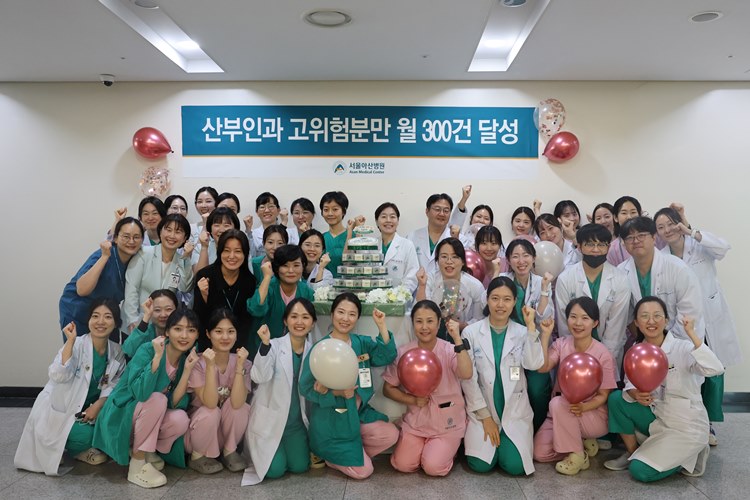
▲ In January, 329 deliveries were performed despite the challenging environment in which high risk pregnancies and fetal anomalies accounted for 60 percent of all cases.
The photo shows members of the Department of Obstetrics and Gynecology posing for a commemorative photograph.
Serin was born with ectopia cordis, a rare condition in which the heart develops outside the body. Ejoon was diagnosed with a complex congenital heart defect, his heart no larger than a thumb. Geonwoo and Sarang entered the world weighing just 288 grams and 302 grams, respectively, among the lowest birth weights ever recorded in Korea. These fragile newborns, once facing survival rates of less than 1 percent, created miracles through the dedication and expertise of the medical staff at Asan Medical Center.
In January alone, Asan Medical Center recorded 329 deliveries despite an exceptionally high proportion of complex cases. Approximately 60 percent of all deliveries involved high-risk pregnancies or fetal anomalies, including severe preeclampsia, placental abruption, and intrauterine growth restriction. Even while managing cases that are often beyond the capacity of general maternity hospitals, the center maintained a structured system for advanced obstetric and neonatal care in close collaboration with the Division of Neonatology and other related specialties.
Asan Medical Center has steadfastly cared for mothers and fetuses requiring advanced treatment even amid successive crises, including the COVID 19 pandemic and workforce shortages stemming from prolonged medical disputes.
As a result, Asan Medical Center has consistently performed an average of 200 deliveries per month, recording the highest number of deliveries among Korea’s Big 5 hospitals. Beyond a numerical achievement, this record underscores its commitment as a tertiary referral center that continues to accept and manage critically ill patients with complex conditions under any circumstances.
In the United States, widely recognized for advanced medical care, institutions specializing in complex obstetric services report comparable volumes. Mayo Clinic and Johns Hopkins Hospital each perform approximately 200 deliveries per month, while Massachusetts General Hospital records around 300 deliveries monthly. The recent achievement of Asan Medical Center therefore places it alongside leading global medical institutions in the field of high complexity obstetric care.
The foundation of this global level performance lies in extensive clinical experience. An analysis of 6,999 deliveries performed at Asan Medical Center over the past three years showed that 4,163 cases, or approximately 60 percent, involved high risk pregnancies or fetal anomalies. In other words, six out of every ten women who delivered at the hospital were classified as high risk.
Specifically, the majority of cases required intensive and highly specialized management, including 461 cases of preterm labor, 723 cases of preterm premature rupture of membranes, 288 cases of severe preeclampsia, 51 cases of placental abruption, 468 cases of placenta previa, 155 cases of polyhydramnios or oligohydramnios, 163 cases of cervical insufficiency, and 298 cases of intrauterine growth restriction.
.jpg)
▲ Professor Lee Mi Young of the Department of Obstetrics and Gynecology (center) provides post delivery care to a mother with placenta previa who underwent uterine artery embolization due to postpartum hemorrhage.
Notably, 1,517 cases of severe fetal anomalies were recorded over the three-year period. These included congenital heart defects and congenital diaphragmatic hernia, conditions that require precise prenatal diagnosis and immediate intervention at birth. The data indicate that a substantial proportion of the nation’s most critically ill fetuses are being treated at Asan Medical Center.
Despite primarily managing high-risk deliveries, Asan Medical Center reported no safety incidents throughout the past year, successfully carrying out all deliveries and related treatments without a single adverse event. This achievement reflects the unwavering commitment of physicians, nurses, and other healthcare professionals who safeguard patient safety around the clock in the delivery unit, obstetric ward, and neonatal intensive care unit, as well as the extensive clinical expertise accumulated over the years.
At the center of this safe and advanced care environment is the Asan Medical Center Fetal Treatment Center, which opened in 2004 as the first of its kind in Korea. The center performs approximately 5,000 detailed fetal ultrasound examinations annually, enabling early detection of fetal anomalies and providing integrated care from prenatal intervention to postnatal treatment and long-term outcome management.
Asan Medical Center Fetal Treatment Center has accumulated extensive experience in advanced fetal therapies aimed at safeguarding fetal health, including highly complex procedures such as fetoscopic surgery. Since its opening, the center has performed 332 fetoscopic surgeries, 711 fetal shunt procedures, 291 radiofrequency ablations, and 234 intrauterine transfusions.
Another driving force behind Asan Medical Center’s advanced obstetric care is its coordinated multidisciplinary care system. Treatment initiated in the Department of Obstetrics and Gynecology is seamlessly linked with the Department of Neonatology and further integrated with Pediatric Cardiology, Pediatric Surgery, Pediatric Cardiothoracic Surgery, Pediatric Urology, Pediatric Orthopedic Surgery, and Pediatric Neurosurgery, ensuring comprehensive and continuous care for high-risk mothers and newborns.
Preterm infants and critically ill newborns with congenital disorders are placed under the immediate care of neonatology specialists right after delivery and receive round-the-clock intensive treatment in one of the largest Neonatal ICU in Korea at Asan Medical Center. Emergency surgery is also performed through a well-coordinated system. In cases involving congenital heart disease, congenital diaphragmatic hernia, or esophageal atresia, the relevant specialists promptly assess the newborn’s condition and proceed with surgical intervention immediately.
In addition, depending on each infant’s condition, specialists across multiple disciplines collaborate closely to provide integrated care from immediate neonatal intensive care after birth through post discharge follow up. This coordinated system is regarded as a key factor in significantly improving survival rates and long-term outcomes for critically ill newborns at Asan Medical Center.
Chair Hye-Sung Won of the Department of Obstetrics and Gynecology at Asan Medical Center, said, “Achieving 300 deliveries in a single month under circumstances in which more than half of all cases involve high risk pregnancies or fetal anomalies is a meaningful accomplishment made possible by the unwavering dedication of our medical staff, who have worked tirelessly without giving up on even the most fragile lives.” She added, “We will continue to strengthen close collaboration with the Division of Neonatology and other related specialties, further advance the Fetal Treatment Center, and enhance our expertise in high complexity obstetric care so that high risk mothers and fetuses can receive safe treatment and return home in good health.”
ASAN MEDICAL CENTER
BROCHURE DOWNLOAD
Sharing your hope
ASAN MEDICAL CENTER
