


-
- Global AMC MENU
- NEWS
- HEALTH
- PEOPLE
- Introduction


Korea’s First Domestic Percutaneous Coronary Intervention Support Robot ‘AVIAR’ Enters Full Scale Clinical Use
Demonstrates Clinical Self Reliance and Global Competitiveness of Korean Technology in the Medical Robotics Field Previously Dependent on Imports
Enhances Patient Safety by Reducing Procedure Time and Contrast Agent Use While Lowering Radiation Exposure Risk for Operators
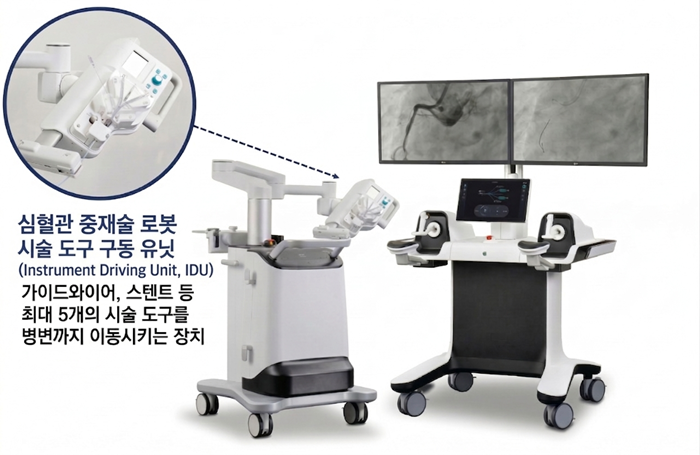
▲ Percutaneous Coronary Intervention Support Robot AVIAR, consisting of a console on the right that allows the operator to remotely control the system and a device drive unit on the left that performs the actual procedure.
As physical AI, which combines artificial intelligence and robotics, drives innovation across industries, its application in clinical settings is also gaining momentum. In particular, physical AI equipped with millimeter level precision control is now being actively introduced in the field of cardiovascular interventions used to treat conditions such as angina and myocardial infarction, bringing the era of robot assisted precision medicine closer to reality.
A team led by Professor Jung-Min Ahn of the Division of Cardiology at Asan Medical Center recently announced the successful treatment of a 56 year old male patient with angina using the percutaneous coronary intervention support robot AVIAR. The patient, who underwent a highly precise procedure for complex lesions with robotic assistance, was discharged in good health just one day after the procedure without any complications.
AVIAR, Korea’s first domestic robotic system for percutaneous coronary intervention, was developed in 2019 based on Asan Medical Center’s expertise and know how in medical robotics. Following continuous upgrades and refinements, the system received product approval from the Ministry of Food and Drug Safety in February 2023 and has since been used in clinical feasibility studies at Asan Medical Center, Eunpyeong St. Mary’s Hospital, and Kangbuk Samsung Hospital. It was subsequently designated as an innovative medical technology in December 2024 and, about a year later, has now begun to be applied in real world clinical practice.
The clinical application of AVIAR is regarded as a significant milestone demonstrating the potential for clinical self reliance and global competitiveness of Korean technology in a field that has largely depended on imported robotic systems from countries such as the United States, Germany, and France.
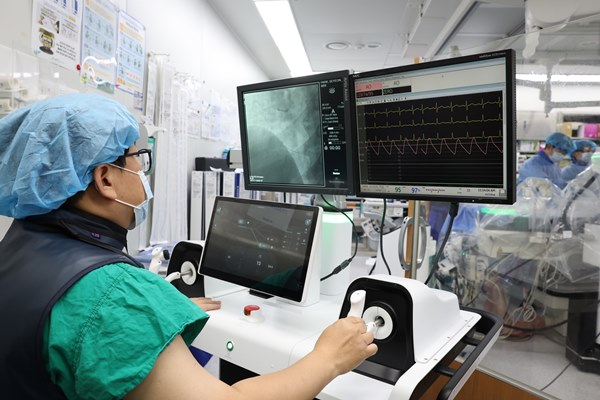
▲ Professor Jung-Min Ahn of the Division of Cardiology performs a procedure using the percutaneous coronary intervention support robot AVIAR in the cardiac catheterization laboratory on March 27.
Percutaneous coronary intervention is a highly complex procedure in which a thin catheter is advanced into the coronary arteries of the heart, followed by the insertion of a balloon to dilate narrowed vessels and the deployment of a stent. It is performed in patients with angina or myocardial infarction, where the coronary arteries are narrowed or blocked due to atherosclerosis or thrombosis. Traditionally, physicians have had to perform the procedure manually while viewing real time X ray images, resulting in prolonged radiation exposure and significant physical strain from wearing heavy lead protective gear.
Robotic systems for percutaneous coronary intervention were developed to address these limitations in the clinical environment. In particular, AVIAR distinguishes itself from existing overseas robotic systems by being the first in the world to implement a multi-channel platform capable of simultaneously mounting and controlling up to five interventional devices, including guidewires, balloons, and stents. This enables flexible use even in highly complex lesion procedures.
Compared with overseas robotic systems, AVIAR has maximized patient safety by reducing procedure time by more than 46 percent and lowering patient radiation exposure by over 22 percent. It also improves procedural accuracy through real time AI based imaging guidance while decreasing the use of contrast agents. As operators remotely control interventional devices from a console, their risk of radiation exposure is significantly reduced.
In addition, AVIAR enhances procedural precision with millimeter level positioning control and a haptic feedback system that delivers subtle tactile sensations during the procedure. Its AI driven computer platform provides real time data, including vessel curvature analysis, supporting clinicians in making accurate decisions.
Looking ahead, robotic systems for percutaneous coronary intervention are expected not only to enable more precise stent placement but also to reduce operator fatigue, contributing to safer medical care. They also hold potential for a wide range of clinical applications, including remote interventions for emergency patients and procedures in infectious disease settings.
Professor Jung-Min Ahn of the Division of Cardiology at Asan Medical Center said, “The success of this procedure demonstrates that a domestically developed robotic system for percutaneous coronary intervention is both safe and highly precise. We will continue to advance robot assisted clinical techniques by accumulating clinical evidence and expanding its application to a broader range of procedures.”
ASAN MEDICAL CENTER
BROCHURE DOWNLOAD
Sharing your hope
ASAN MEDICAL CENTER
