


-
- Global AMC MENU
- NEWS
- HEALTH
- PEOPLE
- Introduction


Implementation of ESG activities, including reduction of medical waste and carbon emissions, and health screenings for children from vulnerable populations
“We will establish ESG management across all aspects of hospital operations to realize social value.”
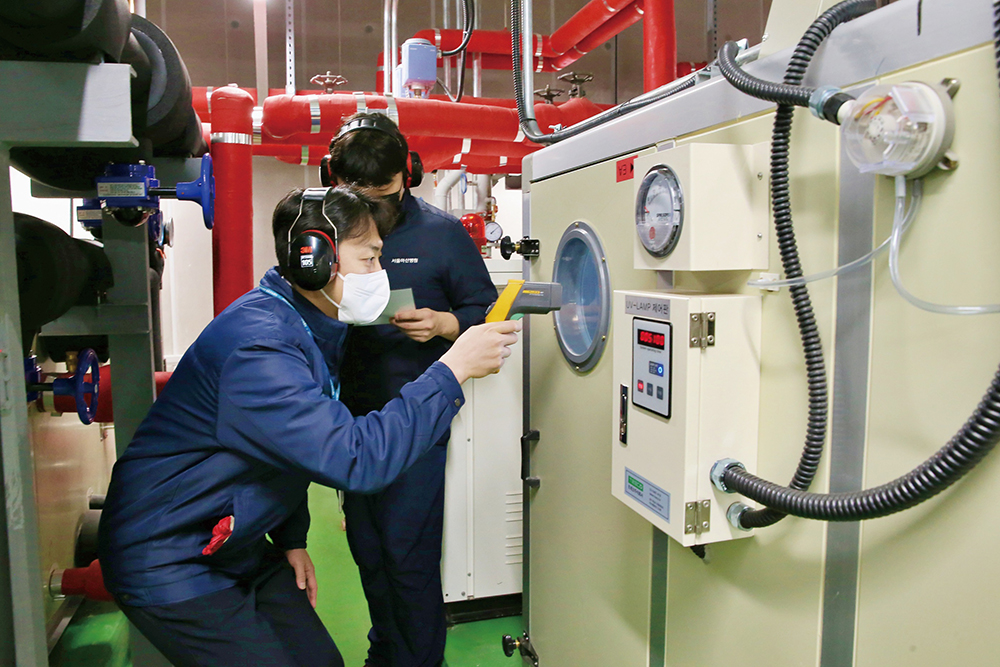
▲ A staff member of Asan Medical Center is inspecting a waste heat recovery system installed to improve energy efficiency.
Asan Medical Center, the first among domestic general hospitals to establish an ESG committee, has been actively exploring measures in environmental protection, social responsibility, and transparent governance, and is now substantially expanding ESG management across all aspects of hospital operations.
Asan Medical Center (President Seung-Il Park) announced that since the launch of its ESG Committee in 2021, it has been developing phased ESG management strategies and implementing a wide range of ESG activities, including reduction of medical waste and carbon emissions, strengthening engagement with local communities, and improving organizational culture.
Asan Medical Center’s ESG Committee has established three key goals environmental protection, social responsibility, and transparent governance, along with 23 indicators based on the K-ESG Guidelines and KH-ESG Guidelines, to ensure sustainable and execution oriented ESG management.
From an environmental management perspective, Asan Medical Center has identified the reduction of waste and carbon emissions as key priorities. Over the past year, Asan Medical Center implemented a range of initiatives, including waste management education programs conducted on site, expanded segregation of disposable materials and liquid waste, the “Asan Green (energy saving)” campaign, and improvements to inverter systems, boilers, and cooling equipment. As a result, total medical waste related costs decreased by approximately 4.9 percent in 2023 compared to the previous year, while greenhouse gas emissions were reduced by about 3.6 percent.
In addition, Asan Medical Center is participating in Seoul Metropolitan Government’s Building Greenhouse Gas Reduction Cap System and the Building ESG program. It has also installed a power consumption monitoring device developed by the Korea Institute of Civil Engineering and Building Technology and plans to measure the hospital’s energy consumption through May 2026. Based on these data, it aims to develop standardized emission benchmarks.
Asan Medical Center is also actively advancing its social responsibility initiatives. Last year, it conducted health screenings for 200 children at a welfare center in Gangdong District, and identified 33 children with obesity to be enrolled in a health management program starting in 2024.
Close collaboration with the local community to support the health of children from economically and medically vulnerable groups requires significant time, manpower, and resources. However, it is expected to generate a greater virtuous cycle by helping children grow up healthy and become productive members of society.
From a transparent governance perspective, Asan Medical Center has focused on strengthening operational efficiency, risk management, and organizational culture improvement. To enhance ethical awareness among staff members, Asan Medical Center has adopted a prevention oriented approach to audit activities and has been conducting regular and ongoing ethics code training programs.
Meanwhile, Asan Medical Center is often regarded as having embodied ESG values even before the concept was formally introduced, given that its 34 year history itself reflects ESG oriented activities. Established under the Asan Foundation with the founding principle of helping the most vulnerable members of society, Asan Medical Center has served since its opening in 1989 as a “quaternary care hospital” that treats a large number of severe patients referred from tertiary hospitals after treatment options have been exhausted.
Over the past decade, more than 3,700 international medical professionals from around 90 countries, including the United States, Germany, China, and Saudi Arabia, have been trained in advanced medical technologies at the hospital. The “Asan in Asia” project has also continued, sharing highly advanced medical techniques such as living donor liver transplantation with medically under-resourced countries in Asia, including Mongolia and Vietnam.
In addition, in order to establish a proper healthcare delivery system and promote a sustainable medical ecosystem, Asan Medical Center established Korea’s first Referral and Collaboration Center in 1995, which continues to operate today.
Based on these efforts, Asan Medical Center received high evaluations in areas such as social contribution, environmentally friendly management, and corporate trustworthiness, and was selected for the 17th consecutive year as “Korea’s Most Admired Hospital” in March 2023. It was also ranked first in Korea for five consecutive years in Newsweek’s “World’s Best Hospitals” evaluation.
Asan Foundation, which operates Asan Medical Center, has since its establishment in 1977 contributed to the advancement of society and the promotion of public welfare through a wide range of initiatives. These include medical welfare programs such as financial support for low income patients’ medical expenses; social welfare programs providing emergency living assistance for vulnerable groups in local communities; scholarship programs supporting the education of low income university students; academic research funding for projects essential to social development; the Asan Award, which promotes a culture of service and sharing; and the Asan Award in Medicine, which honors physician scientists in Basic and Clinical Medicine categories.
Je-Hwan Lee, Chair of Asan Medical Center’s ESG Committee and Vice President & Chief Medical Officer (CMO) of Asan Medical Center, stated that Asan Medical Center, which has consistently upheld the founding philosophy of the Asan Foundation to help the most vulnerable members of society, will further embed ESG management across all areas of hospital operations in order to realize a higher level of social responsibility.
ASAN MEDICAL CENTER
BROCHURE DOWNLOAD
Sharing your hope
ASAN MEDICAL CENTER
