


-
- Global AMC MENU
- NEWS
- HEALTH
- PEOPLE
- Introduction


“We cannot give up while there is hope”: Dedication of Asan Medical Center Team and Parents Leads To A Miracle
Left lung nonviable, right lung functioning at only 40%: ECMO assisted surgery performed as a last resort for severe respiratory failure
Rapid treatment based on Korea’s most extensive ECMO experience: “The child is expected to grow up healthy like other children”
.JPG)
▲ In March, Professor Byong Sop Lee of the Division of Neonatology at Asan Medical Center examines Han-gyeol ahead of his discharge.
A newborn who had struggled to breathe due to a congenital lung malformation, leading even the parents to nearly lose hope, has recently recovered and been discharged, thanks to the unwavering dedication of the medical team at Asan Medical Center.
Although the infant’s condition was critical enough to require extracorporeal membrane oxygenation (ECMO), often regarded as a last resort, just two days after birth, the shared determination of both the medical staff and the parents, who believed there was still hope, ultimately led to a remarkable recovery.
The neonatal team led by Professor Byong Sop Lee at Asan Medical Center recently announced the successful treatment of baby Song Han-gyeol, a male infant whose chances of survival were extremely low due to a severe congenital lung malformation that caused his lungs to become nearly twice their normal size shortly after birth. The team performed surgical resection of the lung mass under extracorporeal membrane oxygenation support.
Despite the fact that proceeding with surgery itself was highly challenging due to persistent severe respiratory failure, the team was able to successfully treat the infant based on their extensive experience in neonatal ECMO procedures. Han-gyeol made a healthy recovery and was discharged in March.
.JPG)
▲ Han-gyeol and his mother ahead of his discharge.
Han-gyeol’s mother, Ms. Cheon (30), first visited Asan Medical Center in October 2025 after a detailed ultrasound at 22 weeks of pregnancy revealed a suspected mass in the fetus’s lung. However, the results of further evaluation at Asan Medical Center were even more concerning. The lung mass occupied most of the left thoracic cavity, leaving almost no normally formed left lung, while the right lung was expected to function at only about 40 percent of normal capacity.
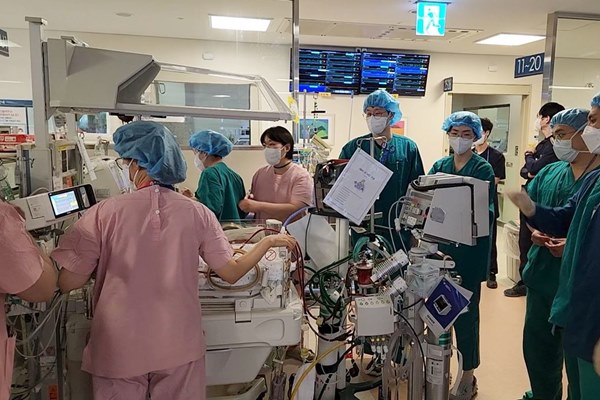
▲ Han-gyeol, weighing less than 4 kilograms, is transported to the operating room while connected to ECMO and a mechanical ventilator.
Despite the devastating news, she held on to the hope that surgery could offer a solution and continued her pregnancy. On January 14, 2026, Han-gyeol was born weighing 3.58 kilograms.
However, Han-gyeol’s condition after birth was even more critical. The left lung mass, which had expanded to nearly twice the size of a normal neonatal lung, was compressing both the heart and the right lung. In addition, he was diagnosed with pneumothorax caused by air leakage from the lung, as well as pulmonary hypertension, in which abnormally elevated pressure in the pulmonary arteries prevented adequate oxygen saturation from being maintained.
Immediately after birth, Han-gyeol was transferred to the neonatal intensive care unit. Despite respiratory support, severe respiratory failure persisted, and on January 16, just two days after birth, he was placed on extracorporeal membrane oxygenation, often considered a last resort.
Extracorporeal membrane oxygenation (ECMO) is a life support therapy in which blood is circulated outside the body, oxygenated, and then returned to the patient in cases of severe cardiopulmonary failure. While it has become widely used in adult critical care, its application in newborns remains highly challenging, as the procedure requires surgical cannulation and carries a high risk of complications such as intracranial hemorrhage.
Han-gyeol’s parents had even begun preparing themselves for the possibility of making an extreme decision, believing that discontinuing treatment might be in their child’s best interest. However, the medical team at Asan Medical Center stood firm. After a consultation with Professor Byong Sop Lee of the Division of Neonatology at Asan Medical Center, who emphasized that there was still hope and that they could not give up, the parents resolved to continue treatment.
Accordingly, on January 27, 13 days after Han-gyeol’s birth, the medical team decided to proceed with surgical removal of the lung mass. Even the process of initiating the surgery was far from simple. With a large ECMO system and a mechanical ventilator connected to a newborn weighing less than 4 kilograms, more than ten medical staff members, including neonatologists, nurses, and perfusionists, were required just to safely transport him to the operating room.
Professor SeHoon Choi of the Department of Thoracic and Cardiovascular Surgery at Asan Medical Center successfully removed the lung mass, which was connected to the left upper lobe, through an open thoracotomy while Han-gyeol remained on ECMO support. He was ultimately diagnosed with bronchial atresia accompanied by a lymphatic venous malformation, an extremely rare condition occurring in approximately one out of 100,000 individuals. The associated lymphatic and venous malformations had caused the lung to become abnormally stiff and overinflated.
After surgery, Han-gyeol’s condition gradually improved. However, a critical setback occurred at the point when the medical team attempted to wean him off ECMO, as pulmonary hypertension worsened again. This was attributed to the slow recovery of lung and cardiac function after prolonged compression.
The Neonatal ICU team at Asan Medical Center responded with highly individualized intensive care, precisely adjusting medication doses based on echocardiographic findings and implementing advanced treatments including inhaled nitric oxide and high frequency ventilation. As a result, Han-gyeol recovered rapidly and was able to be weaned off mechanical ventilation one month after surgery. Pre discharge evaluations also confirmed significant improvement, with the right lung returning to normal function and more than two thirds of the remaining left lung showing recovery.
Han-gyeol’s mother, Ms. Cheon, expressed her gratitude, saying, “It is thanks to the medical team at Asan Medical Center that Han-gyeol can be by my side. As they believed in him and saved him even when I was close to giving up, I will do my best to raise him to be healthy.”
Professor Byong Sop Lee of the Division of Neonatology at Asan Medical Center said, “Han-gyeol’s lung mass was unusually large and had a significant impact on cardiopulmonary function, so we anticipated that conventional anesthesia and surgery alone would not be sufficient, unlike in typical cases.”
He added, “Thanks to the rapid and coordinated efforts of a multidisciplinary team, including specialists from the Division of Neonatology, the Division of Pediatric Cardiac Surgery, the Division of Pediatric Cardiology, the Department of Pediatric Anesthesiology and Pain Medicine, and the Department of Thoracic and Cardiovascular Surgery, along with ECMO specialized nurses, Han-gyeol was able to be discharged safely. As the remaining lung continues to grow, we expect that he will be able to lead a healthy life like other children.”
ASAN MEDICAL CENTER
BROCHURE DOWNLOAD
Sharing your hope
ASAN MEDICAL CENTER
