


-
- Global AMC MENU
- NEWS
- HEALTH
- PEOPLE
- Introduction


New Surgical Standard for Forward Head Posture Correction: “NeckCA” Formula Developed
Predicts and Incorporates Postoperative Compensatory Changes from Head Center of Gravity Shift to Derive Optimal Correction Angle
Professor Jin Hoon Park of the Department of Neurosurgery at Asan Medical Center: “NeckCA Enables Precise Calculation of Patient Specific Correction Angles”
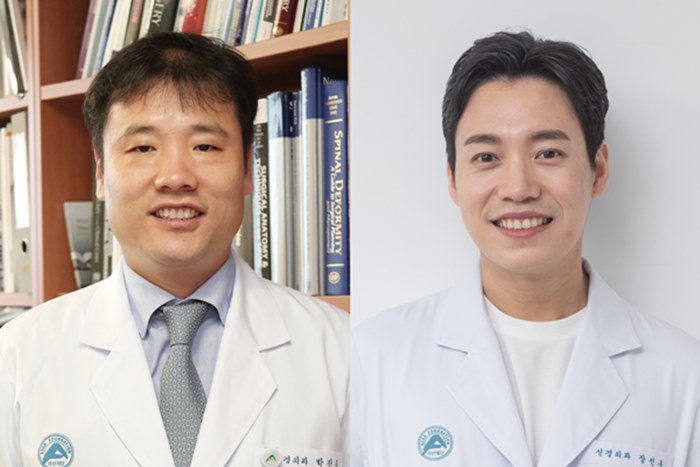
▲ Professor Jin Hoon Park of the Department of Neurosurgery at Asan Medical Center and Professor Jang Sun-woo of the Department of Neurosurgery at GangNeung Asan Hospital
Patients with cervical deformities, such as severe forward head posture that makes it difficult to maintain a forward gaze or causes debilitating pain, often require corrective surgery to realign the neck. However, even after surgical correction, insufficient adjustment of the correction angle frequently leads to “compensatory changes” as the body attempts to restore overall balance, resulting in recurrent misalignment of the cervical spine.
To address this issue, a research team led by Professor Jin Hoon Park of the Department of Neurosurgery at Asan Medical Center and Professor Jang Sun-woo of the Department of Neurosurgery at GangNeung Asan Hospital has developed a new surgical parameter, “NeckCA (Necessary Cervical Kyphosis Correction Angle).” This novel metric enables the prediction of compensatory changes during the preoperative planning stage and facilitates the calculation of the optimal correction angle for each patient.
The research team focused on the observation that when the cervical spine is surgically realigned, the head’s center of gravity shifts posteriorly, accompanied by changes in the slope of the first thoracic vertebra (T1). While conventional approaches considered only the degree of cervical curvature, the newly developed NeckCA is distinguished by incorporating both the existing curvature and the anticipated postoperative shift in the center of gravity into its calculation.
By applying this formula, the team expects to preemptively account for angular changes that occur as the body naturally restores balance after surgery. This approach is anticipated to secure a sufficient correction range, helping to prevent the cervical spine from gradually reverting to a forward-bent posture over time.
The research team developed an original formula expressed as “NeckCA = C2 slope (C2S) + COG–T1 tilt – 15.” The key concept of this formula is to intuitively determine the “true required correction” within the complexity of cervical anatomy.
Following corrective surgery to restore cervical alignment, the head’s center of gravity shifts posteriorly, prompting the body to increase the slope of the first thoracic vertebra (T1) in order to maintain balance. As a result, even when the cervical spine appears to have been adequately corrected to a normal angle, postoperative changes can lead to recurrent deformity over time. Therefore, preventing recurrence requires not only restoring cervical alignment but also incorporating anticipated compensatory angular changes into the surgical plan in advance.
The research team analyzed the clinical validity of the NeckCA parameter in 29 patients who underwent cervical deformity surgery at Asan Medical Center between 2012 and 2024. The results showed that patients who achieved sufficient correction in accordance with the NeckCA metric demonstrated better recovery outcomes one month after surgery, with a neck pain score (VAS) of 1.4 and a modified Japanese Orthopaedic Association (mJOA) score of 16.5, compared to those with insufficient correction (VAS 2.5, mJOA 15.9).
Notably, a significant difference was observed in the rate of postoperative deformity recurrence. The insufficient correction group showed a complication rate of 69.2%, whereas the adequately corrected group had a markedly lower rate of 18.7%. In addition, the team proposed a tailored surgical strategy based on NeckCA values, recommending focal correction for cases below 40° and extensive long segment correction with advanced osteotomy techniques for cases of 45° or higher.
The research team led by Professor Jin Hoon Park of the Department of Neurosurgery at Asan Medical Center has consistently produced notable research outcomes in the field of cervical and cervicothoracic junction surgery. Previously, the team demonstrated that using a thicker, single diameter 5.5 mm rod in combination with cervical pedicle screws during cervicothoracic junction surgery allows for stable fixation even over shorter segments, suggesting its potential as a game changer in the treatment of spinal disorders (Medicine, 2025). They also comprehensively reviewed over a century of surgical advancements in their study titled “The Artistic Evolution of Craniovertebral Junction Fixation” (Neurospine, 2025).
Professor Jin Hoon Park of the Department of Neurosurgery at Asan Medical Center stated, “Cervical deformity surgery has traditionally been highly challenging due to complex anatomical structures and unpredictable postoperative changes. The newly developed NeckCA parameter enables precise preoperative calculation of patient specific correction angles tailored to individual anatomy, which is expected to improve surgical accuracy and help prevent recurrence.”
The findings of this study were recently published in the ‘Journal of Neurosurgery: Spine’ (impact factor 3.1), one of the most authoritative international journals in the field of neurosurgery.
ASAN MEDICAL CENTER
BROCHURE DOWNLOAD
Sharing your hope
ASAN MEDICAL CENTER
