


-
- Global AMC MENU
- NEWS
- HEALTH
- PEOPLE
- Introduction


Professor Jae Suk Yoo from the Department of Thoracic and Cardiovascular Surgery at Asan Medical Center Performs Four Procedures Simultaneously Including Valve Replacement, Repair, and Atrial Fibrillation Through Minimal Incision
Overcoming the Challenges of an Elderly High Risk Patient Who Refused Transfusion for Religious Reasons “Will Further Expand Clinical Applications”
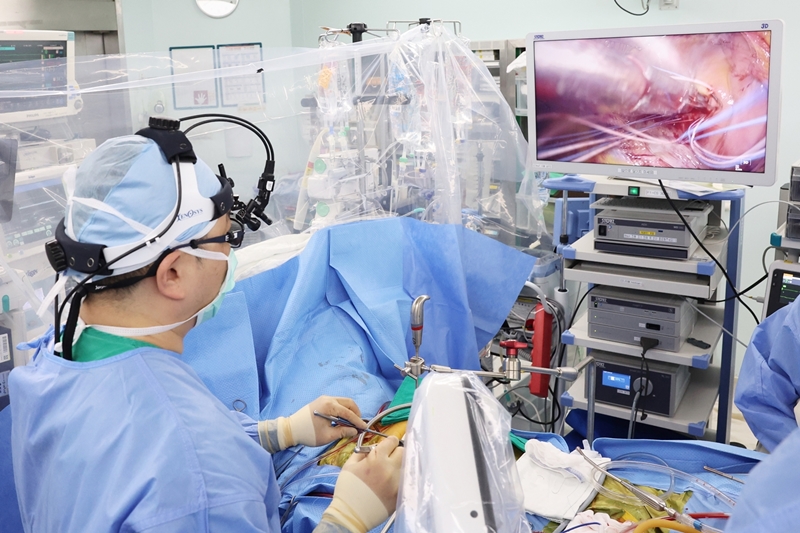
▲ Professor Jae Suk Yoo from the Department of Thoracic and Cardiovascular Surgery at Asan Medical Center performing bloodless complex cardiac surgery using 3D full endoscopy
Professor Jae Suk Yoo from the Department of Thoracic and Cardiovascular Surgery at Asan Medical Center announced that his team successfully performed four cardiac procedures at once using 3D full endoscopy on an elderly patient with multiple heart conditions. The procedures included aortic and mitral valve replacement, tricuspid valve repair, and surgery for atrial fibrillation.
In particular, this case is drawing significant attention from the medical community as it represents the first successful surgery performed without blood transfusion in a situation where transfusion was not possible due to the patient’s religious beliefs.
3D full endoscopic cardiac surgery requires only a 3 to 4 cm incision, which is smaller than the 6 to 8 cm incision typically used in conventional minimally invasive cardiac surgery. During the procedure, an endoscope equipped with a 3D camera is inserted, and the surgeon operates while viewing a high definition 3D image transmitted by the camera through specialized glasses.
The patient, Ms. Kang (77), who underwent the surgery, visited Asan Medical Center earlier this year with symptoms of dyspnea. She was diagnosed with four complex cardiac conditions, including aortic valve stenosis, mitral valve stenosis, tricuspid regurgitation, and atrial fibrillation, and was advised to undergo surgery. However, she strongly refused blood transfusion due to her religious beliefs.
Reflecting the patient’s request, Professor Jae Suk Yoo from the Department of Thoracic and Cardiovascular Surgery at Asan Medical Center performed four cardiac procedures simultaneously without blood transfusion in February using 3D full endoscopy. The operations included prosthetic valve replacement for both the aortic and mitral valves, tricuspid valve repair, and surgery for atrial fibrillation, all conducted in a single session. The patient made a good recovery and was discharged just eight days after surgery.
Complex cardiac surgery, which involves performing multiple cardiac procedures at once, is a highly demanding operation that has traditionally been carried out through open chest surgery. Due to the prolonged recovery period associated with open chest procedures, elderly patients or those with underlying conditions often forgo surgery and rely instead on medication to manage symptoms. In this case, the patient’s refusal of blood transfusion for religious reasons made conventional open chest surgery unfeasible.
However, 3D full endoscopic surgery has made it possible to perform precise and safe procedures through small incisions without cutting the sternum. In particular, in highly complex cases requiring multiple procedures to be performed simultaneously, as in this case, the 3D visual field allows surgeons to perceive depth and tissue thickness more clearly, enabling a higher level of surgical precision.
In addition, 3D full endoscopic cardiac surgery involves a much smaller incision than conventional open chest surgery, significantly shortening recovery time. As the sternum is not divided, postoperative pain is reduced and scarring is minimal. This approach lessens both physical and psychological burden on patients, making it particularly suitable for elderly individuals or those who are apprehensive about open chest procedures. The treatment outcomes are comparable to those of conventional open chest surgery.
While 3D full endoscopic cardiac surgery was initially limited to mitral valve repair, its applications have recently expanded to include aortic valve replacement, cardiac tumor surgery, atrial septal defect repair, and atrial fibrillation surgery.
Professor Jae Suk Yoo from the Department of Thoracic and Cardiovascular Surgery at Asan Medical Center stated, “This is the first case in the world in which four cardiac procedures were performed simultaneously using 3D full endoscopy in a situation where blood transfusion was absolutely not possible. As we continue to set new milestones in minimally invasive cardiac surgery, we will further expand the application of 3D full endoscopy to provide patients with a wider range of treatment options and improve their quality of life.”
ASAN MEDICAL CENTER
BROCHURE DOWNLOAD
Sharing your hope
ASAN MEDICAL CENTER
