


-
- Global AMC MENU
- NEWS
- HEALTH
- PEOPLE
- Introduction


Professor Hyun Suk Suh of the Department of Plastic Surgery at Asan Medical Center Performs Asia Pacific Region’s First Robotic Vascular Reconstruction Surgery
Following approval from Korea’s Ministry of Food and Drug Safety for clinical use in January, Asan Medical Center initiated a patient based clinical study
“We aim to establish standardized protocols for robotic supermicrosurgery and disseminate them to healthcare professionals in Korea and abroad, ultimately expanding treatment options for patients.”
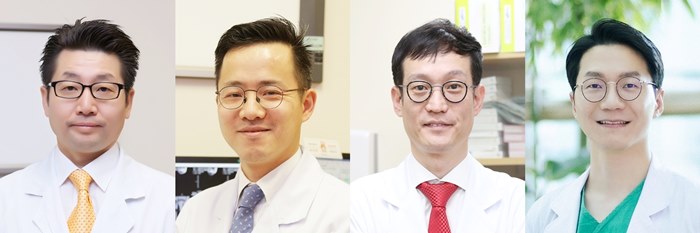
▲ (From left) Professors Joon Pio Hong, Hyun Suk Suh, Changsik Pak, and Jin Geun Kwon of the Department of Plastic Surgery at Asan Medical Center.
Korean researchers have achieved a major milestone in the field of robotic microsurgery by successfully performing an anastomosis of ultrafine blood vessels thinner than a human hair using a supermicrosurgical robot, marking the first such achievement in the Asia-Pacific region.
A team led by Professors Joon Pio Hong, Hyun Suk Suh, Changsik Pak, and Jin Geun Kwon of the Department of Plastic Surgery at Asan Medical Center recently performed the Asia Pacific region’s first successful free flap reconstruction using the Symani supermicrosurgical robotic system on a 57 year old woman with sarcoma. The patient recovered well after surgery and was discharged in good condition eight days later.
This procedure is particularly significant because it successfully applied robotic technology to the highly specialized field of supermicrosurgery, where operations have traditionally been performed only by surgeons with extensive expertise. The team successfully connected ultrafine blood vessels measuring less than 1 mm in diameter during an actual reconstructive procedure, demonstrating the clinical feasibility of robotic supermicrosurgery.
Symani is a supermicrosurgical robotic system designed for use in a wide range of procedures, including reconstructive surgery, breast reconstruction, and limb reconstruction. Professor Joon Pio Hong’s team at Asan Medical Center, which has long been at the forefront of advances in microsurgical reconstruction, has been involved in the project since the early stages of the robot’s development. Following approval for clinical use by the Korea Food and Drug Administration (KFDA) in January, the team has been conducting a clinical study at Asan Medical Center to evaluate the system in complex reconstructive surgeries.
The first robotic supermicrosurgical procedure was performed on a patient who underwent tumor resection for a suspected malignant peripheral nerve sheath tumor, a type of soft tissue sarcoma, in the thigh. To minimize the risk of cancer recurrence, surgeons performed a wide excision that included surrounding tissues, resulting in an extensive defect in the patient’s left groin area.
To restore both function and appearance, Professor Hyun Suk Suh of the Department of Plastic Surgery at Asan Medical Center performed a free flap reconstruction using the patient’s own tissue. A healthy flap was harvested from the patient’s right groin and transplanted to the left groin defect created by the extensive tumor resection.
Successful tissue engraftment depends on the precise connection of blood vessels from the transplanted tissue to those at the recipient site. Using the supermicrosurgical robotic system, Professor Hyun Suk Suh identified ultrafine vessels measuring just 0.3 to 0.8 mm in diameter and meticulously performed arterial and venous anastomoses.
Supermicrosurgery, which involves operating on blood vessels smaller than 1 mm, is an exceptionally demanding procedure that requires prolonged concentration and highly refined technical skills under a high magnification microscope. Mastering these techniques takes years of specialized training and experience. Globally, fewer than 600 surgeons are capable of performing supermicrosurgery, and surgical outcomes can vary depending on the operator’s level of expertise and concentration.
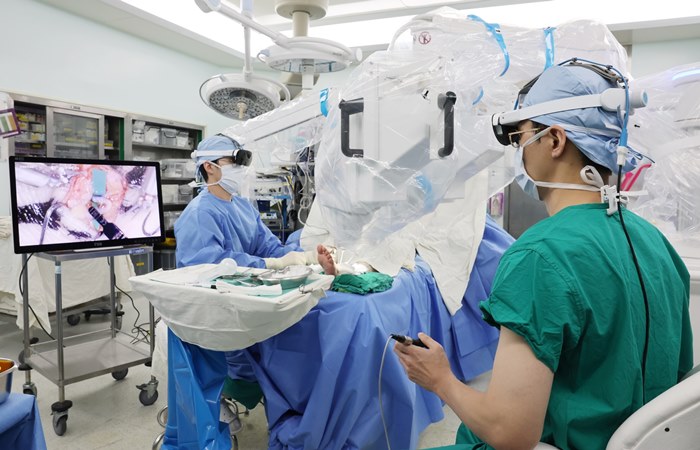
▲ Professor Jin Geun Kwon (right) of the Department of Plastic Surgery at Asan Medical Center performs a lymphaticovenular anastomosis using a supermicrosurgical robotic system, connecting a delicate lymphatic vessel measuring approximately 0.4 mm in diameter to a vein in a patient with lower extremity lymphedema.
The supermicrosurgical robotic system was developed to address these limitations in clinical practice. Designed specifically for open microsurgery and supermicrosurgery, it features wristed micro instruments that replicate the natural movements of the human hand. The system is engineered to perform delicate procedures such as anastomosis, suturing, and ligation of tiny blood vessels and lymphatic vessels measuring between 0.1 and 2.5 mm in diameter.
As the surgeon’s hand movements are transmitted to the robotic instruments, the system scales down motion and incorporates tremor filtration technology to reduce physiological hand tremors. This allows for greater precision even in complex anatomical environments, helping to minimize vessel injury and improve surgical accuracy.
In November 2023, Asan Medical Center signed a memorandum of understanding with Medical Microinstruments Inc. (MMI), an Italian developer of supermicrosurgical robotic systems, to establish research and educational programs for microsurgical robotics. As the first institution in the Asia-Pacific region to do so, the hospital has developed research and training programs for robotic supermicrosurgery, conducted preclinical animal studies, and laid the groundwork for clinical implementation.
Building on this successful procedure, Asan Medical Center is now expanding the use of the supermicrosurgical robotic system to a broader range of applications, including supermicrosurgical free flap procedures requiring anastomosis of extremely small vessels and lymphaticovenous anastomosis. The hospital plans to continue generating clinical evidence to demonstrate the long term value of robotic assistance in highly complex procedures and to improve patient access to advanced microsurgical treatments.
Looking ahead, supermicrosurgical robotic systems are expected to enhance the precision of microsurgical procedures, lower the technical barriers associated with complex reconstructive surgery, and provide safer treatment options for patients, ultimately contributing to improved quality of life.
Professor Hyun Suk Suh of the Department of Plastic Surgery at Asan Medical Center said, “This procedure represents a meaningful first step in demonstrating that a supermicrosurgical robotic system can reliably perform highly complex ultrafine vascular anastomoses in actual patient care. We expect robotic technology to play a pivotal role in advancing microsurgery. Moving forward, we will continue working to establish standardized protocols for robotic supermicrosurgery and share them with medical professionals in Korea and around the world, ultimately expanding treatment options for a greater number of patients.”
ASAN MEDICAL CENTER
BROCHURE DOWNLOAD
Sharing your hope
ASAN MEDICAL CENTER
