


-
- Global AMC MENU
- NEWS
- HEALTH
- PEOPLE
- Introduction


AI System Delivers Sepsis Protocols, Diagnostic Tests, and Antibiotic Guidelines Within Seconds
Highest Level of Security with an On Premises System Powered Entirely by In House Servers and Data
Director Young-Hak Kim for Digital Information Innovation Headquarter: “We Will Lead Trust Based Digital Healthcare Innovation Without Concerns Over Data Leakage”
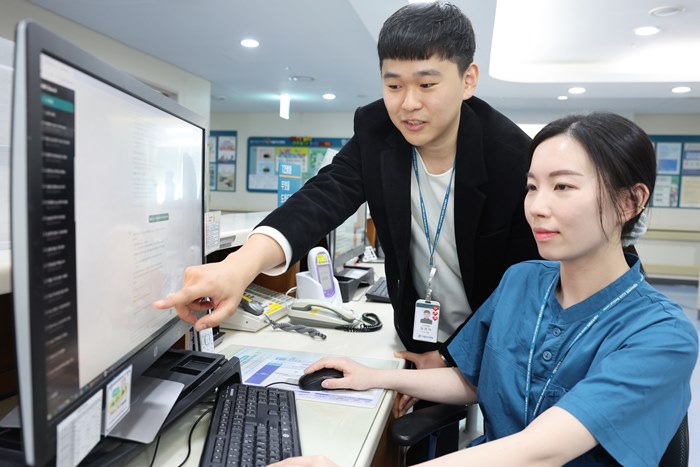
▲ A staff member demonstrates the use of the Private AI Knowledge Retrieval System.
A patient with suspected sepsis, a life threatening condition in which infection rapidly damages major organs, arrives at the hospital. With every second critical, the attending clinician immediately accesses the Private AI Knowledge Retrieval System and enters the prompt: “Please provide the initial response protocol and antibiotic administration guidelines for a patient with suspected sepsis.”
Within seconds, the system searches through a database containing hundreds of pages of clinical practice protocols and instantly presents key information, including a list of tests that must be performed within the first hour, fluid resuscitation recommendations, detailed antibiotic administration guidelines, and diagnostic criteria for sepsis. The response also clearly identifies the source documents from which the information was retrieved.
Asan Medical Center has become the first healthcare institution in Korea to establish and fully deploy a Private AI Knowledge Retrieval System operating within a completely isolated closed network environment with no connection to the external internet. Private AI refers to an approach in which AI models are operated exclusively on an organization’s internal servers without transmitting data to external cloud services.
Because medical data contain highly sensitive information, including patients’ medical records and diagnostic results, stringent security measures are essential. Conventional generative AI systems typically rely on external cloud infrastructure, raising concerns about potential data exposure. To address these challenges, Asan Medical Center adopted a fully on premises infrastructure, operating all servers and data exclusively within the hospital’s internal environment and reducing dependence on external cloud services to zero.
This enables Asan Medical Center to fully leverage the benefits of generative AI while ensuring the highest level of data protection, with patient information never leaving Asan Medical Center’s internal network. In addition, by developing the system in house rather than relying on external vendors, Asan Medical Center has further strengthened its technological independence and internal AI capabilities.
With the Private AI Knowledge Retrieval System, healthcare professionals no longer need to manually search through extensive clinical guidelines or operational regulations. Instead, they can obtain accurate answers within seconds through a single query. In urgent situations where consulting a manual is essential, such as managing accidental extubation and reintubation procedures or reporting a confirmed case of a legally designated infectious disease, the system provides objective, evidence based guidance that enables clinicians and staff to respond quickly and confidently.
At the core of the system is the integration of a vector database with Retrieval Augmented Generation (RAG), an advanced AI architecture that combines information retrieval with generative AI capabilities.
A vector database is a technology that converts and stores documents in a format that enables AI to understand their meaning and retrieve relevant information rapidly. Unlike conventional databases that rely primarily on keyword matching, vector databases analyze the context and semantic meaning of a query to identify the most relevant documents. By converting and storing vast collections of hospital documents, including clinical guidelines and operational regulations, into a vector database, Asan Medical Center has created a foundation that allows AI to retrieve the information it needs almost instantly.
RAG (Retrieval Augmented Generation) is a technology that requires AI to generate responses based on actual documents stored in the database. Rather than creating answers solely from its internal knowledge, the AI first searches for relevant source documents and then generates responses grounded in that information. This approach structurally prevents AI hallucinations, in which a model produces plausible but inaccurate information without supporting evidence. The achievement is particularly significant in healthcare, where hallucinations can have serious consequences, as it helps ensure that responses remain accurate, reliable, and evidence based.
To address the limitations of a closed network environment, where incorporating the latest external information in real time can be challenging, Asan Medical Center plans to operate a separate sandbox based external search engine. When external searches are required, the system will transmit only fully anonymized queries that contain no personally identifiable patient information. This approach creates a secure channel through which up to date medical information can be retrieved while ensuring that no internal hospital data are ever exposed outside the organization.
Director Young-Hak Kim for Digital Information Innovation Headquarter at Asan Medical Center, said, “This system is particularly meaningful because it addresses two major challenges simultaneously: maintaining the highest level of security while enabling the effective use of AI. It demonstrates that AI can be fully utilized even within a closed network environment. We will continue to enhance the system and lead trust based digital healthcare innovation without concerns over data leakage.”
ASAN MEDICAL CENTER
BROCHURE DOWNLOAD
Sharing your hope
ASAN MEDICAL CENTER
