


-
- Global AMC MENU
- NEWS
- HEALTH
- PEOPLE
- Introduction


Proportion of Unruptured Cerebral Aneurysm Patients Increases 20 Fold Over Two Decades, Shifting Treatment Paradigm from Emergency Care After Rupture to Preventive Treatment Before Rupture
Leading Cerebral Aneurysm Treatment for 36 Years Since the First Surgery in 1989, Performing More Than 1,000 Complex Cases Annually
Complication Rate Less Than Half the Global Average, Achieving World Class Outcomes Through Collaboration Between Neurosurgery and Radiology

▲ Professor Jae Sung Ahn of the Department of Neurosurgery at Asan Medical Center performing surgery on a patient with a cerebral aneurysm
Cerebral aneurysms, often referred to as a “ticking time bomb in the brain,” occur when a weakened area of a blood vessel wall in the brain becomes enlarged like a balloon. Because they usually cause no symptoms before rupture, they are difficult to detect. However, once ruptured, they can lead to brain hemorrhage and become life threatening. Therefore, early detection and preventive treatment before rupture, as well as emergency treatment after rupture, are crucial.
The Cerebrovascular Team at Asan Medical Center (Professors Byung Duk Kwun, Jae Sung Ahn, Jung Cheol Park, and June Ho Choi of the Department of Neurosurgery, and Professors Deok Hee Lee, Yoonsun Song, and Boseong Kwon of the Department of Radiology at Asan Medical Center) has performed a total of 20,874 cerebral aneurysm treatments since the first surgery in 1989. Asan Medical Center is the first medical institution in Korea to surpass 20,000 cerebral aneurysm treatments, a milestone achieved through consistently performing more than 1,000 complex cases annually since 2019.
With the increasing use of health screenings, the detection and preventive treatment of unruptured cerebral aneurysms before rupture through brain CT and MRI scans have rapidly increased. At Asan Medical Center, unruptured cerebral aneurysm cases accounted for only 4.4% (21 patients) of all cerebral aneurysm patients between 1989 and 1993. The proportion surpassed 90% for the first time in 2015 and has recently reached 93 to 94%. This reflects a major shift in the treatment paradigm for cerebral aneurysms from “emergency treatment after rupture” to “preventive treatment before rupture.”
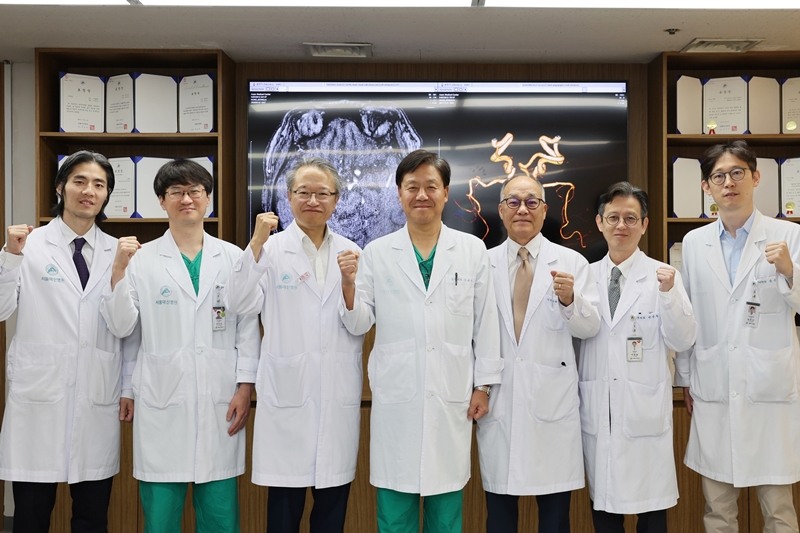
▲ The Cerebrovascular Team at Asan Medical Center taking a commemorative photo to celebrate achieving 20,000 cerebral aneurysm treatments, the first in Korea
Cerebral aneurysm treatment mainly involves two approaches: surgical clipping and endovascular coil embolization. Clipping is a surgical procedure in which the skull is opened and a clip is placed at the aneurysm to block blood flow. Coil embolization is a minimally invasive endovascular procedure that does not require opening the skull; instead, platinum coils are inserted through the femoral artery in the thigh to prevent blood from flowing into the aneurysm. For cerebral aneurysms with complex shapes, advanced procedures such as aneurysm neck clipping performed under cardiac arrest or intracranial to extracranial bypass surgery may also be performed.
An analysis of 20,874 cerebral aneurysm treatments performed at Asan Medical Center showed that 13,334 cases involved surgical treatments, including clipping and vascular bypass surgery, while 7,540 cases involved endovascular treatments, including coil embolization and flow diverter stent placement. The findings confirmed that the most appropriate treatment method was selected based on each patient’s individual condition.
In addition, an analysis of treatment outcomes for unruptured cerebral aneurysms over the past 10 years from 2016 to 2025 showed that the rate of major complications, death, or severe neurological disability after treatment was 3.5% for clipping and 1.7% for coil embolization. These rates are less than half of the globally reported figures (approximately 6 to 12% for clipping and 5 to 10% for coil embolization), demonstrating world-class treatment outcomes.
When determining the optimal treatment approach for a cerebral aneurysm, various factors including the patient’s age, family history, and the aneurysm’s shape and location must be comprehensively considered. To reduce the risk of complications, receiving treatment from experienced specialists is essential to reducing complications. The Cerebrovascular Team at Asan Medical Center works closely with specialists from the Department of Neurosurgery and the Department of Radiology to select the most appropriate treatment strategy tailored to each patient, minimizing complications and improving treatment outcomes.
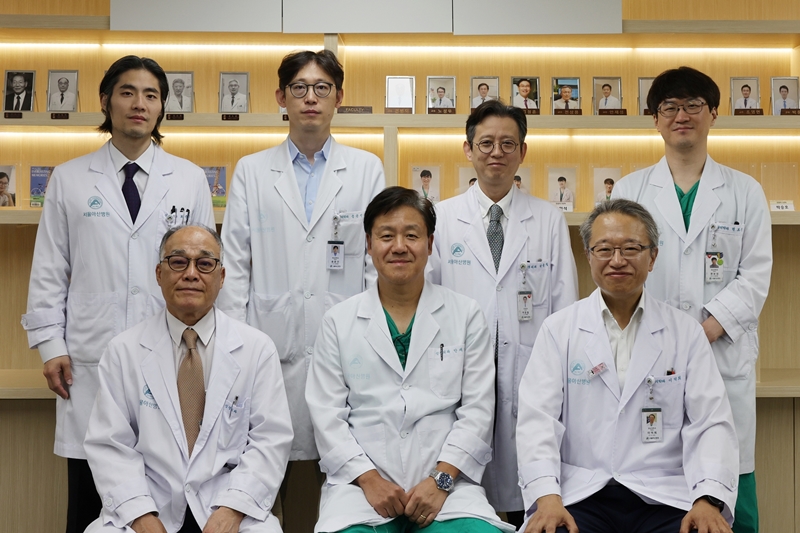
▲ The Cerebrovascular Team at Asan Medical Center taking a commemorative photo to celebrate achieving 20,000 cerebral aneurysm treatments, the first in Korea
The history of cerebral aneurysm treatment at Asan Medical Center began in 1989 with the first surgery performed by Professor Choong-Jin Whang of the Department of Neurosurgery at Asan Medical Center. In 1991, Asan Medical Center performed Korea’s first aneurysm neck clipping under cardiac arrest. In 1996, Professor Do Hoon Kwon of the Department of Neurosurgery at Asan Medical Center successfully performed Korea’s first embolization procedure using a fine platinum coil (Guglielmi Detachable Coil, GDC coil) to block blood flow into the aneurysm, further expanding the scope of cerebral aneurysm treatment.
In August 2025, Asan Medical Center became the first institution in Korea to surpass 20,000 cerebral aneurysm treatments. Asan Medical Center continues to play a leading role in cerebral aneurysm treatment in Korea, with Professors Byung Duk Kwun and Jae Sung Ahn of the Department of Neurosurgery performing 5,000 and 5,140 cerebral aneurysm surgeries, respectively, and Professor Jung Cheol Park of the Department of Neurosurgery performing 3,432 cerebral aneurysm embolization procedures.
“Cerebral aneurysms typically cause no symptoms until rupture, but once ruptured, they can become a life threatening condition,” said Professor Jae Sung Ahn of the Department of Neurosurgery at Asan Medical Center. “The milestone of 20,000 cases is meaningful not simply as a number, but because each case represented a treatment directly related to saving patients’ lives. We will continue to leverage our accumulated experience and expertise to ensure that more patients can receive safe and effective treatment in the future.”
ASAN MEDICAL CENTER
BROCHURE DOWNLOAD
Sharing your hope
ASAN MEDICAL CENTER
