


-
- Global AMC MENU
- NEWS
- HEALTH
- PEOPLE
- Introduction


Indonesia's Largest Hospital, Siloam Hospitals, Performs First Robotic Kidney Transplantation After Training at Asan Medical Center
Professor Sung Shin: "We Will Share Advanced Medical Expertise Wherever It Is Needed"
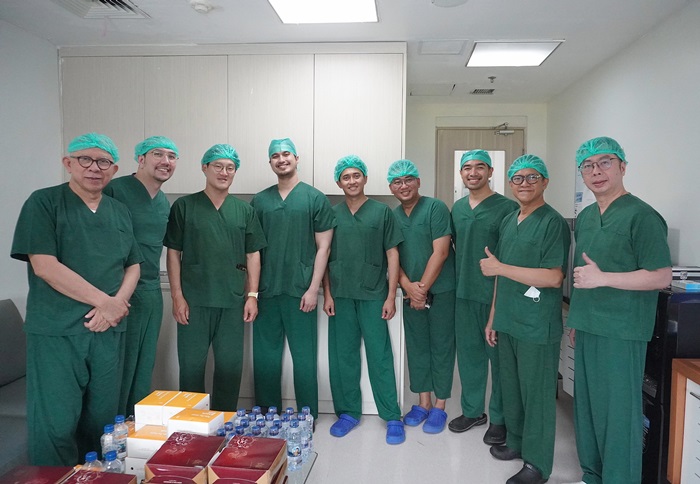
▲ Physicians from Siloam Hospitals who trained in kidney transplantation at Asan Medical Center successfully carried out Indonesia's first robotic kidney transplant in early June.
As Korean medical expertise continues to gain global recognition, Asan Medical Center's world leading experience and innovation in kidney transplantation have once again made an impact on the international stage.
Asan Medical Center recently announced that the kidney transplantation team at Indonesia's Siloam Hospitals successfully performed the country's first robotic kidney transplantation using advanced surgical techniques and clinical expertise acquired through training at Asan Medical Center.
An Indonesian man in his 50s, who had been undergoing dialysis for nearly a year after developing end stage kidney disease caused by hypertension, regained his health after receiving a kidney from an unrelated donor in his 20s in early June. Following Indonesia's first robotic kidney transplantation, the patient made a stable recovery and was discharged just 13 days after surgery.
Siloam Hospitals, Indonesia's largest private hospital network, operates a dedicated kidney transplantation center and has performed more than 450 open kidney transplantation procedures to date.
Compared with conventional open surgery, robotic kidney transplantation provides up to a tenfold-magnified surgical view and enables highly precise procedures through the robotic system's articulated instruments. Smaller incisions also reduce postoperative pain, shorten hospital stays, and lower the risk of complications such as surgical site infections and hernias.
Recognizing these advantages and seeking to improve patients' quality of life, Siloam Hospitals decided to introduce robotic kidney transplantation. To prepare for the program, the hospital selected Asan Medical Center for clinical training, where more than 100 robotic kidney transplantations were performed in 2023 alone.
The partnership between Asan Medical Center and Siloam Hospitals began in 2023 with the signing of a memorandum of understanding on medical collaboration, including physician training, technology transfer, and international patient referrals.
A six member urology team from Siloam Hospitals completed a clinical training program at Asan Medical Center in May 2024. Throughout the program, Asan Medical Center specialists provided hands on instruction covering every aspect of robotic kidney transplantation, from surgical techniques to patient management protocols, sharing the practical expertise they had accumulated through extensive clinical experience.
Driven by a strong commitment to mastering the procedure, several members of the Indonesian team returned to Asan Medical Center for an additional month of training. Their dedication allowed them to gain comprehensive experience across every stage of robotic kidney transplantation.
After returning to Indonesia, the Siloam Hospitals kidney transplantation team established a comprehensive robotic kidney transplantation program based on the knowledge gained at Asan Medical Center. The team introduced key clinical systems, including vascular anastomosis training, laparoscopic surgery protocols, standardized nursing practices, intensive care unit management, and infection control protocols for transplantation recipients. Built on this strong clinical foundation, Siloam Hospitals successfully performed Indonesia's first robotic kidney transplantation in June this year.
Professor Nur Rasyid of the Department of Urology at Siloam Hospitals, who led the operation, said, "The successful completion of Indonesia's first robotic kidney transplantation marks a major milestone in the country's medical advancement. Robotic surgery has enabled us to enhance surgical precision and improve patient outcomes. I sincerely thank the kidney transplantation team at Asan Medical Center for generously sharing their expertise and supporting us in making this achievement possible."
Professor Sung Shin of the Division of Kidney and Pancreas Transplantation Surgery at Asan Medical Center, who served as the Indonesian team's mentor, said, "It has been one of the most rewarding experiences of my career to support the Indonesian team in performing the country's first robotic kidney transplantation. We will continue to share Asan Medical Center's advanced medical expertise and clinical systems with healthcare professionals around the world wherever they are needed."
Since introducing robotic kidney transplantation in August 2020, Asan Medical Center has performed more than 200 robotic kidney transplantations, the largest number in Asia. In May 2026, Asan Medical Center also surpassed 8,000 kidney transplantations, including 6,312 living donor and 1,668 deceased donor procedures. With a one-year graft survival rate of 98.5 percent, meaning transplanted kidneys remained functional without the need for dialysis or retransplantation, Asan Medical Center continues to set the global standard in kidney transplantation.
ASAN MEDICAL CENTER
BROCHURE DOWNLOAD
Sharing your hope
ASAN MEDICAL CENTER
