


-
- Global AMC MENU
- NEWS
- HEALTH
- PEOPLE
- Introduction


Professor Dong-Myung Shin's Team at Asan Medical Center Identifies Protein Signature Predictive of Chemotherapy Response in Muscle Invasive Bladder Cancer
Combination Therapy Overcomes Cisplatin Resistance, Reduces Tumor Size by 80% in Animal Study
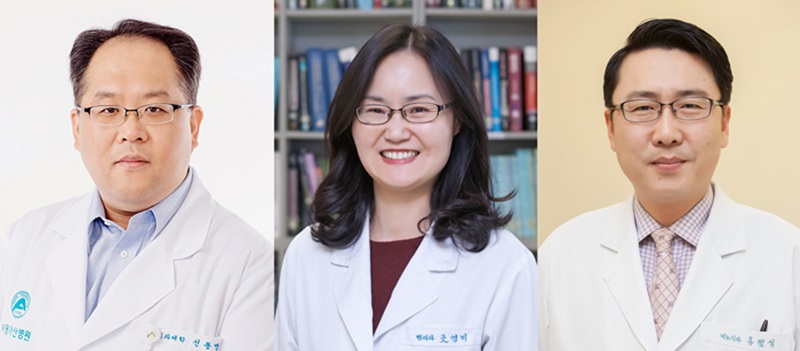
▲ (From left) Professors Dong-Myung Shin of the Department of Cell and Genetic Engineering, Yong Mee Cho of the Department of Pathology, and Bumsik Hong of the Department of Urology at Asan Medical Center.
Muscle invasive bladder cancer, in which the tumor has spread into the muscle layer of the bladder, carries a high risk of metastasis through the blood or lymphatic system and is associated with poor survival outcomes. Although neoadjuvant chemotherapy is administered before surgery to remove the cancer and surrounding tissues, treatment response varies considerably among patients. For those unlikely to benefit, unnecessary chemotherapy may delay surgery and ultimately worsen prognosis.
A research team led by Professors Dong-Myung Shin of the Department of Cell and Genetic Engineering, Yong Mee Cho of the Department of Pathology, and Bumsik Hong of the Department of Urology at Asan Medical Center recently developed an AI based precision medicine platform that can predict patients' response to neoadjuvant chemotherapy while also identifying the underlying mechanisms of chemotherapy resistance in muscle invasive bladder cancer.
Using transcriptomic data from 399 patients with muscle invasive bladder cancer, Professor Dong-Myung Shin's research team applied machine learning to identify a protein signature (GLS, IL15RA, AFAP1, and FOXA1) that can predict individual responses to neoadjuvant chemotherapy. The researchers also found that the KEAP1–NRF2 signaling pathway is a key mechanism underlying chemotherapy resistance in muscle invasive bladder cancer and demonstrated that targeting this pathway could enhance the therapeutic efficacy of chemotherapy.
The current standard treatment for muscle invasive bladder cancer is neoadjuvant cisplatin based chemotherapy administered for two to three months before radical cystectomy. This approach aims to shrink the primary tumor and eliminate micrometastatic cancer cells, thereby reducing the risk of recurrence after surgery.
However, only 30 to 40 percent of patients achieve a pathological complete response, meaning no residual cancer is detected in the surgical specimen following neoadjuvant chemotherapy. Although transcriptome based molecular subtyping, which analyzes gene expression patterns to predict treatment response before surgery, has recently been introduced, its clinical application has been limited by substantial intratumoral heterogeneity and the complexity of the analytical process. Likewise, immunohistochemistry, which assesses the expression of specific proteins in tissue samples, is subject to interobserver variability and is not well suited for large-scale analysis.
Many patients either exhibit primary resistance to chemotherapy from the outset or acquire resistance during treatment. In particular, abnormalities in the KEAP1–NRF2 signaling pathway, which protects cells against oxidative stress, are known to enhance cancer cell survival and promote chemotherapy resistance.
To identify biomarkers capable of predicting response to chemotherapy, the research team performed a machine learning based integrative analysis of transcriptomic and digital pathology data.
The researchers first analyzed transcriptomic data from 399 patients with muscle invasive bladder cancer, including patients treated at Asan Medical Center and those from multicenter cohorts, using machine learning. They identified KEAP1, PCDHB9, POU2F2, and AFAP1 as key candidate genes that distinguish responders from nonresponders to neoadjuvant chemotherapy.
The team then validated the clinical utility of the candidate biomarkers identified through transcriptomic analysis using immunohistochemistry and digital pathology. Pathological tissue samples from 91 patients with muscle invasive bladder cancer who had received neoadjuvant chemotherapy at Asan Medical Center were analyzed. After converting pathology slides into digital images, an AI model distinguished tumor regions from the surrounding stromal tissue and quantitatively measured protein expression.
The analysis identified a four protein panel consisting of GLS, IL15RA, AFAP1, and FOXA1 as a promising immunohistochemistry based biomarker for predicting response to neoadjuvant chemotherapy. Patients classified as responders by the prediction model showed significantly longer overall survival and progression free survival than those classified as nonresponders. These findings suggest that a small panel of key proteins could serve as a practical pathological biomarker for predicting response to neoadjuvant chemotherapy in patients with muscle invasive bladder cancer.
The research team next investigated the KEAP1–NRF2 signaling pathway to elucidate the mechanism underlying chemotherapy resistance. Cisplatin resistant bladder cancer cells showed reduced KEAP1 expression and excessive activation of NRF2. This led to increased glutathione metabolism, a major intracellular antioxidant system, thereby enhancing cancer cell survival. In cell-based experiments, restoring KEAP1 expression or inhibiting NRF2 reduced the antioxidant capacity and invasiveness of cancer cells while improving their sensitivity to cisplatin.
The researchers further demonstrated in animal models that the KEAP1–NRF2 signaling pathway could serve as a novel therapeutic target for overcoming cisplatin resistance. Combination treatment with cisplatin and the NRF2 inhibitors ML385 or R16 produced significantly greater tumor growth inhibition than either agent alone. Tumor volume was reduced by 80.29 percent with the cisplatin–ML385 combination and by 75.44 percent with the cisplatin–R16 combination.
Professor Dong-Myung Shin of the Department of Cell and Genetic Engineering at Asan Medical Center said, "This study is significant because it demonstrates that biomarkers identified by integrating transcriptomic and digital pathology data using machine learning can be applied to guide treatment strategies and overcome chemotherapy resistance. We expect these findings to contribute to improved survival by enabling the early identification of patients who require neoadjuvant chemotherapy and supporting personalized treatment."
The study was recently published in Experimental & Molecular Medicine (impact factor: 17.5), a prestigious journal in the field of biochemistry and a member of the Nature Portfolio.
ASAN MEDICAL CENTER
BROCHURE DOWNLOAD
Sharing your hope
ASAN MEDICAL CENTER
