


-
- Global AMC MENU
- NEWS
- HEALTH
- PEOPLE
- Introduction


Living Donor Liver Transplantation Becomes the Only Hope for Patient with End Stage Liver Disease and Liver Cancer
After Researching Liver Transplantation Centers Worldwide, Son Working as a Physician in France Chose Asan Medical Center
Asan Medical Center Successfully Transplants Right and Left Liver Lobes Donated by Two Sons into Their Father
.JPG)
▲ The Moroccan father and his two sons pose for a commemorative photo with the Liver Transplantation Team at Asan Medical Center following the successful dual living donor liver transplantation.
From left: Professor Deok-Bog Moon, Professor Gi-Won Song, Hicham El Kettani (older son and donor), the recipient's wife, Mohamed El Kettani (recipient), Omar El Kettani (younger son and donor), Professor Dong-Hwan Jung, and Endowed-Chair Professor Sung-Gyu Lee.
“Father, you have to come to Korea with us. It is the only way you can survive.”
Mohamed was facing a life-threatening situation. Suffering from end stage liver disease and liver cancer, he had also developed tumor invasion into the portal vein inside the liver as the cancer progressed rapidly. Doctors told him that even a deceased donor liver transplantation, once considered his best chance, was no longer an option. The only remaining hope was a living donor liver transplantation.
His younger son, a cardiac surgeon practicing in France, spent countless hours reviewing medical literature from leading liver transplantation centers around the world. After careful research, he concluded that Asan Medical Center offered the best chance for his father. The hospital has performed more living donor liver transplantations than any other center in the world and achieves among the highest survival rates.
Mohamed initially refused to travel to Korea, fearing that his two sons might be harmed by donating part of their livers for him. But his sons would not give up. They told their father that, after a lifetime of sacrifices for his family, donating part of their livers was the least they could do in return. They also reassured him that Asan Medical Center had never experienced a donor death following living liver donation.
The three family members traveled more than 10,000 kilometers from Morocco to Korea, where they underwent surgery simultaneously on May 22. After a 17 hour operation, portions of the two sons' livers were successfully transplanted into their father. Following the procedure, the Moroccan father and his two sons recovered well and returned to their normal daily lives.
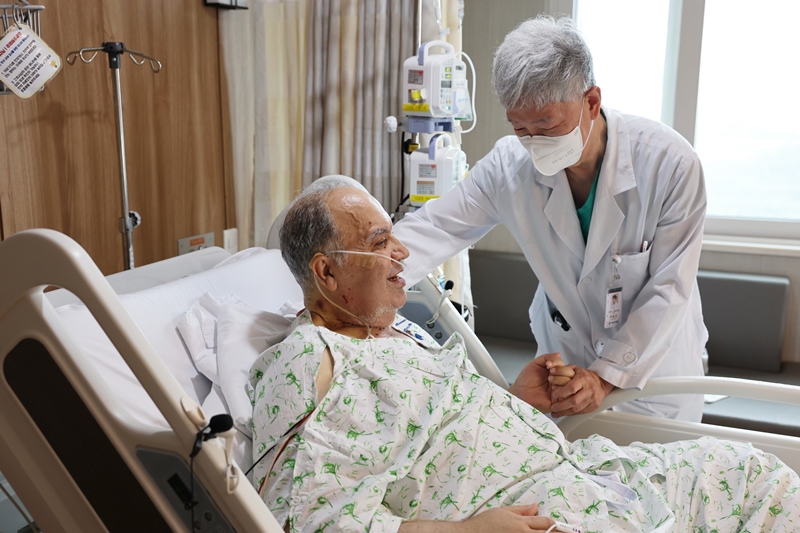
▲ Mohamed expresses his gratitude to Endowed-Chair Professor Sung-Gyu Lee of the Division of Liver Transplantation and Hepatobiliary Surgery at Asan Medical Center, who led his liver transplantation surgery.
Believing that Korea was the only place that could save their father, who was on the brink of death from end stage liver disease and liver cancer, a Moroccan father and his two sons traveled more than 10,000 kilometers for a liver transplantation at Asan Medical Center, where he miraculously regained hope and a new lease on life.
The Liver Transplantation Team at Asan Medical Center recently performed a successful dual living donor liver transplantation for Mohamed El Kettani (64), who was suffering from end stage liver disease and advanced liver cancer. During the procedure, portions of the livers donated by his two sons were transplanted into their father. Both donors and the recipient recovered smoothly after surgery and have since returned to their normal daily lives.
Twenty years ago, while running a major oil refining company in Morocco, Mohamed was diagnosed with hepatitis C. Although antiviral treatment successfully cured the infection a decade later, years of chronic liver disease had already caused irreversible damage, leaving 85 percent of his liver scarred and resulting in liver cirrhosis and liver failure.
He managed to live with the remaining 15 percent of his liver function for years, but his condition deteriorated after the COVID 19 pandemic. Holding dual Moroccan and French citizenship, Mohamed traveled to France in late 2025 to undergo evaluation for liver transplantation. During the assessment, he received another devastating diagnosis: early stage liver cancer.
Mohamed appeared to have overcome the immediate crisis after undergoing transarterial chemoembolization to eliminate the tumor. However, a follow up examination in February revealed a new tumor that had not been detected previously. The second tumor had rapidly grown to 6 cm and had already invaded the portal vein within the liver. His physicians in France concluded that liver transplantation was no longer feasible, and he was removed from the transplantation waiting list.
At that point, Mohamed's two sons took action. Omar El Kettani (30), a cardiac surgeon practicing in France, joined his older brother, Hicham El Kettani (33), in searching for the world's leading liver transplantation centers. With their father's cancer progressing rapidly, waiting for a deceased donor liver was no longer an option. A living donor liver transplantation was their only remaining hope.
After reviewing published research from leading liver transplantation centers around the world, the brothers concluded that Asan Medical Center offered the best chance of saving their father. Since performing its first liver transplantation in 1992, Asan Medical Center became the first single institution in the world to surpass 9,000 liver transplantations in early 2025 and now performs about 500 liver transplantations each year. It is particularly recognized as the global leader in living donor liver transplantation. While France's largest liver transplantation center performs only 20 to 30 living donor liver transplantations annually because it relies primarily on deceased donor transplantation, and the Cleveland Clinic in the United States performs about 30 such procedures each year, Asan Medical Center performs approximately 400 living donor liver transplantations annually.
Despite these results, Mohamed initially refused to travel to Korea, fearing that donating part of their livers might put his sons' lives at risk. His sons, however, would not give up. They reassured him that Asan Medical Center is the world's leading center for living donor liver transplantation and had never experienced a donor death following living liver donation. Convinced by their determination and Asan Medical Center’s outstanding safety record, Mohamed finally agreed, and the three boarded a flight to Korea in early April this year.
At his first appointment at Asan Medical Center, Mohamed received encouraging news from Professor Gi-Won Song of the Division of Liver Transplantation and Hepatobiliary Surgery at Asan Medical Center that a living donor liver transplantation was still possible. He was admitted on April 8 for a comprehensive evaluation.
The assessment, however, revealed multiple challenges. Because his liver cancer had already reached an advanced stage, there was a significant risk of early recurrence even after transplantation, with any recurrence likely to progress rapidly. In addition, Mohamed weighed nearly 135 kg, requiring a liver graft large enough to meet his metabolic demands. This meant that two living donors would be needed, but it remained uncertain whether the combined liver volume from both donors would be sufficient for a patient of his size.
A dual living donor liver transplantation is performed when a liver graft from a single donor would be too small for the recipient or when removing a larger portion of the liver could compromise the donor's safety. The procedure was pioneered in 2000 by Endowed-Chair Professor Sung-Gyu Lee of the Division of Liver Transplantation and Hepatobiliary Surgery at Asan Medical Center. Since then, Asan Medical Center has performed 664 dual living donor liver transplantations for critically ill patients with end stage liver disease and liver cancer, the highest number reported by any institution worldwide.
One additional challenge was that Omar's blood type was incompatible with his father's. However, this posed no obstacle for the transplantation team. Asan Medical Center has performed more than 1,100 ABO incompatible living donor liver transplantations, the highest volume in the world, providing extensive expertise in this highly specialized procedure.
At 8 a.m. on May 22, the lights came on simultaneously in three operating rooms as Mohamed and his two sons were taken into surgery. Nearly 10 medical professionals in each operating room worked in close coordination as the procedures began.
Professors Gi-Won Song and Dong-Hwan Jung of the Division of Liver Transplantation and Hepatobiliary Surgery at Asan Medical Center performed the donor hepatectomies. The older son's left liver lobe was removed through a minimal incision measuring less than 10 cm, while the younger son's right liver lobe was harvested laparoscopically to minimize scarring and reduce the risk of postoperative complications.
Endowed-Chair Professor Sung-Gyu Lee and Professor Deok-Bog Moon then performed Mohamed's liver transplantation. His native liver had become severely shrunken from cirrhosis, and his abdomen contained a large amount of ascitic fluid. Because the hepatocellular carcinoma was suspected to have invaded the portal vein, the surgical team removed the entire liver using a no touch technique, carefully avoiding direct manipulation of the tumor to minimize the risk of cancer cell dissemination.
The liver grafts from Mohamed's two sons were then transplanted. During the procedure, the surgeons found that the space beneath the diaphragm was more limited than anticipated, making it difficult to accommodate the right liver graft. To create sufficient room, they carefully mobilized the right kidney, together with the adrenal gland, slightly downward and forward within the abdominal cavity. This allowed the right liver graft to be positioned securely and also contributed to a smoother postoperative recovery.
The surgery, which began early in the morning, was completed after 2 a.m. the following day, lasting a total of 17 hours. Despite its complexity, all three family members recovered steadily. Mohamed is expected to be discharged next week, marking the successful conclusion of the family's remarkable journey to Korea for lifesaving treatment.
Endowed-Chair Professor Sung-Gyu Lee of the Division of Liver Transplantation and Hepatobiliary Surgery at Asan Medical Center, said, "The fact that this family traveled all the way from Morocco to Korea to save their father reflects the global recognition of Korea's expertise in liver transplantation. We will continue striving to help patients with end stage liver disease and liver cancer from around the world regain their health at Asan Medical Center and return home to begin a new chapter in their lives."
Mohamed said, "Our entire family had almost lost hope as my cancer progressed so rapidly. Thanks to my two sons' determination to bring me to Korea, I came to Asan Medical Center and was given a second chance at life. I believe that medicine without compassion is nothing more than a business. The Liver Transplantation Team at Asan Medical Center cared for me with genuine warmth and never gave up on saving my life. I extend my deepest gratitude and blessings to the medical team for giving our family a new beginning."
His younger son, Omar, said, "During our stay at Asan Medical Center, our family was deeply impressed not only by the hospital's outstanding medical expertise and advanced healthcare system, but also by the genuine compassion shown to every patient. As a cardiac surgeon practicing in France, I now hope to have the opportunity to train at Asan Medical Center someday. Above all, I am grateful that I was able to donate part of my liver to my father and see him regain his health."
ASAN MEDICAL CENTER
BROCHURE DOWNLOAD
Sharing your hope
ASAN MEDICAL CENTER
