


-
- Global AMC MENU
- NEWS
- HEALTH
- PEOPLE
- Introduction


Whenever I walked through the hospital, bustling with patients, I often wondered what kind of pain each person was carrying and what had brought them here.
I was treated for congenital malocclusion and received full financial support for my treatment through Asan Medical Center’s “Sharing Hope Campaign.” This experience changed many aspects of my life.
For much of my life, I struggled to show myself to the world because of my appearance and family circumstances that I wanted to hide. Being able to share my story now is an act of courage and represents a profound change in my life.
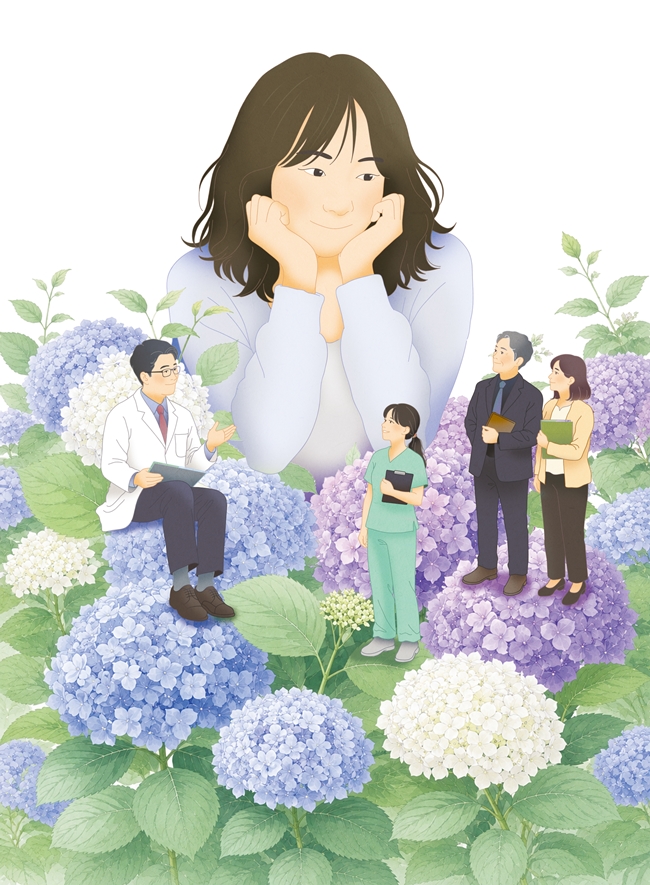
A Secret I Could Never Tell Anyone
A fitting place to begin my story would be one day when I was seven years old. On my first day at a new kindergarten, my father did not come to pick me up, even as night fell. That was when I realized that I was living in a group home for children facing difficult circumstances.
My parents’ divorce, financial hardship, and life in an unfamiliar group home were more than I could comprehend at that age. I was only seven, and it was already difficult enough to bear the fact that my father was not there.
The prayers of a seven-year-old seemed powerless. Fortunately, my twin sister was by my side, and the pastor who oversaw the group home and the social worker cared for us with warmth and dedication. Thanks to them, not every day felt cold and lonely.
Still, whenever my school found out that I lived in a group home, I would transfer to another school, almost as if I were running away. After changing schools several times, I began to build a secret of my own.
Whenever my friends started talking about “food their mothers had made for them,” I would keep my mouth shut. I became frightened whenever someone said, “Let’s go to your house.” I did not want anyone to pity me, so I could not bring myself to tell even my closest friends about my circumstances.
As time passed, I was able to get back in touch with my parents. But I knew that they were not in a position to live with us, so I could not ask for more.
I also carried another source of insecurity. I had been born with severe malocclusion, which caused my face to appear asymmetrical. “Why do you only smile on one side?” was a question I heard repeatedly, often accompanied by teasing.
I felt as though everyone’s eyes were drawn to my mouth and jaw. I would walk with my head down, with my mask resting on my chin.
When I became more conscious of my appearance in middle school, my social worker told me about Asan Medical Center’s “Sharing Hope Campaign,” which provides financial support for surgical treatment to people in need.
Filled with hope that I might finally be able to correct my facial condition, I met with Professor Jong-Woo Choi of the Department of Plastic Surgery at Asan Medical Center. However, I was told that because my bones were still growing, I would need to wait until I became an adult before undergoing treatment.
“But I feel like I’m already grown up…”
I cried all the way home. Adulthood suddenly seemed unbearably far away.
Finding My Place
After entering college, I reached out directly to the Social Work Team at Asan Medical Center. Because of my facial deformity, which I had always considered a lifelong flaw, and because I was living in a group home and receiving basic livelihood assistance, I became eligible for financial support for my treatment.
After a year of orthodontic treatment, I underwent orthognathic surgery.
“Your malocclusion was quite severe. It must have been very difficult for you to chew food normally,” Professor Jong-Woo Choi said.
“I didn’t know it was difficult,” I replied.
It was simply something I had grown accustomed to since childhood. Having someone take a closer look at my life, recognize that what I had considered normal was not, and promise me that things could change was a great source of comfort.
On the day of the surgery I had been waiting for, however, I developed a fever just before I was to be put under anesthesia, and the surgery was canceled. Once again, I had no choice but to wait.
“How nervous were you? This is a surgery I perform all the time, and I’ll take good care of you. Come back next time with a relaxed mind!”
Professor Jong-Woo Choi laughed warmly, then scheduled my surgery for the following month.
Immediately after the surgery, my lips were finally centered on my face. As the swelling went down, I began to feel my molars meeting properly when I chewed. It was unfamiliar, but it was a wonderful feeling.
Professor Jong-Woo Choi showed me photos from before and after the surgery and smiled. “You look like a completely different person now, don’t you?”
The surgery had been scheduled just before a holiday, so my father volunteered to stay with me and care for me instead of the teacher who usually lived with me. Every time he looked at my face, he would exclaim how beautiful I looked. He even brought plenty of snacks to give to the nurses on the ward.
I think I could finally understand how much he must have worried about me all those years whenever he looked at my face.
With this surgery, it felt as though the parts of my everyday life that had been out of place had finally begun to fall back into place.
A Time to Dream of Becoming a Nurse
Of course, living with my teeth fixed in place for two weeks was more difficult than I had expected. I had little energy because I could not eat properly, and I could not even go for a walk. At times, I found myself taking out my frustration on my father, who was caring for me.
Although my hospital stay was not long, becoming a patient taught me how sensitive and vulnerable patients can be and what can make their days difficult.
“I must never forget how patients feel when I become a nurse.”
As I was nearing graduation from nursing school, this was a truly valuable experience. At the same time, I watched the nurses closely and imagined myself in their place one day.
At every shift change, they came to my room, greeted me, and checked my IV line and medications. When I was discharged, one of the nurses made sure I had the facial support bands I needed and warmly encouraged me, saying, “You were so brave. You did so well.”
Her kindness reminded me of the warmth of a mother I had imagined all my life.
In fact, becoming a nurse was not my dream from the beginning. During my school years, I fell in love with dance, which gave me a way to express myself freely, and prepared to pursue it as my college major. But I did not achieve the result I had hoped for.
As an alternative, I entered nursing school. Yet whenever I watched a dance performance, the dream I had never fulfilled continued to linger in my heart.
After barely making it through my first year, I decided to drop out. The pastor, however, persuaded me to stay, telling me that it would not be too late to pursue what I truly wanted after graduating from college.
It was not until my third year, when I began my clinical training, that I finally discovered an interest in nursing. I felt a sense of joy in knowing that there were things I could do to help patients.
After undergoing surgery and spending time at Asan Medical Center, I found myself wanting even more to become a skilled and compassionate nurse.
As I prepare to enter the workforce, I am realizing just how difficult it is to become a nurse at Asan Medical Center. I hope to gain valuable experience at another hospital and one day return here, not as a patient, but as an experienced nurse.
I wonder if, when we sincerely wish for something, a meaningful connection born of gratitude can somehow find its way back to us.
Another Wish
There is one more thing I hope to do when I become a nurse. I want to help connect patients who, like me, find themselves in overwhelming circumstances with the various sources of support available to them.
For those who have had to start from far behind others, simply finding out what opportunities are available in the world can feel like a challenge in itself.
I have been fortunate to have people around me who helped ensure that what I lacked did not become lasting disadvantages. My twin sister and friends would reassure me whenever I asked, “Does my face look really crooked?” They would respond with genuine surprise and tell me that it did not look that way at all.
The pastor and social workers allowed me to remain at the group home until I became an adult and was able to support myself financially, while actively seeking information about treatment assistance. Asan Medical Center also stood by me, providing access to treatment regardless of my circumstances and the highest level of medical care.
Thanks to them, I have been able to come to terms with the circumstances I was given in the past and imagine the future I can create for myself.
Now, with a deep sense of gratitude and responsibility, I am ready to take my first step into the world of healthcare.
ASAN MEDICAL CENTER
BROCHURE DOWNLOAD
Sharing your hope
ASAN MEDICAL CENTER
