


-
- Global AMC MENU
- NEWS
- HEALTH
- PEOPLE
- Introduction


Professor Seung-Jae Myung’s Team at Asan Medical Center Selected for 2026 Korea-U.S. Innovation and Achievement R&D Program
New Radiopharmaceutical Therapy Targeting Both Cancer Cells and the Tumor Microenvironment Offers Hope for Treating Treatment Resistant Solid Tumors
Building an Integrated System Linking Radiopharmaceutical Development with AI Based Patient Stratification and Treatment Response Prediction
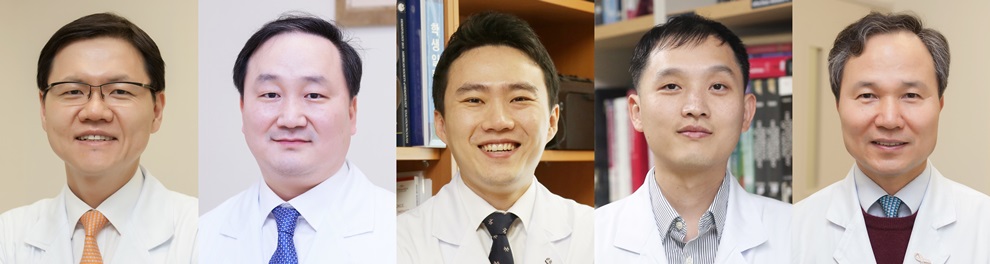
▲ (From left) Professors Seung-Jae Myung of the Division of Gastroenterology, Seung Jun Oh of the Department of Nuclear Medicine, Changhoon Yoo of the Division of Oncology, Byung-Kwan Jeong of the Department of Pathology, and Byung Ho Son of the Division of Breast Surgery at Asan Medical Center
Asan Medical Center and U.S. researchers are joining forces to develop a new treatment strategy for solid tumors that have shown limited response to conventional therapies by combining next generation radiopharmaceutical technology with artificial intelligence (AI) based precision medicine.
A research team led by Professors Seung-Jae Myung of the Division of Gastroenterology, Seung Jun Oh of the Department of Nuclear Medicine, Changhoon Yoo of the Division of Oncology, Byung-Kwan Jeong of the Department of Pathology, and Byung Ho Son of the Division of Breast Surgery at Asan Medical Center has been selected for the 2026 Korea U.S. Innovation and Achievement R&D Program for Research Centered Hospitals, organized by the Ministry of Health and Welfare. The team will develop an AI based radiopharmaceutical therapy platform aimed at overcoming treatment resistant solid tumors.
The Research Centered Hospital Korea U.S. Innovation and Achievement R&D Program is a national R&D initiative that supports joint research between Korean researches centered hospitals and leading U.S. research institutions to secure advanced medical technologies and generate global research outcomes, including international patents, clinical studies and technology commercialization.
The project will combine Asan Medical Center’s large-scale clinical and pathology datasets with AI based digital pathology analysis technology from Emory University and pathology and clinical research expertise from Case Western Reserve University and University Hospitals Cleveland Medical Center. Through this collaboration, the team aims to establish a precision medicine system spanning the entire process from therapeutic development to patient selection and treatment response prediction.
Asan Medical Center plans to leverage this project to expand its research capabilities in next-generation radiopharmaceuticals and AI based precision oncology, while establishing itself as a global hub for collaborative research.
Solid tumors, such as gastric, colorectal, pancreatic and breast cancers, form complex tumor microenvironments in which cancer cells interact with surrounding fibroblasts, immune cells and blood vessels.
In particular, a fibrotic tumor microenvironment can prevent therapeutic agents from reaching cancer cells and contribute to treatment resistance. As a result, treatment resistant solid tumors that do not respond adequately to conventional anticancer therapies have limited treatment options and remain challenging to treat.
This research to overcome treatment resistant solid tumors will proceed along two main tracks. The first, Composite Targeted Radiopharmaceutical Therapy for Cancer Resistance (C-TRACER), aims to develop radiopharmaceutical therapies that simultaneously target cancer cells and the tumor microenvironment. The second, Cancer AI Treatment Companion (CATCH), uses AI to analyze diverse patient data, including digital pathology images and spatial omics data, to identify patients most likely to benefit from treatment and predict treatment response.
The composite targeted radiopharmaceutical therapy approach focuses on CLDN18.2, a protein predominantly expressed in cancer cells, and LRRC15, which is elevated in components of the tumor microenvironment, including cancer-associated fibroblasts (CAFs). Based on these targets, the research team will develop candidate radiopharmaceutical therapies using therapeutic radioisotopes and evaluate their tumor-targeting ability, therapeutic efficacy and safety.
The AI based companion diagnostic technology will integrate and analyze digital pathology images, spatial omics data mapping the distribution of genes and proteins within cancer tissue, patient clinical information and preclinical treatment results. The goal is to quantitatively assess target expression and characteristics of the tumor microenvironment, identify patients most likely to benefit from radiopharmaceutical therapy and predict treatment response.
By integrating these two technologies, from radiopharmaceutical development to AI based patient stratification and treatment response prediction, the research aims to establish an end-to-end platform that improves the efficiency of clinical development while reducing development risks. Professor Seung-Jae Myung of the Division of Gastroenterology at Asan Medical Center will serve as the principal investigator, with several Korean companies, including Dong-A ST, Genuinus and Addis Biotech, participating in the project.
Professor Seung-Jae Myung of the Division of Gastroenterology at Asan Medical Center said, “What sets this research apart is that it goes beyond developing new radiopharmaceuticals to also predicting, using AI, which patients are most likely to benefit from the treatment. By combining a novel therapeutic approach that targets not only cancer cells but also the tumor microenvironment with precise patient selection technology, we hope to offer new treatment opportunities for patients with solid tumors who have limited therapeutic options.”
ASAN MEDICAL CENTER
BROCHURE DOWNLOAD
Sharing your hope
ASAN MEDICAL CENTER
