


-
- Global AMC MENU
- NEWS
- HEALTH
- PEOPLE
- Introduction


Asan Medical Center Professors Jeong-Sik Byeon and Seung Wook Hong Use AI to Detect Colorectal Cancer from DNA in Blood, Achieving 90% Sensitivity
“Reducing the Burden of Conventional Screening Procedures, Such as Bowel Preparation, with Early Detection Expected to Improve Survival Rates”
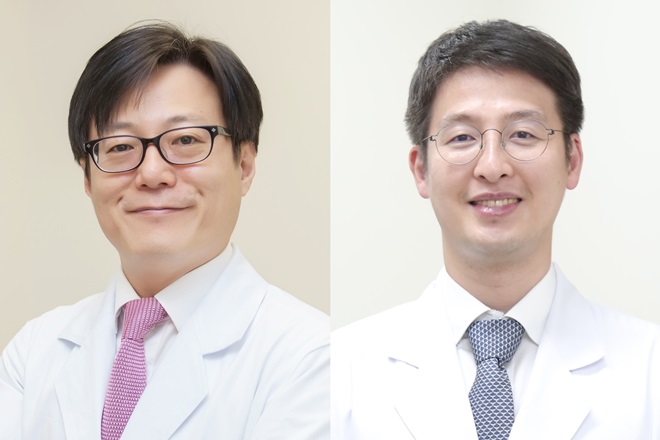
▲ (From left) A research team led by Professors Jeong-Sik Byeon and Seung Wook Hong of the Division of Gastroenterology at Asan Medical Center
Colorectal cancer is the third most common cancer in Korea. Although the survival rate exceeds 95% when the disease is detected early, some cases are diagnosed at a later stage due to the inconvenience associated with conventional colorectal cancer screening procedures.
Recently, a Korean research team reported that a blood based test for colorectal cancer demonstrated a high level of accuracy. The findings raise the possibility of early detection through a simple blood test, eliminating the need for inconvenient procedures such as stool sample collection or bowel preparation before screening
A research team led by Professors Jeong-Sik Byeon and Seung Wook Hong of the Division of Gastroenterology at Asan Medical Center analyzed more than 1,000 patients with colorectal cancer and healthy controls using an AI based cell free DNA blood test, achieving a diagnostic sensitivity of 90.4%.
The cell free DNA blood test analyzes the characteristics of cell free DNA derived from cancer cells circulating in the blood to screen for the possibility of cancer. The test is gaining attention as a new paradigm in cancer diagnosis. Its diagnostic accuracy was also found to be superior to that of the conventional fecal occult blood test, which has a sensitivity of approximately 70 to 80% for colorectal cancer screening.
The findings were recently published in the American Journal of Gastroenterology (impact factor: 8.5), an international journal published by the American College of Gastroenterology.
Under Korea’s national cancer screening program, colorectal cancer screening primarily relies on the fecal occult blood test, which requires the collection of a stool sample. Individuals with positive results are recommended to undergo a colonoscopy as a follow up examination.
However, according to the National Health Insurance Service, the colorectal cancer screening participation rate is 44.4%, the lowest among the major cancer types. The fecal occult blood test requires individuals to collect stool samples themselves, while colonoscopy requires thorough bowel preparation before the procedure, making both examinations burdensome for many people. In addition, the proportion of individuals with positive fecal occult blood test results who proceed to colonoscopy remains relatively low.
The research team, in collaboration with GC Genome, a company specializing in liquid biopsy and clinical genomic analysis, analyzed the diagnostic results of 1,677 individuals, including 302 patients with colorectal cancer, 108 patients with advanced colorectal polyps, and 1,267 healthy controls, using a cell free DNA blood test.
The researchers collected blood samples and extracted cell free DNA, which was then analyzed using next generation sequencing (NGS). They subsequently used an artificial intelligence deep learning model to analyze characteristics including DNA fragment length, end structure, and genomic distribution. Since cancer derived cell free DNA differs from that of normal cells in terms of fragment length, cleavage sites, and end structures, these characteristics can be analyzed to predict the presence of cancer using a blood sample alone.
The test achieved a sensitivity of 90.4% for colorectal cancer detection. In other words, it accurately identified approximately nine out of 10 colorectal cancer patients, demonstrating a higher detection rate than the conventional fecal occult blood test, which has a sensitivity of approximately 70 to 80%.
In addition, the cell free DNA blood test demonstrated a specificity of 94.7% among healthy controls, correctly identifying 95 out of 100 healthy individuals as cancer free. Analysis by colorectal cancer stage showed sensitivities of 84.2% for stage I, 85.0% for stage II, 94.4% for stage III, and 100% for stage IV, indicating that the test maintained high diagnostic performance even in early stage colorectal cancer.
The test also detected early stage colorectal cancer, which can be treated endoscopically, with a sensitivity of 90%. For advanced colorectal polyps, which are precancerous lesions that can progress to colorectal cancer, the test achieved a sensitivity of 58.3%, demonstrating its potential for early screening to help prevent colorectal cancer. This compares with a sensitivity of only 25 to 40% for conventional fecal occult blood tests in detecting advanced colorectal polyps.
Director Jeong-Sik Byeon of the Digestive Endoscopy Center (Professor of the Division of Gastroenterology) at Asan Medical Center said, “The findings of this study suggest the possibility of reducing the burden associated with conventional screening procedures and conveniently screening for colorectal cancer through a blood test alone. In particular, as demonstrated by this study, which improved the accuracy of blood based testing through an AI deep learning model, AI technology is expected to be usefully applied across various areas of medicine in the future.”
He added, “As the incidence of colorectal cancer is increasing among people in their 20s to 40s, who are younger than the current national colorectal cancer screening target age of 50, combining the convenience of blood based diagnosis with AI technology could make colorectal cancer screening more accessible. If colorectal cancer is detected early, it can be treated with endoscopic resection, a minimally invasive procedure, which is expected to contribute to improved survival rates and quality of life after treatment.”
Meanwhile, a research team led by Professors Jeong-Sik Byeon, Dong-Hoon Yang, and Seung Wook Hong of the Division of Gastroenterology at Asan Medical Center is actively conducting collaborative research on the application of artificial intelligence in medicine with Professor Namkug Kim’s team in the Department of Convergence Medicine at Asan Medical Center.
Recently, the teams developed an AI based method to determine whether endoscopic treatment or surgical resection would be more appropriate for patients with early colorectal cancer. The findings were published in the international journal Gut and Liver (impact factor: 4.1).
ASAN MEDICAL CENTER
BROCHURE DOWNLOAD
Sharing your hope
ASAN MEDICAL CENTER
