


-
- Global AMC MENU
- NEWS
- HEALTH
- PEOPLE
- Introduction


Patients with Chronic Otitis Media Achieve Excellent Cochlear Implant Outcomes Comparable to Those with Typical Hearing Loss
Language and Cognitive Function Preserved Despite Long Term Hearing Loss in Patients with Otitis Media; Presence of Labyrinthitis Determines Surgical Prognosis
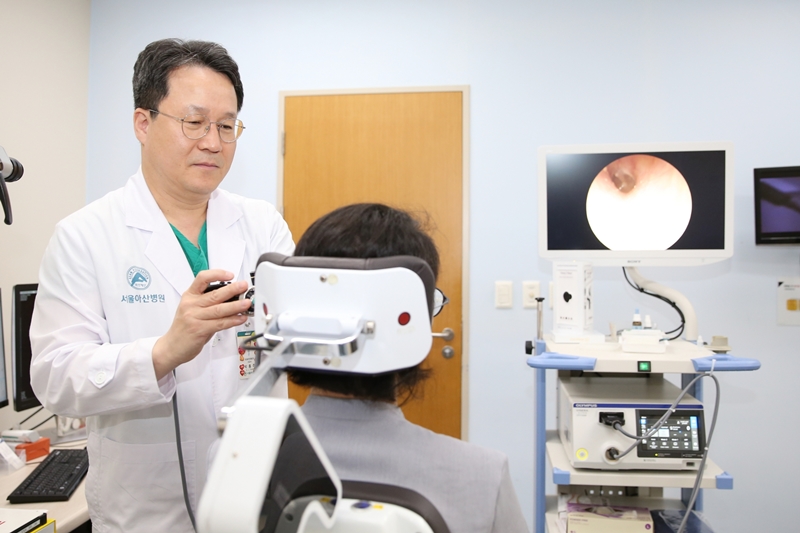
▲ Professor Hong Ju Park of the Department of Otorhinolaryngology-Head and Neck Surgery at Asan Medical Center examines a patient with hearing loss.
A recent study has found that patients with chronic otitis media can regain their hearing through cochlear implantation, even after having untreated hearing loss for more than 20 years, despite experiencing hearing loss for an extended period and receiving limited benefit from hearing aids.
A research team led by Professor Hong Ju Park of the Department of Otorhinolaryngology-Head and Neck Surgery at Asan Medical Center compared hearing outcomes after cochlear implantation in patients with acquired chronic otitis media and those with typical sensorineural hearing loss. The results showed that one year after surgery, the patients with chronic otitis media achieved hearing outcomes comparable to those of patients with typical sensorineural hearing loss.
In particular, even patients with chronic otitis media who had experienced hearing loss for more than 20 years maintained stable word recognition ability without a decline in their ability to clearly understand words.
Otitis media refers to inflammation of the middle ear. It can impair hearing, the ear’s primary function, and interfere with communication. Recurrent otitis media over a long period can also cause sensorineural hearing loss, further worsening hearing impairment. When hearing loss persists, the cerebral cortex responsible for hearing, language acquisition, and speech production can shrink, leading to a decline in cognitive function and potentially progressing to dementia.
When hearing loss develops due to otitis media, prompt treatment is necessary, and hearing can sometimes be improved through surgery to treat the otitis media. However, if early treatment is missed, sensorineural hearing loss may develop, eventually requiring hearing aids to hear or even reaching a point where hearing aids no longer provide sufficient benefit.
In such cases, the remaining option is cochlear implantation. However, cochlear implantation has traditionally been performed only selectively in patients with chronic otitis media because chronic inflammation or anatomical changes in the middle ear and mastoid, the air-filled space within the bone behind the ear, can increase the risk of complications such as infection and electrode extrusion during surgery.
The research team led by Professor Hong Ju Park of the Department of Otorhinolaryngology-Head and Neck Surgery at Asan Medical Center completely removed the inflammation and filled the middle ear cavity with a fat graft. Cochlear implantation was then performed, effectively restoring the patients’ hearing.
The team subsequently compared and analyzed preoperative and postoperative hearing and imaging findings in 33 patients with acquired chronic otitis media who underwent cochlear implantation between July 2006 and July 2021 and 70 age and sex matched patients with noninflammatory sensorineural hearing loss.
The results showed that one year after surgery, the patients with chronic otitis media achieved overall hearing outcomes, including word recognition scores and pure tone hearing thresholds, that were comparable to those of patients with typical sensorineural hearing loss.
The most notable finding was the difference in outcomes depending on the duration of hearing loss. Among patients with typical sensorineural hearing loss, word recognition scores tended to decline sharply after cochlear implantation when the duration of hearing loss exceeded 20 years. In contrast, patients with chronic otitis media maintained stable word recognition scores even after experiencing hearing loss for more than 20 years. The research team suggested that residual bone conduction hearing in patients with chronic otitis media may have continuously stimulated the auditory system, helping preserve the auditory pathways and neural function.
However, preoperative magnetic resonance imaging (MRI) showed that 9.1% of patients with chronic otitis media had concomitant labyrinthitis. Patients with labyrinthitis had significantly lower word recognition scores after cochlear implantation than other patients. This finding demonstrates that the presence or absence of labyrinthitis is an important predictor of prognosis following cochlear implantation.
Professor Hong Ju Park of the Department of Otorhinolaryngology-Head and Neck Surgery at Asan Medical Center said, “This study suggests that even patients who have experienced long-term hearing loss due to chronic otitis media and no longer benefit from hearing aids can successfully regain their hearing through cochlear implantation. For successful cochlear implantation, it is important to conduct detailed imaging examinations, including preoperative MRI, to determine whether labyrinthitis is present and establish an optimal treatment plan.”
He also emphasized, “There are various treatment options for hearing loss, and the earlier it is treated, the more effectively it can be overcome. With recent advances in science and technology, auditory rehabilitation is now possible through various methods for most patients, regardless of the severity of their hearing loss. Treating hearing loss can improve quality of life by facilitating social activities, reducing depression, and improving cognitive function. It is important to identify the exact cause of hearing loss and provide active auditory rehabilitation tailored to each patient.”
The findings were published in the latest issue of Ear, Nose & Throat Journal, an international journal in the field of otorhinolaryngology.
ASAN MEDICAL CENTER
BROCHURE DOWNLOAD
Sharing your hope
ASAN MEDICAL CENTER
