


-
- Global AMC MENU
- NEWS
- HEALTH
- PEOPLE
- Introduction


Asan Medical Center and the Korea National Institute of Health Launch Study to Identify More Than 700 Rare Genetic Diseases in Newborns
Six Korean Hospitals to Enroll 1,800 Newborns by 2028 to Establish a Korean Newborn Screening System
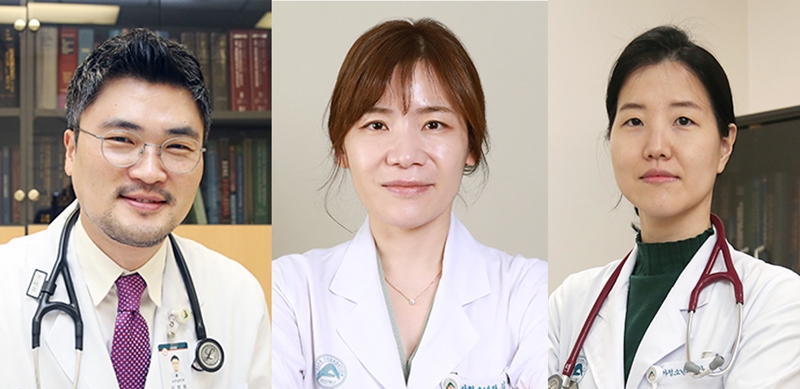
▲ (From left) Professors Beom Hee Lee, Ja Hye Kim and Soojin Hwang of the Medical Genetics Center at Asan Medical Center
Recent advances in genomic analysis technology have increased the need for whole genome sequencing, which analyzes all genetic information to screen for a broader range of rare genetic diseases at once. Against this backdrop, Asan Medical Center has launched an initiative with the Korea National Institute of Health to establish a genomic screening system for newborns.
A research team led by Professors Beom Hee Lee, Ja Hye Kim and Soojin Hwang of the Medical Genetics Center at Asan Medical Center, in collaboration with the Korea National Institute of Health, announced that it began actively recruiting participants in August for the “AGIJIGI” project, which aims to protect newborns’ health through genomic screening. The project seeks to enable early detection of rare genetic diseases and establish a proactive health management system.
Rare genetic diseases can have significantly different treatment outcomes and prognoses when detected early, before symptoms appear. However, conventional screening tests have been limited to specific diseases.
The AGIJIGI (Advanced Genomic Initiative for Just-born Infants Guiding Informed Care) project conducts whole genome sequencing for healthy newborns within 28 days of birth. It is a national public health initiative that aims to detect and treat genetic diseases at an early stage while evaluating the clinical utility of genome based newborn screening.
Since April, the research team has completed a series of preparations, including establishing a multidisciplinary consultative body, obtaining approval from the Institutional Review Board (IRB), and developing systems for participant recruitment and genetic counseling. The team began recruiting newborn participants in August. A total of 1,800 newborns will be recruited by 2028, starting with 500 participants in the first year of the project.
The project involves six hospitals across Korea, including Asan Medical Center, the lead research institution, Samsung Medical Center, Severance Hospital, CHA Bundang Medical Center, Chungnam National University Sejong Hospital (CNU) and Pusan National University Yangsan Hospital. The project team is currently promoting participant recruitment and providing educational information through the project website (www.kgnbs.kr).
Currently, newborn screening in Korea is limited to screening for about 50 types of inherited metabolic disorders, six lysosomal storage disorders and hearing loss. In contrast, major countries including the United States, the United Kingdom and European countries are actively conducting various projects to evaluate the clinical utility of whole genome sequencing for newborn screening, while discussions are underway on its implementation worldwide.
In Korea, the Korea National Institute of Health established a framework for the Korean Genome based Newborn Screening (K-gNBS) research program through a pilot project in 2025. The project identified 647 essential and 136 optional diseases and genes for newborn screening and developed a patient consent system and clinical guidelines.
Building on the results of the pilot project, this study will evaluate the diagnostic efficiency and clinical and economic utility of genome based newborn screening to establish evidence for its potential adoption as a national policy.
Professor Beom Hee Lee of the Medical Genetics Center at Asan Medical Center, the principal investigator of the study, said, “Whole genome sequencing based newborn screening represents a new medical paradigm that enables early detection of rare genetic diseases that can be treated before symptoms appear, allowing treatment to begin at the appropriate time. Through this study, we plan to establish a Korean newborn genomic screening system.”
ASAN MEDICAL CENTER
BROCHURE DOWNLOAD
Sharing your hope
ASAN MEDICAL CENTER
