


-
- Global AMC MENU
- NEWS
- HEALTH
- PEOPLE
- Introduction


Microsurgical Reconstruction Helps Cancer Patients Regain the Ability to Speak, Swallow and Return to Daily Life
More Than 130 Procedures Performed Annually Over the Past Five Years, Fourfold Increase Since the 2000s… 97% Surgical Success Rate
Professor Jong Woo Choi: “This Milestone Was Made Possible by Teamwork Among Specialists in Otorhinolaryngology, Medical Oncology, Radiation Oncology, Rehabilitation Medicine and Dentistry”
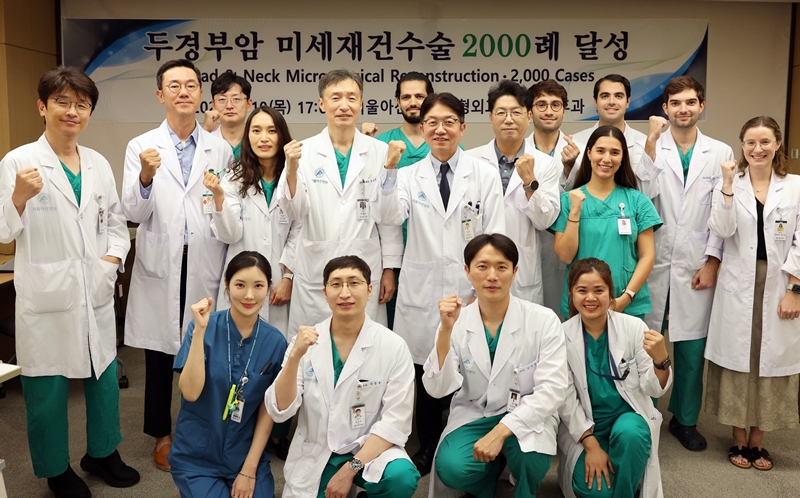
▲ Medical staff, including Professor Seung-Ho Choi of the Department of Otorhinolaryngology-Head and Neck Surgery and Professor Jong Woo Choi of the Department of Plastic Surgery at Asan Medical Center (fourth and fifth from left in the back row), pose for a commemorative photo at a ceremony held on September 10 to celebrate 2,000 microsurgical reconstruction procedures for head and neck cancer.
Last April, Mr. Song, a 50-year-old man, underwent a total glossectomy to treat oral cancer. While removing the cancer itself was a major surgery, reconstructive surgery was essential to precisely restore the resected tissue and preserve his ability to speak and swallow as much as possible after surgery.
The Head and Neck Reconstructive Surgery Team in the Department of Plastic Surgery at Asan Medical Center transplanted an anterolateral thigh (ALT) free flap, consisting of skin, soft tissue, blood vessels and nerves harvested from Mr. Song’s thigh, along with the gracilis muscle, to the area of the defect. The highly complex procedure involved using a microscope to connect blood vessels measuring only 1 to 2 mm in diameter, restoring blood flow to the transplanted tissue.
The surgery was successfully completed, and after a period of recovery and rehabilitation, Mr. Song regained his ability to speak and swallow and was able to return to his daily life.
A team of Professors Jong Woo Choi, Tae-Suk Oh, Woo Shik Jeong and Young Chul Kim in the Department of Plastic Surgery at Asan Medical Center has become the first in Korea to perform 2,000 microsurgical reconstruction procedures for head and neck cancer. The team first began performing the procedures in 1996 and reached 1,000 cases in 2019. It has since performed another 1,000 procedures in just seven years.
The Head and Neck Reconstructive Surgery Team in the Department of Plastic Surgery at Asan Medical Center has increased the annual number of microsurgical reconstruction procedures for head and neck cancer more than fourfold, from approximately 30 cases per year in the 2000s to more than 130 cases annually over the past five years. This achievement was made possible by a multidisciplinary care system supported by close collaboration among multiple departments, including the Department of Plastic Surgery and the Head and Neck Cancer Team in the Department of Otorhinolaryngology Head and Neck Surgery, as well as extensive experience accumulated through years of performing highly complex surgeries.
Head and neck cancer is a collective term for cancers that develop in various areas of the head and neck, including the oral cavity, pharynx, larynx, maxilla and mandible. Prognosis varies significantly depending on the location and stage of the cancer. In particular, advanced head and neck cancer is a serious disease that is difficult to treat and is associated with a significantly lower survival rate.
In the treatment of head and neck cancer, completely removing the cancer is important, but so is reconstructing the resected tissue to restore the patient’s function and quality of life. During cancer removal, substantial portions of the tongue, oral cavity, pharynx, larynx, maxilla or mandible often need to be removed. Without appropriate reconstruction, patients may experience severe difficulties with basic functions such as speaking and swallowing, as well as significant changes in the appearance of the face and neck.
Microsurgical head and neck reconstruction using free flaps provides these patients with a foundation to regain their ability to speak, swallow and return to daily life. In this highly complex procedure, tissue such as skin, muscle or bone is harvested along with its blood vessels from areas such as the patient’s thigh, arm, abdomen or calf and transferred to the site where the cancer was removed. Using a microscope, surgeons then connect tiny arteries and veins measuring approximately 1 to 2 mm in diameter to restore blood flow to the transplanted tissue.
In particular, Professor Jong Woo Choi’s team is the first in the world to perform not only soft tissue reconstruction but also functional muscle transplantation to dynamically restore tongue movement, thereby minimizing patients’ difficulties with swallowing.
Head and neck cancer surgery often involves the Head and Neck Cancer Team in the Department of Otorhinolaryngology Head and Neck Surgery spending approximately five to six hours removing the cancer and cervical lymph nodes, followed by the Plastic Surgery Reconstructive Team taking over and performing reconstruction for another five to six hours or more. Close collaboration among specialists from multiple departments is therefore essential. In addition, reconstructing the complex three-dimensional anatomy inside the oral cavity and meticulously suturing the surgical site to prevent saliva from leaking require a high level of surgical expertise.
The Head and Neck Reconstructive Surgery Team in the Department of Plastic Surgery at Asan Medical Center maintains a high success rate of approximately 97% in these highly complex microsurgical free flap reconstruction procedures. Precise reconstruction enables aggressive cancer treatment even when extensive tissue resection is required. It also plays an important role in helping patients return to their daily lives by restoring essential functions such as eating and communication after surgery.
Professor Jong Woo Choi of the Department of Plastic Surgery at Asan Medical Center said, “Microsurgical reconstruction for head and neck cancer involves delicate work on tiny blood vessels and is a highly complex procedure that continues for many hours immediately after cancer removal surgery. In some cases, if complications arise in the transplanted tissue after surgery, surgeons may need to return to the hospital even in the early hours of the morning for emergency surgery. Nevertheless, being able to see patients regain their ability to speak and swallow and return to their daily lives makes this one of the most rewarding fields of plastic surgery.”
He added, “Treatment and reconstruction for head and neck cancer can never be completed by a single physician. Reaching 2,000 cases was possible because of the teamwork that has been built over many years among specialists in various fields, including the Head and Neck Cancer Team in the Department of Otorhinolaryngology Head and Neck Surgery, as well as Plastic Surgery, Medical Oncology, Radiation Oncology, Rehabilitation Medicine, Dentistry and nursing. Going forward, we will continue our efforts not only to treat the cancer itself but also to help patients regain as much normal function and quality of life as possible.”
ASAN MEDICAL CENTER
BROCHURE DOWNLOAD
Sharing your hope
ASAN MEDICAL CENTER
