


-
- Global AMC MENU
- NEWS
- RESEARCH
- PEOPLE
- Introduction


The latest technologies and applications of AI medical imaging biomarkers, from drug development to clinical trials, were shared on October 1
Asan Image Metrics, Korea’s first specialized organization for imaging assessment established in 2017, provides systematic management and analysis of medical imaging data.
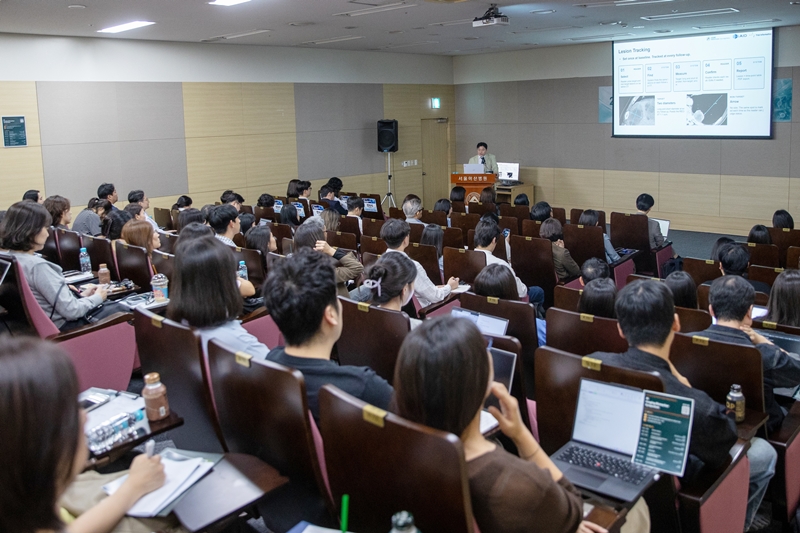
▲ Professor Kyung Won Kim of the Department of Radiology at Asan Medical Center introduces AI medical imaging technologies at the “AI Medical Imaging Biomarkers 2026” symposium held on October 1 at the Asan Institute for Life Sciences.
Asan Medical Center’s Asan Image Metrics (AIM) under the Clinical Trial Center held the “AI Medical Imaging Biomarkers 2026” symposium on October 1 at the Auditorium of the Asan Institute for Life Sciences.
The symposium was organized to share the latest technologies and real world applications of AI medical imaging biomarkers, which transform information obtained from individual pixels in medical images into objective clinical evidence, and to discuss their future applications in drug development and clinical trials.
Medical images such as CT, MRI and PET are important sources of data in clinical trials for assessing disease progression and treatment response. Recently, AI has been increasingly used to quantitatively analyze vast amounts of imaging data, enabling researchers to quantify changes that may be difficult to identify through conventional visual interpretation alone and explore their use as biomarkers for evaluating the efficacy of new drugs and patient prognosis.
For AI medical imaging biomarkers to be effectively used in clinical trials, it is essential not only to develop accurate image analysis technologies but also to standardize image acquisition, quality control and analysis methods and establish objective evidence to ensure consistent results across different medical institutions and imaging equipment.
At the symposium, experts from various fields introduced, through a range of real world cases, the processes needed to advance AI medical imaging technologies beyond the research and development stage and into actual drug development, clinical trials and clinical practice.
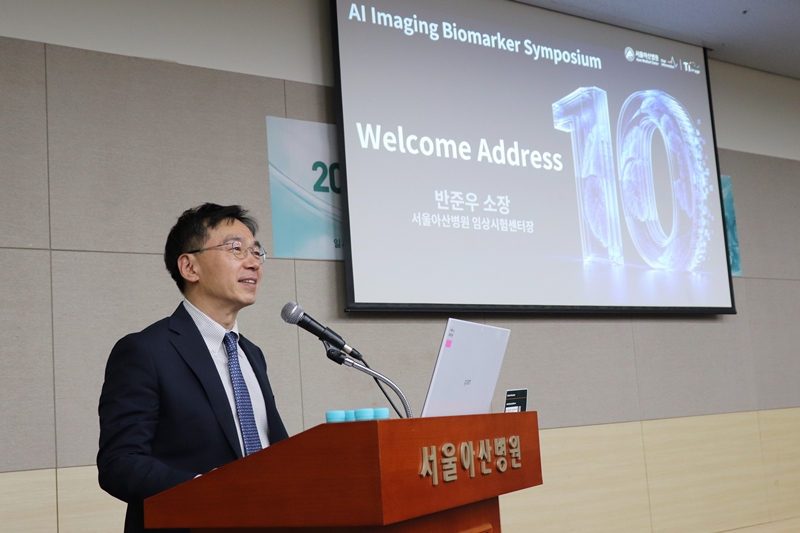
▲ Director Joonwoo Bahn of the Clinical Trial Center at Asan Medical Center delivers welcoming remarks at the “AI Medical Imaging Biomarkers 2026” symposium held on October 1 at the Asan Institute for Life Sciences.
The event began with welcoming remarks by the Director Joonwoo Bahn of the Clinical Trial Center at Asan Medical Center, followed by opening remarks from Professor Seong Ho Park of the Department of Radiology at Asan Medical Center.
In the first presentation, Sinae Kim, Unit Manager at the Clinical Trial Center of Asan Medical Center, introduced how AI based medical imaging analysis technologies can be applied throughout the drug development process under the topic “AI Applications in Drug Development: Case of the First Medical Imaging AI Tool Recognized by the FDA.”
The following technology showcase session focused on AI medical imaging technologies being developed across various disease areas and their potential applications.
Professor Kyung Won Kim of the Department of Radiology at Asan Medical Center introduced AI medical imaging technologies in oncology, while Professor Chong Hyun Suh of the Department of Radiology at Harvard Medical School shared the latest AI based medical imaging analysis technologies and research trends in neurological diseases.
Next, Professor Seongwon Na of the University of Ulsan College of Medicine introduced AI medical imaging technologies being applied across various diseases and presented the potential for expanding medical imaging based AI technologies.
In the final session, Jisung Jang of Trial Informatics shared the processes and key considerations required to translate AI medical imaging biomarkers developed at the research stage into actual clinical practice and clinical trials under the topic “Application of AI Medical Imaging Biomarkers in Clinical Practice and Clinical Trials.”
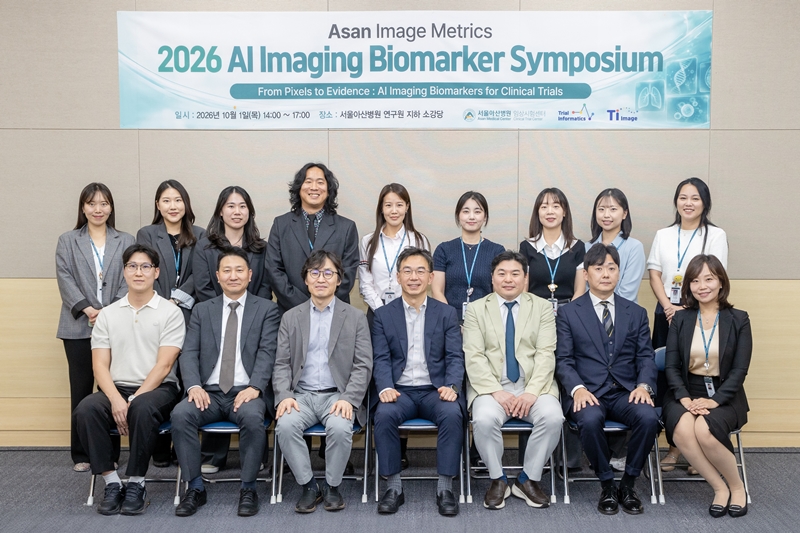
▲ Officials and participants of the “AI Medical Imaging Biomarkers 2026” symposium held on October 1 at the Asan Institute for Life Sciences pose for a commemorative photo.
Following the presentations, a panel discussion was held with the speakers and participants. They exchanged views on the technical and clinical challenges that need to be addressed to expand the use of AI medical imaging biomarkers in clinical trials, as well as their future development, bringing the symposium to a close.
Director Joonwoo Bahn of the Clinical Trial Center at Asan Medical Center, said, “With advances in AI technology, medical imaging is evolving beyond a means of identifying disease into an important source of clinical trial data that can objectively measure treatment efficacy and changes in patients.”
He added, “This symposium was meaningful in that it went beyond introducing AI technologies and provided an opportunity to discuss what is needed for medical imaging AI technologies to serve as reliable assessment tools in actual drug development and clinical trials.”
Asan Image Metrics (AIM) of the Clinical Trial Center at Asan Medical Center, which hosted the symposium, is a specialized organization that provides systematic management and analysis of medical imaging data for clinical trials. Since its establishment in 2017, AIM has supported new drug development and clinical research by specializing in imaging related activities, including image acquisition, quality control, analysis and assessment, to facilitate the use of medical imaging data in clinical trials.
AIM is also continuing research to standardize and advance imaging assessment methods. Recently, it presented a study on imaging based body composition analysis that precisely evaluates the effects of obesity treatments by measuring changes in body fat and muscle mass using CT and MRI. Going forward, AIM plans to continue research on the development of AI based medical imaging biomarkers and their application in clinical trials.
ASAN MEDICAL CENTER
BROCHURE DOWNLOAD
Sharing your hope
ASAN MEDICAL CENTER
