


-
- Global AMC MENU
- NEWS
- RESEARCH
- PEOPLE
- Introduction


AI Accuracy Varies by Skin Tone; New Technology Darkens Skin Tone While Preserving Lesions in Images of Light Skin
AI Generated and Real Photos Difficult to Distinguish; Training on AI Generated Images of Darker Skin Improves Diagnostic Performance
Asan Medical Center Research Team Uses AI to Address Data Gaps in Darker Skin Tones and Reduce Skin Tone Related Performance Disparities
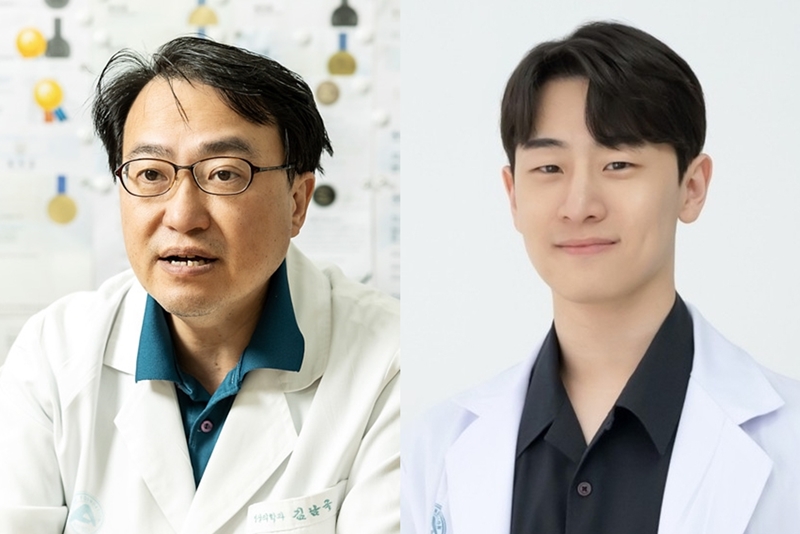
▲ Professor Namkug Kim of the Department of Convergence Medicine and Dermatology Resident Gyeonghoon Kim at Asan Medical Center.
Artificial intelligence (AI) is increasingly being used in research across various medical fields. In some areas, AI systems for diagnosing skin diseases have demonstrated performance comparable to that of dermatologists. However, concerns have been raised that diagnostic accuracy may vary depending on patients’ skin tones and racial backgrounds.
A research team led by Professor Namkug Kim of the Department of Convergence Medicine, Dermatology Resident Gyeonghoon Kim, and Ik Jun Moon, a dermatologist and former professor at Asan Medical Center, has developed a generative AI technology that darkens the skin tone of images of patients with light skin while preserving the appearance of their skin lesions.
The AI generated images were highly realistic and closely resembled actual photographs. When these images of darker skin tones were used to train AI models, diagnostic performance for skin diseases improved significantly. The findings suggest that AI generated images could help address the shortage of clinical data on darker skin tones.
AI diagnostic performance can vary depending on the volume, diversity, and composition of the training data. This makes it essential to train AI models on datasets that adequately represent the characteristics of diverse patient populations.
However, most clinical data currently used for AI training are concentrated on lighter skin tones (Fitzpatrick Skin Types I and II), while data on darker skin tones (Types V and VI) remain relatively limited. In particular, obtaining sufficient clinical data from patients with darker skin tones whose diagnoses have been confirmed by biopsy remains a challenge worldwide.
The research team developed a Skin Type Translation Network (STTN), a technology that darkens skin tone while preserving the appearance of skin lesions in images of patients with light skin.
Unlike conventional generative AI, which creates new skin lesions, STTN transforms only the skin tone in existing clinical images of patients with light skin. This approach preserves lesion features that are critical for diagnosis while helping address the shortage of clinical data on darker skin tones.
The team trained STTN using 16,707 clinical images and then evaluated how closely the AI generated images resembled actual photographs.
A total of 42 participants, including 19 dermatologists, 12 physicians from other specialties, and 11 nonmedical individuals, took part in a blinded evaluation to distinguish actual photographs from AI generated images. The average accuracy was 49.7%, comparable to random guessing.
These results indicate that even medical professionals had difficulty distinguishing AI generated images from actual photographs. However, dermatologists with more clinical experience tended to identify subtle differences that remained in the generated images.
The research team then investigated whether images generated by STTN could help reduce differences in AI diagnostic performance across skin tones.
The research team compared two AI models: a conventional model trained exclusively on images of lighter skin tones and an STTN trained model that incorporated AI generated images of darker skin tones alongside the original images of lighter skin.
The results showed a statistically significant improvement in diagnostic performance with the STTN trained model. The area under the receiver operating characteristic curve (AUC), which measures the model’s ability to distinguish benign from malignant skin tumors, increased significantly from 0.56 with the conventional model to 0.66 with the STTN trained model. Sensitivity and specificity also improved, while diagnostic performance for lighter skin tones was maintained.
The study demonstrates the potential of AI generated images to mitigate performance disparities in medical AI caused by a shortage of clinical data for certain skin tones. Given the difficulty of obtaining sufficient images of skin lesions in patients with darker skin tones over a short period, the findings offer a practical approach to addressing these data gaps using AI.
“ As AI becomes more widely used in clinical practice, fairness in AI is becoming increasingly important. In medicine, performance for each individual patient matters more than average performance, making it essential for AI to deliver consistent results across diverse patient groups. We will continue working to develop fair AI systems whose accuracy does not vary by race, skin tone, sex, age, or other patient characteristics,” said Professor Namkug Kim of the Department of Convergence Medicine at Asan Medical Center.
The study, conducted in collaboration with researchers from Ethiopia, was recently published in the Journal of Investigative Dermatology (impact factor: 7.0), an international dermatology journal. The synthetic data and code developed by the research team have been made publicly available online for use by other researchers.
ASAN MEDICAL CENTER
BROCHURE DOWNLOAD
Sharing your hope
ASAN MEDICAL CENTER
