


-
- Global AMC MENU
- NEWS
- RESEARCH
- PEOPLE
- Introduction


Comparable Outcomes With 26 vs. 33 Radiation Treatments, Offering More Efficient Use of Healthcare Resources…Published in the Journal of Clinical Oncology
A Research Team Led by Professor Young Seok Kim of Asan Medical Center Reports Phase III Trial of Radiation Therapy in Patients With Rising Prostate Specific Antigen Levels After Surgery
 서울아산병원 방사선종양학과 김영석 교수_송영주 전문의_삼성서울병원 방사선종양학과 박원 교수.jpg)
▲ (From left) Professor Young Seok Kim and Clinical Fellow Youngju Song of the Department of Radiation Oncology at Asan Medical Center, together with Professor Won Park of the Department of Radiation Oncology at Samsung Medical Center.
Prostate cancer is the most common cancer among men in Korea. Even after surgical removal of the prostate, one in three to four patients experiences a rise in prostate specific antigen (PSA) levels within 10 years, a condition known as biochemical recurrence. These patients typically undergo 30 to 33 radiation treatments over six to seven weeks. A new study has found that hypofractionated radiation therapy, which reduces the number of treatments by approximately 20 percent, can achieve cancer control outcomes comparable to those of conventional treatment.
A research team led by Professor Young Seok Kim and Clinical Fellow Youngju Song of the Department of Radiation Oncology at Asan Medical Center, together with Professor Won Park of the Department of Radiation Oncology at Samsung Medical Center, compared treatment outcomes according to the number of radiation treatments in patients with biochemical recurrence after prostate cancer surgery. The results showed that reducing the number of treatments from 33 to 26 achieved similar cancer control outcomes.
The findings of this randomized Phase III clinical trial were recently published in the Journal of Clinical Oncology, a leading international oncology journal with an impact factor of 44.7.
Biochemical recurrence occurs when prostate specific antigen (PSA) levels rise above a certain threshold following prostatectomy. Even when imaging tests show no clear evidence of a tumor, this rise indicates the possibility that cancer cells remain. Without treatment, PSA levels often continue to increase, eventually leading to recurrence detectable on imaging. In such cases, radiation therapy targeting the area surrounding the surgical site can be used as the only curative treatment option.
Conventional radiation therapy delivers a dose of 2 Gy (gray, a unit of radiation dose) per session, whereas hypofractionated radiation therapy increases the dose per session to 2.5 Gy, thereby reducing the total number of treatments.
Hypofractionated radiation therapy is already widely used in patients with prostate cancer who undergo radiation therapy as their primary curative treatment without surgery. However, high quality clinical evidence directly comparing its efficacy with that of conventional standard treatment in patients with biochemical recurrence after surgery has been lacking.
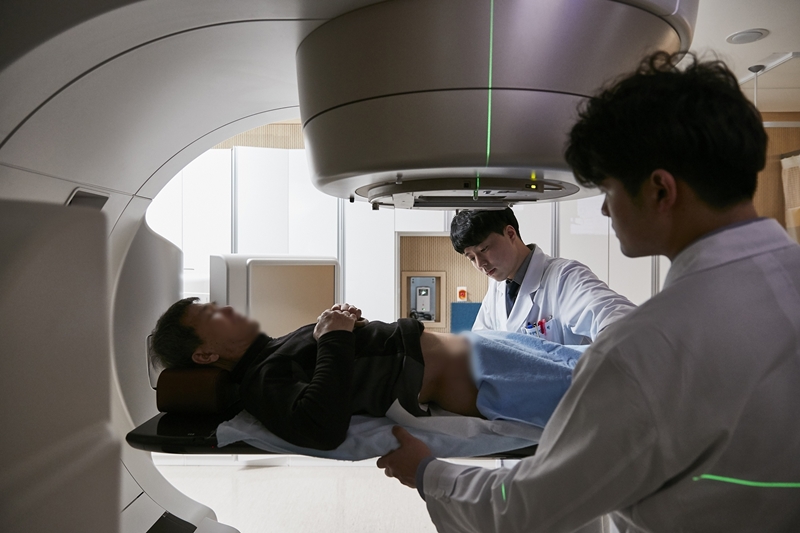
▲ Medical staff from the Department of Radiation Oncology at Asan Medical Center prepare to administer radiation therapy to a patient with prostate cancer.
Professor Young Seok Kim’s research team enrolled 316 patients with prostate cancer who experienced biochemical recurrence after radical prostatectomy between 2019 and 2021. The patients were randomly assigned to receive either hypofractionated radiation therapy or conventional standard radiation therapy and were followed for approximately five years.
All patients received intensity modulated radiation therapy (IMRT), which precisely targets radiation at the tumor site, and image guided radiation therapy (IGRT), which uses CT scans to verify the treatment area before each session. The hypofractionated group received a total radiation dose of 65 Gy in 26 sessions of 2.5 Gy each, while the conventional treatment group received 66 Gy in 33 sessions of 2 Gy each.
The primary endpoint, the four year biochemical progression free survival rate, which measures the proportion of patients who remained alive without a subsequent rise in PSA levels after treatment, was 80.1% in the hypofractionated group and 78.1% in the conventional treatment group. The difference between the two groups was not statistically significant.
The four year distant metastasis free survival rate, representing the proportion of patients who remained alive without cancer spreading beyond the radiation treatment area to other organs, was also comparable between the groups, at 91.7% and 91.0%, respectively. The four year prostate cancer specific survival rate, representing the proportion of patients who did not die from prostate cancer, was 100% in both groups.
However, moderate gastrointestinal side effects, including rectal bleeding, were temporarily more common in the hypofractionated radiation therapy group, occurring in 7.6% of patients. No severe adverse events were reported, and the side effects occurred primarily in patients who did not use an intrarectal balloon during treatment. All affected patients had recovered by the final follow up. Patient reported quality of life, including gastrointestinal and genitourinary function, also showed no significant differences between the two groups.
With comparable treatment outcomes and adverse event profiles, hypofractionated radiation therapy is expected to offer a new treatment option that reduces the number of sessions from 33 to 26, easing the burden of hospital visits for patients while enabling more efficient use of hospital radiation therapy resources.
More than 8,000 radical prostatectomies are reportedly performed annually in Korea. Wider adoption of hypofractionated radiation therapy is therefore expected to contribute to annual National Health Insurance savings of at least KRW 5 billion.
Professor Young Seok Kim, corresponding author of the study and a professor in the Department of Radiation Oncology at Asan Medical Center, said, “Patients who experience biochemical recurrence after prostate cancer surgery face not only the anxiety of cancer returning but also the burden of repeated hospital visits for radiation therapy over several weeks. This study confirmed that reducing the number of treatments can maintain cancer control outcomes and quality of life comparable to those of conventional treatment.”
He added, “However, as certain gastrointestinal side effects occurred more frequently with hypofractionated radiation therapy, it is important to combine precise image guided radiation therapy with measures to protect the rectum.”
ASAN MEDICAL CENTER
BROCHURE DOWNLOAD
Sharing your hope
ASAN MEDICAL CENTER
