


-
- Global AMC MENU
- NEWS
- RESEARCH
- PEOPLE
- Introduction


Fatty Liver Disease Progresses to Cirrhosis, Causing Fluid Buildup in the Lungs and Risk of Kidney Failure
“The Best Doctors Are in Korea, My Only Option” — Patient Chooses Korea for Living Donor Liver Transplantation
Asan Medical Center’s Liver Transplantation Team Successfully Transplants Daughter’s Right Liver Lobe into Her Father
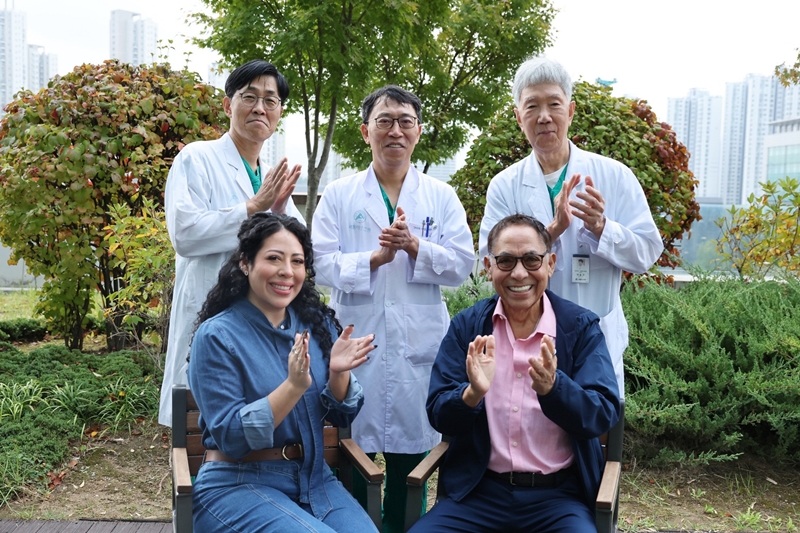
▲ American philanthropist Marco and his daughter, Kimberly, pose for a commemorative photo with the medical team from the Division of Liver Transplantation and Hepatobiliary Surgery at Asan Medical Center’s outdoor garden in the New Building on Wednesday, October 21, ahead of their return to the United States, looking healthy after surgery.
In the front row, from left, are Kimberly, the donor, and Marco, the recipient.
In the back row, from left, are Professor Gi-Won Song, Professor Deok-Bog Moon, and Endowed-Chair Professor Sung-Gyu Lee.
“I have a lot of work left to do in my homeland of Peru, where many people live in poverty. I am deeply grateful to have received a liver transplant in Korea, which has given me the opportunity to continue serving others.”
Marco, an American philanthropist who has made monthly trips to Peru to carry out charitable work, had long suffered from fatty liver disease, which eventually progressed to cirrhosis. As fluid accumulated in his lungs, he became increasingly short of breath. His attending physician warned that his kidneys were also at significant risk of failure and that liver transplantation was his only option.
The biggest obstacle was the long waiting time for a deceased donor liver transplant in the United States, where the wait could exceed a year. Desperate to find a way to regain his health and continue his lifelong mission of helping others, Marco began searching online. He discovered that living donor liver transplantation offered a possible alternative.
Marco was surprised to learn that living donor liver transplantation was possible. He was even more impressed to discover that Korea has the world’s most extensive experience in living donor liver transplantation, with survival rates among the highest in the world.
“The best doctors are in Korea, and Korea is my only option.”
Convinced that Korea was his best option, Marco traveled 10,000 kilometers with his family and arrived in Korea in late May. He and his children were admitted to Asan Medical Center, where they underwent a series of preoperative examinations for living donor liver transplantation. His daughter was ultimately selected as the donor.
On August 14, after more than 17 hours of surgery, a portion of his daughter’s liver was successfully transplanted into Marco.
Both father and daughter recovered well after surgery and were recently discharged from the hospital. They are scheduled to return to the United States in late October.
A 69-year-old American philanthropist who has dedicated his life to serving disadvantaged communities in his homeland of Peru faced a life threatening battle with liver cirrhosis. After traveling thousands of kilometers to Korea, he received a liver transplantation and made a remarkable recovery.
The Liver Transplantation Team at Asan Medical Center’s Organ Transplantation Center successfully performed a living donor liver transplantation for Marco Antonio Quiros, 69, using a portion of the liver donated by his daughter, Kimberly Lucia Quiros, 30. Both father and daughter recovered well after surgery and were recently discharged from the hospital. They are scheduled to return to the United States in late October.
Marco has been actively involved in real estate development and charitable work, traveling between the United States and Peru. Using proceeds from his real estate business, he has provided financial and material support to those in need, including elderly residents of nursing homes, low-income families, and children undergoing treatment for serious illnesses.
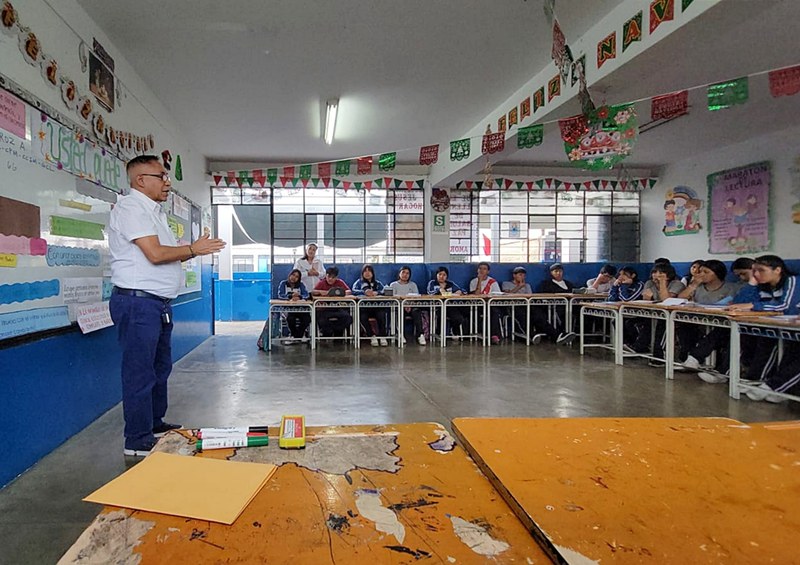
▲ Marco (first from left) teaches students at a school in Peru about the importance of positive thinking.
In 2008, Marco underwent gallbladder removal surgery in Peru. After the procedure, his surgeon unexpectedly informed him that he had fatty liver disease. Given that Marco neither drank alcohol nor smoked, the doctor suggested that a genetic predisposition might be the cause. Marco later consulted his primary care physician in the United States, sharing the results of his medical tests. As he was told that the condition was not yet severe, he continued his life without further treatment.
가 페루의 저소득층 아이들에게 선물을 전달하고 있다._1.JPG)
▲ Marco (first from right), dressed as Santa Claus, hands out gifts to children from low income families in Peru.
More than a decade passed as Marco devoted himself to his real estate development business and charitable work. Around September 2025, however, he visited a hospital in Peru after noticing that his abdomen was becoming increasingly swollen. The swelling was caused by ascites, a buildup of fluid in the abdominal cavity. By then, his fatty liver disease had progressed to liver fibrosis.
When Marco returned to the hospital in February this year because he was experiencing increasing difficulty breathing, his ascites had worsened and fluid had also accumulated in his lungs. He was diagnosed with liver cirrhosis, a condition in which healthy liver tissue is progressively replaced by scar tissue, impairing liver function.
Liver transplantation was his only remaining option, as his condition also put him at risk of kidney failure. However, Peru limits eligibility for liver transplantation to patients aged 65 or younger, excluding Marco, who was 69. In the United States, he was eligible for surgery but would have to join the waiting list for a deceased donor liver, facing an uncertain wait of more than a year. The thought that another person would have to die before he could receive a transplantation also weighed heavily on him.
Desperate to find a solution, Marco began researching his options online and discovered living donor liver transplantation for the first time. As he delved deeper into the available information, he narrowed his choices to countries and hospitals with proven expertise in performing the procedure safely. Ultimately, only one option remained: Asan Medical Center in Korea.
Since performing its first liver transplantation in 1992, Asan Medical Center has continued to advance the field, performing its 9,000th liver transplantation in early 2025, becoming the first hospital in the world to reach this milestone as a single medical institution. The hospital performs approximately 500 liver transplantations annually and is particularly renowned for its expertise in living donor liver transplantation. With around 400 living donor liver transplantations performed each year and a donor mortality rate of zero, Asan Medical Center is recognized as one of the world's leading liver transplantation centers.
Convinced that “the best doctors are in Korea and Korea is the only option,” Marco traveled 10,000 kilometers with his family, arriving in Korea in late May. He had his first consultation at Asan Medical Center on May 28 and was subsequently admitted to the hospital with his children for a series of preoperative examinations.
After a thorough evaluation, the medical team determined that Marco’s daughter would donate a portion of her liver to her father. Taking into account her strong willingness to donate, as well as her physical build and overall health, the team concluded that she could provide a sufficient volume of liver tissue to meet her father’s needs.
At 8 a.m. on August 14, two operating rooms began preparations for the father and daughter, who underwent surgery simultaneously. Professor Gi-Won Song of the Division of Liver Transplantation and Hepatobiliary Surgery at Asan Medical Center performed the donor hepatectomy on Kimberly. The surgical team removed the right lobe of her liver using a minimally invasive technique involving an abdominal incision of less than 10 centimeters, minimizing scarring and the risk of complications.
Endowed-Chair Professor Sung-Gyu Lee and Professor Deok-Bog Moon of the Division of Liver Transplantation and Hepatobiliary Surgery at Asan Medical Center then performed Marco’s liver transplantation. The condition of his liver was more severe than initially anticipated. Elevated pressure in the liver’s blood vessels had caused extensive networks of tangled blood vessels, resembling a spiderweb, to develop around them. In addition, part of his hardened liver had completely encased the inferior vena cava, the body’s largest vein.
Removing the liver posed a significant risk of obstructing blood flow to other organs, potentially causing swelling in the small intestine, kidneys and pancreas.
To prevent these complications, Endowed-Chair Professor Sung-Gyu Lee first carefully separated the blood vessels and then performed a bypass procedure to create an alternative pathway for blood to flow safely. Professor Deok-Bog Moon subsequently detached the liver from the major blood vessels and successfully connected the blood vessels of the transplanted liver to healthy vessels. The surgery began in the morning and was successfully completed after more than 17 hours.
Kimberly was discharged eight days after surgery, while Marco recovered steadily and was discharged in good health during the third week after his operation. The father and daughter plan to complete their remaining medical examinations and outpatient appointments before returning to the United States in late October.
Endowed-Chair Professor Sung-Gyu Lee of the Division of Liver Transplantation and Hepatobiliary Surgery at Asan Medical Center said, “Recently, two brothers from Morocco brought their father, who had liver cancer, all the way to Korea to help him regain his health. Now, a father and daughter from Peru and the United States have found renewed hope through liver transplantation in Korea. I feel a profound sense of responsibility knowing that Asan Medical Center has become a hospital where patients with end stage liver failure and liver cancer, facing life threatening conditions across generations and around the world, come seeking their last hope. “Our entire liver transplantation team will continue to do its utmost to help patients from Korea and around the world regain their health at Asan Medical Center and move forward with new lives.”
Professor Deok-Bog Moon of the Division of Liver Transplantation and Hepatobiliary Surgery at Asan Medical Center said, “Because the patient’s hardened liver had completely encased the inferior vena cava, the surgery inevitably took longer than usual. This also increased the risk of worsening portal hypertension, massive bleeding due to vascular injury during dissection of the inferior vena cava, and air embolism. Fortunately, thorough preparation, including the creation of a portocaval bypass in advance, enabled us to successfully complete this challenging operation. The patient has recovered well without complications despite undergoing such a complex procedure, and I hope he will continue to enjoy good health long after returning to his home country.”
Marco said, “Early this year, when fluid had accumulated in my lungs and I was struggling to breathe, I could not even imagine that my health would improve. I flew all the way to Korea with a faint glimmer of hope, and in this unfamiliar country, which I was visiting for the first time; I was miraculously given a new lease on life. There are many people living in poverty in my homeland of Peru, and I still have much work left to do. I am incredibly happy to have another chance to continue serving others. With the new life I have received in Korea, I will dedicate myself even more wholeheartedly to helping those in needs in my homeland.”
ASAN MEDICAL CENTER
BROCHURE DOWNLOAD
Sharing your hope
ASAN MEDICAL CENTER
