


-
- Global AMC MENU
- NEWS
- RESEARCH
- PEOPLE
- Introduction


80% of Scalp Damaged, Skull Exposed: Local Hospital Says It Has Never Seen Such a Case and Has No Treatment Options
Seeks Help From Asan Medical Center Team That Trained Local Doctors in April, Travels to Korea for Complex Surgery
Professor Jong-Woo Choi at Asan Medical Center Says Tissue Expansion Was Chosen With the Child’s Long Term Quality of Life in Mind; Child Returns Home Healthy This Month
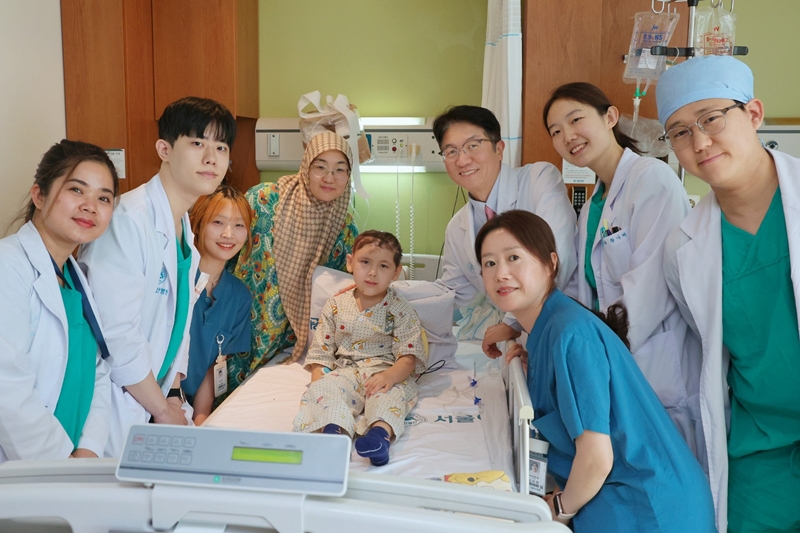
▲ From fourth left: Umar’s mother, Umar, Professor Jong Woo Choi of the Department of Plastic Surgery at Asan Medical Center, and other AMC medical staff pose for a photo on Wednesday, October 14, to celebrate Umar’s discharge.
A six-year-old boy from Kyrgyzstan in Central Asia suffered severe scalp injuries after being attacked by three large dogs, leaving much of his skull exposed. He traveled to Korea for treatment and has now been given a new lease on life.
A team led by Professor Jong-Woo Choi of the Department of Plastic Surgery at Asan Medical Center recently announced that it had successfully treated Umar, a six-year-old boy from Kyrgyzstan whose scalp sustained damage over approximately 80% of its area in the attack. The team brought him to Korea for treatment.
Umar, who boarded an airplane for the first time in his life to receive treatment, returned home in good health on Thursday, October 15, with his dream of becoming a pilot still intact. His return came six months after he first met the Asan Medical Center medical team, which visited Kyrgyzstan in April to share medical expertise.
Kyrgyzstan is a country in northeastern Central Asia, with approximately 80% of its land consisting of mountains. Its rugged geography makes transportation difficult, and the country’s medical infrastructure is severely underdeveloped. As a result, many residents are unable to receive appropriate medical care in a timely manner.
Umar lived in Bishkek, the capital of Kyrgyzstan. On Wednesday, April 1, he was playing with a friend at a neighbor’s house when he lost his balance while climbing over a fence to return home and fell into the neighboring yard. At that moment, several large dogs in the yard charged at him.
The attack left Umar with devastating scalp injuries, exposing his skull. Approximately 80% of his scalp was damaged, covering an area measuring 25 by 25 centimeters, and he also sustained skull fractures.
Umar was found by a police officer patrolling the area and rushed to a nearby hospital. However, the medical team told his family, “We have never seen a case like this before. There is nothing we can do.” With no other treatment options available, Umar received antibiotics solely to prevent infection.
His parents even explored the possibility of taking him to Türkiye for treatment, but the combined cost of air travel and surgery was estimated at approximately $100,000 (130 million KRW). This was an impossibly large sum for Umar’s family, which was raising five children and relying solely on a monthly pension of approximately KRW 300,000, less than half the average monthly wage in Kyrgyzstan.
On April 27, the local medical team learned that a medical team from Asan Medical Center would be visiting Kyrgyzstan to share medical expertise and reached out for help. The five-day medical training program, held at a national hospital in Bishkek, Kyrgyzstan, beginning Saturday, April 25, involved four members of the AMC team, including Professor Hyun Suk Suh of the Department of Plastic Surgery at Asan Medical Center. The team successfully shared expertise in wound management and microsurgical techniques through live surgical demonstrations and helped establish a local breast reconstruction system.
Professor Hyun Suk Suh visited the National Center of Maternity and Childhood Care in Kyrgyzstan, where Umar was hospitalized. “Umar had an extensive scalp defect with his skull exposed, putting him at serious risk of complications. Given the complexity of the surgery and the limited capacity to perform it locally, we determined that transferring him to Korea for treatment would be the best option,” Professor Hyun Suk Suh said.
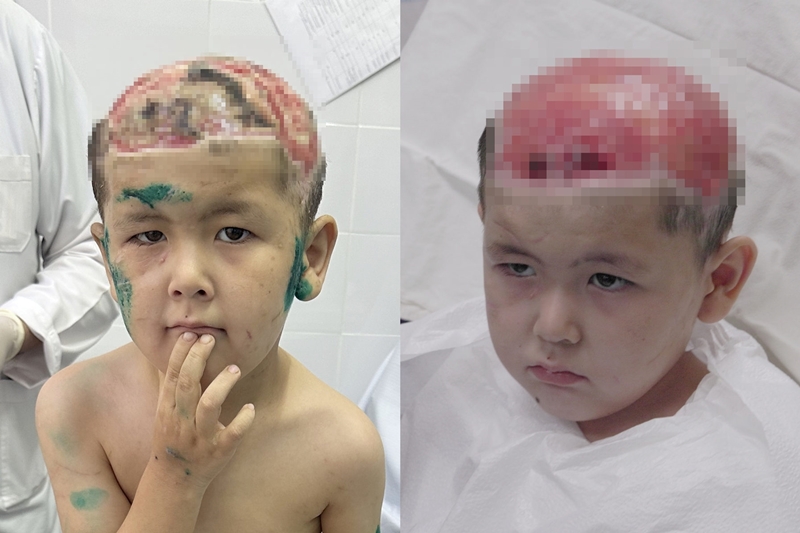
▲ Umar during his hospitalization at the National Center for Maternal and Child Welfare in Kyrgyzstan shortly after the accident in April (left) and during his first medical consultation at Asan Medical Center after arriving in Korea in July (right).
Umar arrived in Korea on Thursday, July 9, and visited Asan Medical Center, where he underwent a comprehensive series of examinations in preparation for surgery.
Professor Jong-Woo Choi of the Department of Plastic Surgery at Asan Medical Center initially considered free flap surgery, a procedure that transplants skin and tissue from other parts of the body, such as the thighs or abdomen, to the scalp and reconnects tiny blood vessels under a microscope. However, because Umar was still very young and small, it was difficult to obtain enough tissue from his thighs and abdomen to reconstruct such an extensive defect. In addition, the transplanted tissue would not grow hair, meaning Umar would have to live without hair for the rest of his life.
Considering Umar’s quality of life in the long term, Professor Jong-Woo Choi opted for skin grafting combined with tissue expansion, a technique that gradually stretches the remaining scalp to cover the damaged area. Tissue expansion involves inserting a silicone expander beneath the skin and gradually injecting saline solution to stretch the skin and scalp. However, with less than 20% of his original scalp remaining, Umar did not even have enough to insert a tissue expander.
On Tuesday, July 21, a team led by Professor Jong-Woo Choi of the Department of Plastic Surgery at Asan Medical Center first performed a skin graft using tissue from Umar’s thigh to create sufficient space for reconstruction. The team then surgically inserted three tissue expanders into the remaining scalp.
The medical team gradually expanded Umar’s scalp at a carefully controlled rate to prevent damage to the implanted tissue expanders. Although complications arose during the process, including wound dehiscence and fever, specialists from the Departments of Dermatology, Pediatric Infectious Diseases and Radiology worked together to manage them promptly and provide intensive care.
After more than two months of meticulous tissue expansion, the team successfully performed scalp reconstruction on Tuesday, September 29. The surgeons removed the tissue expanders and used the newly expanded scalp to cover Umar’s exposed skull.
Despite being only six years old, Umar successfully recovered from the major surgery and regained his cheerful smile. Having boarded an airplane for the first time in his life to receive treatment in Korea, he returned home in good health on Thursday, October 15, holding on to his dream of becoming a pilot.
All treatment expenses were fully covered by the Asan Foundation and Asan Medical Center, while the Dongbu Foreign Resident Center at Seoul provided interpretation services.
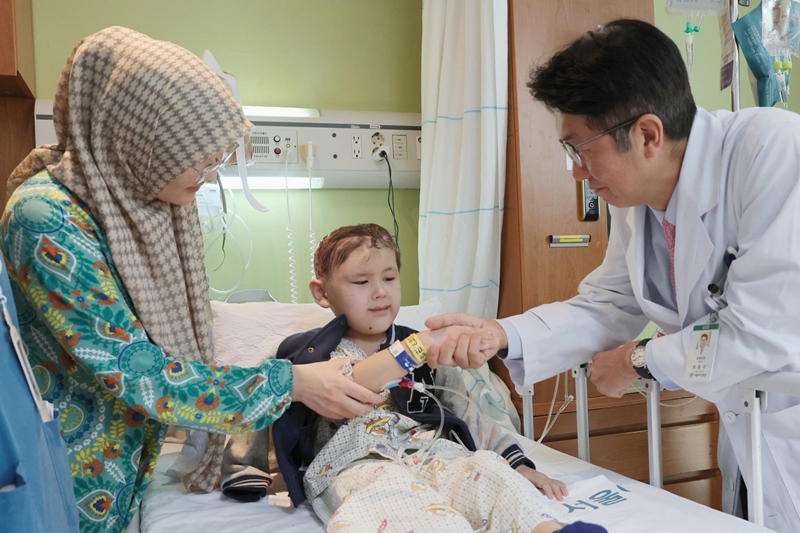
▲ Professor Jong-Woo Choi of the Department of Plastic Surgery at Asan Medical Center (right) bids farewell to Umar to celebrate his discharge.
Professor Jong-Woo Choi said, “Umar’s scalp defect was so extensive that determining the best reconstruction method was challenging. Rather than simply covering the damaged area, we chose an approach that made the greatest possible use of his remaining scalp, taking into account his quality of life as he grows up. Despite the difficult treatment process, Umar remained cheerful and courageous. I hope he continues to grow up healthy after returning home and fulfills his dreams for the future.”
Umar’s mother, Narkiza, 41, expressed her gratitude, saying, “When I saw Umar’s injuries after the accident, I was terrified that I might lose my child. I was devastated when we were told there was no way to treat him in Kyrgyzstan, but by a miracle, we were able to meet the medical team from Asan Medical Center. Thanks to Professor Jong-Woo Choi and the entire AMC medical team, who did everything they could for Umar, we can return home precious and happy memories. I am deeply grateful.”
Umar said, “When I go back to school, I will study hard and read lots of books. Thank you so much to the doctors who treated me!”
Meanwhile, Asan Medical Center continues to promote international medical cooperation through its Asan-in-Asia project, which supports medical self-sufficiency in Asian countries. By sharing medical expertise with countries such as Mongolia and Vietnam, the hospital helps establish a foundation for sustainable, self-sufficient health care systems. Since 2019, AMC has conducted 20 medical training programs across four countries.
Guided by the Asan Foundation’s founding principle of helping the most disadvantaged members of society, the foundation has also conducted 60 overseas medical volunteer missions in 15 countries since 2009. In addition, it operates a program that brings critically ill patients to Korea for free treatment when adequate treatment is unavailable in their home countries.
ASAN MEDICAL CENTER
BROCHURE DOWNLOAD
Sharing your hope
ASAN MEDICAL CENTER
