


-
- Global AMC MENU
- NEWS
- RESEARCH
- PEOPLE
- Introduction


Findings Differ from Western Studies Favoring Surgery for Long Term Survival, Highlighting the Need for Treatment Tailored to Asian Patients
First Successful Left Main Coronary Artery Stenting in 1998, Followed by Long Term Outcomes Analysis Across 46 Institutions in Five Asian Countries
Research Team Led by Professors Duk-Woo Park and Seung-Jung Park at Asan Medical Center Analyzes 5,379 Patients, with Findings Published in The Lancet
 서울아산병원 심장내과 박덕우 박승정 강도윤 위성봉 교수.jpg)
▲ (From left) Professors Duk-Woo Park, Seung-Jung Park, Do-Yoon Kang and Seong-Bong Wee from the Division of Cardiology at Asan Medical Center.
A recent study has found no significant difference in long term mortality between stent procedures and surgery in patients with left main coronary artery disease, a condition affecting a critical section of the coronary arteries that supply blood to the heart. Blockage in this artery can be life threatening.
A research team led by Professors Duk-Woo Park, Seung-Jung Park, Do-Yoon Kang and Seong-Bong Wee from the Division of Cardiology at Asan Medical Center conducted a long term follow up study of 5,379 patients treated for left main coronary artery disease over the past 20 years at 46 medical institutions across five Asian countries. The 10 year mortality rates were similar between patients who underwent stent procedures and those who received coronary artery bypass grafting (CABG), at 24.0% and 22.9%, respectively.
The study was recently published in the prestigious international medical journal The Lancet. Its findings differ from those of some Western studies suggesting that CABG offers better long term survival. The study is also significant for providing a large scale analysis of long term treatment outcomes in Asian patients.
Founded in 1823, The Lancet is one of the world's leading general medical journals. It recently recorded an Impact Factor of 109.0, ranking first among journals in the general medicine category.
The left main coronary artery is the initial segment of the left coronary artery, which branches into two major vessels that supply blood to a large portion of the heart muscle. Narrowing or blockage in this critical artery can restrict blood flow to the heart muscle, potentially leading to serious complications such as myocardial infarction or cardiac arrest. Therefore, selecting the appropriate treatment is essential.
The two main treatment options for left main coronary artery disease are coronary artery bypass grafting (CABG) and stent procedures. For more than 30 years, CABG has been a standard treatment. This open chest surgical procedure uses blood vessels harvested from the patient's chest or leg to create new pathways that bypass narrowed or blocked coronary arteries and restore blood flow. It remains a major treatment option for patients with complex coronary artery narrowing or disease affecting multiple coronary arteries.
In contrast, stent procedures involve inserting a thin catheter through a blood vessel in the thigh and placing a mesh-like metal stent in the narrowed coronary artery to widen it and restore blood flow. Asan Medical Center has been at the forefront of this field since 1998, when Professor Seung-Jung Park of the Division of Cardiology became the first in the world to successfully perform stenting for left main coronary artery disease. Because the procedure does not require opening the chest, it places relatively less physical stress on patients than surgery involving general anesthesia and incisions, and offers the advantage of faster recovery.
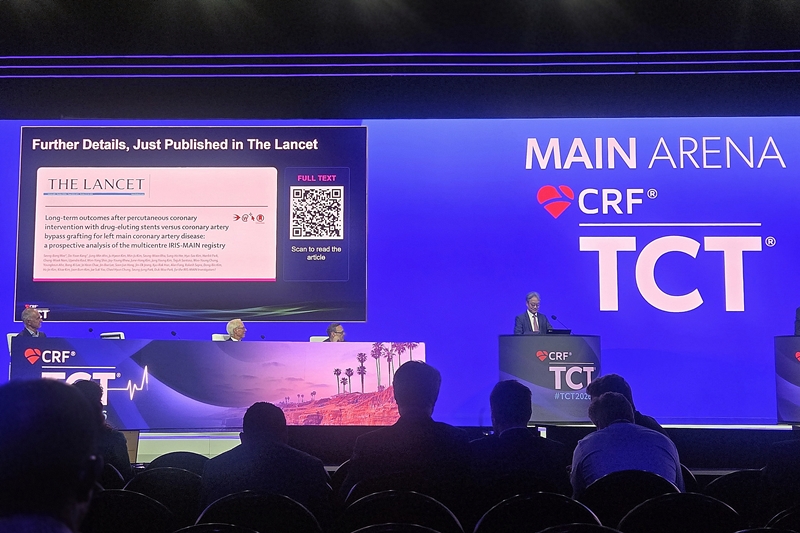
▲ Professor Duk-Woo Park of the Division of Cardiology at Asan Medical Center presents the study findings at TCT 2026, an international conference on cardiovascular interventions held in San Diego, U.S., on November 3 (local time).
With advances in stent technology, the procedure has become widely used to treat left main coronary artery disease. However, studies comparing long term treatment outcomes have primarily focused on Western patient populations. This has underscored the need for research examining long term outcomes in Asian patients, whose clinical characteristics and treatment settings may differ.
The research team led by Professor Duk-Woo Park analyzed data from a total of 5,379 patients with left main coronary artery disease treated at 46 medical institutions across five Asian countries—South Korea, India, Japan, Indonesia and Malaysia—between January 2003 and December 2024. Of these patients, 3,836 underwent percutaneous coronary intervention (PCI) using drug eluting stents, while 1,543 underwent coronary artery bypass grafting (CABG).
The results showed similar mortality rates between the two treatment groups: 3.2% versus 3.4% within the first year after treatment, 9.2% versus 8.4% between one and five years, and 14.3% versus 12.5% between five and ten years for the stent and CABG groups, respectively. The cumulative 10 year mortality rates were also comparable at 24.0% for the stent group and 22.9% for the CABG group, with no statistically significant difference between the two groups.
However, further analysis of complications, including myocardial infarction and stroke, revealed some differences between the two treatment approaches.
The stent group had higher rates of certain complications than the CABG group, including procedure related myocardial infarction occurring immediately after treatment (1.8% vs. 0.4%), spontaneous myocardial infarction occurring later (4.6% vs. 1.9%), and repeat revascularization of the target vessel (11.8% vs. 4.6%).
In contrast, the incidence of stroke was lower in the stent group than in the CABG group, at 3.0% and 6.2%, respectively.
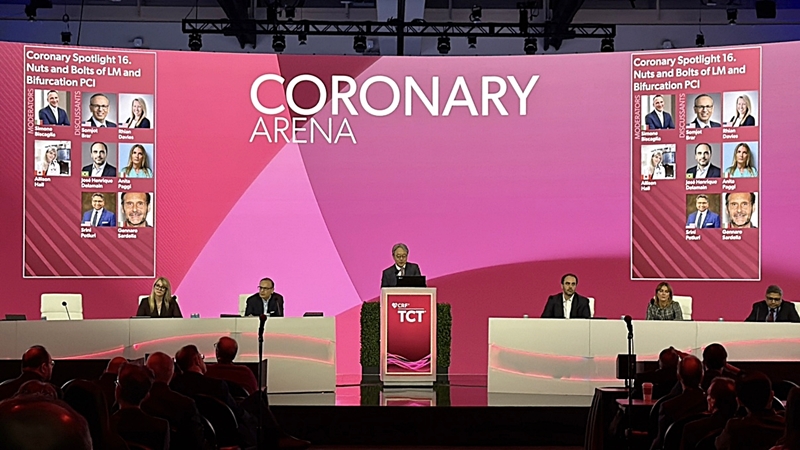
▲ Professor Duk-Woo Park of the Division of Cardiology at Asan Medical Center presents the research findings at TCT 2026, an international conference on cardiovascular interventions held in San Diego, U.S., on November 3 (local time).
Professor Seung-Jung Park of the Division of Cardiology at Asan Medical Center said, “Left main coronary artery stenting is a field in which South Korea has been a global leader for the past 30 years. This study is an important achievement that once again demonstrates how South Korea is advancing the treatment of left main coronary artery disease through decades of accumulated clinical experience and research expertise.”
Professor Duk-Woo Park of the Division of Cardiology at Asan Medical Center, the principal investigator of the study, added, “There has been ongoing international debate over which treatment offers better long term outcomes for patients with left main coronary artery disease. Through this large scale international collaborative study, we confirmed that there is no significant difference in 10 year mortality between the two treatment approaches. We will continue to generate clinical evidence to improve patient care and advance treatment standards for left main coronary artery disease.”
The findings were presented at the Latest Major Clinical Trials session, which highlights key clinical research advances, during Transcatheter Cardiovascular Therapeutics (TCT) 2026, an international conference on cardiovascular interventions held in San Diego, U.S., on November 3 (local time). The study was also published simultaneously in the prestigious medical journal The Lancet.
ASAN MEDICAL CENTER
BROCHURE DOWNLOAD
Sharing your hope
ASAN MEDICAL CENTER
